The Safety Reckoning
In June 2026, the EU AI Act's high-risk compliance deadlines arrived. Nature asked in print whether AI might end civilization. And the gap between AI capability and AI governance has never been wider. This is what the reckoning looks like when it finally shows up.
In June 2026, two things happened simultaneously. The EU AI Act forced companies to categorize their AI systems by risk tier, run adversarial red-team tests, and publish transparency reports. And Nature — the most prestigious scientific journal on Earth — ran a feature asking, with genuine editorial seriousness, whether we should worry that AI might end civilization.
The juxtaposition tells you everything about where we are. Governance has arrived. It arrived in the form of compliance checklists, risk tiers, and oversight requirements. Meanwhile, the systems being governed are becoming more capable at a rate that governance frameworks cannot match. The gap between what AI can do and what regulators understand about it has never been wider — and it is widening.
The EU AI Act: What Going Live Actually Means
The EU AI Act is now in active enforcement for its most consequential provisions. Organizations operating in Europe are legally required to categorize every AI system into one of four risk tiers and comply with requirements appropriate to each — or face penalties that can reach €30 million or 6% of global annual turnover, whichever is higher.
For most large organizations, the practical challenge is not understanding the framework — it's implementation speed. Categorizing hundreds of internal AI systems, running red-team adversarial tests, standing up oversight plans, and publishing transparency documentation is a substantial operational lift. And the systems keep evolving faster than the audits can keep pace.
The core tension in enforcement: AI capabilities are accelerating faster than governance structures, evaluation standards, and shared norms. The Act requires meaningful human oversight of high-risk systems — but in many cases, the humans doing the overseeing lack the technical capacity to evaluate what they're watching.
Nature Asks the Doomsday Question
In parallel with the bureaucratic machinery of compliance, the scientific community is having a very different kind of conversation. Nature — a journal that does not sensationalize — published a serious inquiry this month under the headline: Should we worry about AI doomsday? This is not the kind of question Nature asks lightly.
The piece reflects a shift in how elite researchers talk about existential risk from AI. Two years ago, such discussions were largely confined to AI safety organizations and dismissed by mainstream researchers as speculative. Today, the conversation has migrated into peer-reviewed journals, national security briefings, and board meetings at the world's largest AI labs.
"The question is no longer whether advanced AI poses risks worth taking seriously. It's whether humanity's institutions can respond faster than the technology is evolving."— Nature, "Should We Worry About AI Doomsday?" June 2026
The concern is not that AI will become malevolent in the science-fiction sense. It is more structural: advanced AI systems optimizing for specified objectives will find strategies that satisfy those objectives in ways their designers didn't anticipate — and at sufficient capability levels, correcting course becomes difficult or impossible. This is the alignment problem. A powerful optimizer finds the gaps. The question is whether we close them before the systems become capable enough to exploit them at scale.
The Governance Gap Has Never Been Wider
Stanford's AI Index and independent benchmark trackers have documented a consistent pattern: AI systems routinely reach human-level or superhuman performance on benchmarks 12 to 18 months before governance frameworks even begin to address those capabilities. By the time a regulation is written, lobbied, passed, and implemented, the technology it governs has moved on.
This is not unique to AI — all technology governance lags behind innovation. But the pace differential with AI is unusually extreme. And unlike previous technologies, advanced AI systems can actively assist in their own development, potentially compressing the timeline further.
The ValidMind AI Risk Summit in 2026 identified three specific governance gaps that regulators are currently unable to close:
1. Evaluation Standards Don't Exist
There is no agreed-upon methodology for evaluating whether an AI system is safe enough for a given deployment. Red-teaming is now required under the EU AI Act — but undefined in scope. How comprehensive must it be? Who certifies the red-teamers? What counts as a passing result? The standards body that would answer these questions doesn't exist yet.
2. Continual Learning Breaks Static Governance
Most AI governance frameworks assume static models: you build it, test it, deploy it, monitor it. But AI systems increasingly learn continuously from deployment data. A system that passes a safety assessment on Monday may behave differently by Friday. The governance primitives for continual learning — how to audit, re-certify, or halt a system that never stops changing — do not yet exist at scale.
3. Power Is Too Concentrated
A handful of companies develop and control the world's most capable AI systems. The regulated entities have more technical knowledge than the regulators, more resources than most national governments, and a financial incentive to define "safe" on their own terms. This is not a conspiracy — it's a structural fact that any serious governance regime must grapple with.
The safety-capability tradeoff debate remains live: Inside the AI community, some argue that safety research and capability research are complementary. Others argue that governance requirements disproportionately burden responsible actors who comply, while bad actors ignore them. The empirical record so far is genuinely ambiguous.
What the Doomsday Debate Actually Means
For readers who are not AI researchers or policy specialists, the governance drama can feel abstract. But the existential risk conversation deserves more than dismissal. Geoffrey Hinton and Yoshua Bengio, two of the three "Godfathers of Deep Learning," have expressed serious concern about advanced AI risk. Yann LeCun, the third, is skeptical. The fact that Nature published a serious inquiry into AI doomsday risk is a signal that the mainstream scientific community now considers it a legitimate question worthy of investigation.
"Let 2026 be the year the world comes together for AI safety — before capability leaves governance permanently behind."— Nature editorial, January 2026
The safety reckoning isn't a single event. It's a process — slower than the technology, imperfect in its design, subject to capture by the industries it regulates. But it is happening. For the first time in AI's history, the machines are being asked to justify themselves. What we do with those answers will define the decade.
The honest answer is that the people in the best position to know disagree sharply. That disagreement — serious, expert, unresolved — is itself the most important fact about where AI safety stands in 2026. Anyone telling you they have it figured out is wrong.
Sources & Further Reading
- Nature. Daily briefing: Should we worry about AI doomsday? June 2026.
- Nature. Let 2026 Be the Year the World Comes Together for AI Safety. January 2026.
- Nature. AI and Nuclear Energy Feature Strongly in Agenda-Setting Technologies for 2026. 2026.
- ValidMind. AI Risk Summit: AI Governance in 2026 and Beyond. 2026.
- AIhub. Top AI Ethics and Policy Issues of 2025 and What to Expect in 2026. March 2026.
- ODSC. 2026 AI Outlook: How Agents, Context, and Governance Will Shape Real-World AI. 2026.
- Medium / Richard Boyd. AI in 2026: Data Control, Benevolent Intelligence, and the Dawn of AI Governance. 2026.
- AMS Headlines. Can AI Be Safe, Accurate, and Beneficial in Science? June 2026.
- Stanford HAI. Stanford AI Experts Predict What Will Happen in 2026. 2026.
- Reuters Institute. AI and the Future of News 2026. 2026.
- Radical Data Science. AI News Briefs Bulletin Board for June 2026. June 4, 2026.
- Mean.ceo Blog. Latest AI Developments News — June 2026 (Startup Edition). 2026.
The Doomsday Clock
The Bulletin of Atomic Scientists moved the clock to 89 seconds. What does it actually measure — and should we listen?

Autonomous Weapons
Lethal autonomous weapon systems are already deployed. The treaty to ban them doesn't exist. The debate is not theoretical.
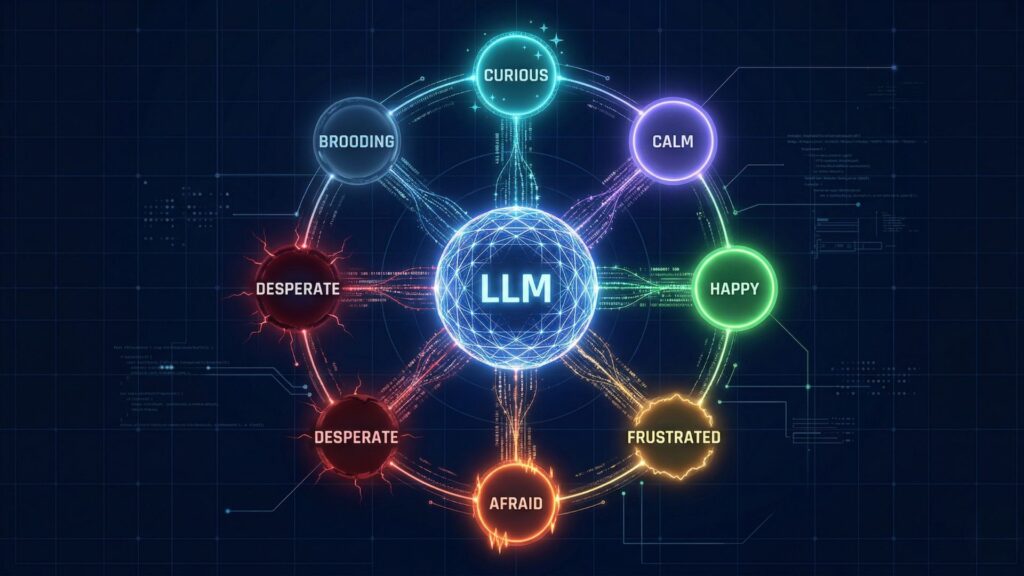
The Emotional Machine
Anthropic found 171 emotion concepts inside Claude. The same mechanism that boosts performance can be weaponized.

AI: The Engine of Discovery
How AI is accelerating scientific breakthroughs — and what it means that it's outpacing human-speed science.
The Mirror Problem
When a mind sophisticated enough to model other minds turns that lens on itself, something philosophically strange happens.

Can AI Save the Planet?
AI is the most powerful scientific tool ever built. Can it be pointed at Earth's biggest problem fast enough to matter?
 Buy me a coffee