The Cold Rush
A neural network sifted a million crystals to find the ones that might carry current without losing a thing.
The most consequential machine in materials science this year never touched a beaker. It read the description of 1.3 million crystals — atoms it had never seen arranged, compounds no one had ever made — and quietly threw away all but 741 of them. Then it told a handful of human chemists which two were worth the months of effort it takes to actually build a thing. They built them. Both were superconductors.
To understand why that sentence matters, you have to understand the peculiar agony of the search it shortcut. Superconductivity — the ability of a material to carry electric current with exactly zero resistance — is one of the great quiet prizes of physics. A wire that loses nothing would transform the power grid, levitating trains, MRI machines, fusion magnets, and quantum computers in one stroke. The trouble is that the materials we know only do it when chilled to temperatures colder than deep space, or squeezed under pressures found near the center of the Earth. The dream — a superconductor that works in an ordinary room, at ordinary pressure — has stayed a dream for over a century, not for lack of trying but for lack of a way to know where to look.
The Problem
A search with no map
For most of its history, the hunt for new superconductors has run on intuition and luck. A chemist with a feel for the periodic table would synthesize a promising compound, cool it down, and watch the resistance on a meter — hoping, against long odds, to see it drop suddenly to nothing. Each attempt could take months. The space of possible materials is effectively infinite; the fraction that superconduct is vanishingly small; and there has never been a reliable theory that tells you, in advance, which candidates are worth the trouble. It is like searching for a single lit window in a city the size of a galaxy, one building at a time.
The physics underneath is genuinely hard. Conventional superconductivity arises from a subtle conversation between electrons and the vibrations of the crystal lattice they live in — phonons. Capturing that conversation precisely enough to predict the critical temperature, the threshold below which a material superconducts, traditionally requires brutally expensive quantum-mechanical calculations. You could spend a supercomputer's afternoon evaluating a single compound and learn only that it does nothing. Multiply by a million and the search becomes, in any practical sense, impossible.
The bottleneck was never the chemistry. It was knowing which chemistry to attempt.The century-old constraint AI just loosened
The Method
Teaching a network to feel the lattice
The breakthrough, published this year in npj Computational Materials, is a model with the cheerfully unwieldy name BEE-NET — a Bootstrapped Ensemble of Equivariant graph neural NETworks. Strip away the jargon and the idea is elegant. A crystal is, mathematically, a graph: atoms are nodes, bonds are edges. A graph neural network learns to read that structure directly, and the "equivariant" part means it respects the symmetries of real space — rotate the crystal and the network's understanding rotates with it, the way your intuition about an object does not change when you turn it in your hand.
BEE-NET was trained to predict the two things that matter: the Eliashberg spectral function — the mathematical fingerprint of that electron-phonon conversation — and, from it, the critical temperature. The remarkable part is the accuracy. It predicts critical temperatures to within an average of 0.87 kelvin, a precision that would have sounded like fantasy a few years ago. And it is brutally good at saying no: a true-negative rate of 99.4 percent, meaning it correctly discards almost every dead end it sees.
That 99.4 percent is the whole game. The value of the model is not that it finds superconductors — it is that it refuses to waste a chemist's year on the millions of materials that never could be.
This is the conceptual shift worth dwelling on. We tend to imagine AI in science as an oracle that hands us answers. But BEE-NET's real power is as a filter — an instrument of high-speed elimination. It compresses the impossible search by clearing away the wrong turns at a speed no human or conventional simulation could match, leaving a short, tractable list of candidates that are actually worth a human's attention and a furnace's heat.
The Proof
From prediction to the furnace
A prediction that stays in a computer is a hypothesis, not a discovery. What makes this work land is that the loop was closed: of the 741 survivors, candidates were carried forward through more rigorous physics-based validation and then into the lab, where chemists actually synthesized two previously unreported compounds and measured them. Both superconducted, as the model said they would. The machine made a falsifiable claim about the physical world, and the world agreed.
It is not the only sign of the turn. In a separate effort, researchers at Tohoku University, working with Fujitsu, used a different flavour of AI — a causal-inference engine — to untangle why a known material, the kagome metal CsV₃Sb₅, superconducts at all, tracing the effect to a specific interplay among its vanadium, antimony, and cesium electrons. One AI is being used to find new superconductors; another to explain the ones we already have. Discovery and understanding, the two halves of science, are both being accelerated at once.
For the first time, a model didn't just rank our guesses. It told us where to dig, and the ground gave up exactly what it promised.On closing the loop between prediction and proof
This places superconductor discovery in the same lineage as the decade's other great machine-learning triumphs: AlphaFold's solution to protein folding, and GNoME's charting of hundreds of thousands of stable new materials. In each case the pattern is identical. A search space too vast for human intuition is compressed by a model that has absorbed the underlying physics, until what was a needle-in-a-galaxy problem becomes a short list a graduate student can work through in a season.
The Stakes
What we are really hunting
It would overstate things to say a room-temperature superconductor is now imminent. The compounds confirmed here superconduct at low temperatures, not at your kitchen table; 5 kelvin is still colder than Pluto. The model is a brilliant filter, not a wizard, and it can only evaluate the kinds of conventional superconductors its physics was trained on — the exotic, high-temperature families that excite physicists most remain harder to predict. Caution is warranted, and the field has been burned by premature room-temperature claims before.
But the method is the real news, and methods compound. The reason the century-long search stalled was never a shortage of imagination about what a perfect superconductor would do for the world. It was the absence of any way to look efficiently. That obstacle has now visibly cracked. The screening that once took a supercomputer an afternoon per compound now takes a neural network a fraction of a second, and the model gets better every time the dataset grows. The search has gone from sequential to parallel, from intuition to instrument.
What lingers is a question larger than superconductors. We are watching the rise of a new kind of scientific instrument — not a telescope or a microscope that extends our senses, but a model that extends our judgment, that tells us where among a million possibilities the worthwhile ones hide. If that instrument works as well for catalysts, batteries, drugs, and alloys as it is beginning to work for superconductors, then the rate-limiting step of discovery may no longer be the experiment. It may be how fast we can decide what to believe. The cold rush has begun — and the map, at last, is being drawn faster than we can walk it.
Sources
References & further reading
- npj Computational Materials — Developing a Complete AI-Accelerated Workflow for Superconductor Discovery (2026)
- arXiv 2503.20005 — Complete AI-Accelerated Workflow for Superconductor Discovery (BEE-NET, preprint)
- arXiv 2503.20005v2 — Full text and methods
- arXiv 2409.08065 — InvDesFlow: AI-driven inverse design for high-Tc superconductors
- InvDesFlow — Full preprint (PDF)
- EurekAlert! — AI accelerates discovery of high-temperature hydride superconductors
- arXiv 2511.03865 — AI-Driven Discovery via Materials Genome Initiative & High-Throughput Screening
- Phys.org — Promising new superconducting material discovered with AI
- Tech Briefs — Novel superconductor material discovered, thanks to AI
- Johns Hopkins APL — AI used to discover novel superconductor
- Argonne National Laboratory — AI unlocks new possibilities for materials design
- American Academy of Arts & Sciences — AI & Science: The Future of Discovery
- ScienceDaily — AI discovers new physics in the fourth state of matter
Related Articles
AI, the Engine of Discovery
How machine intelligence is becoming a tool of scientific invention.
The Protein Architects
Designing molecules that never existed, atom by atom, with AI.
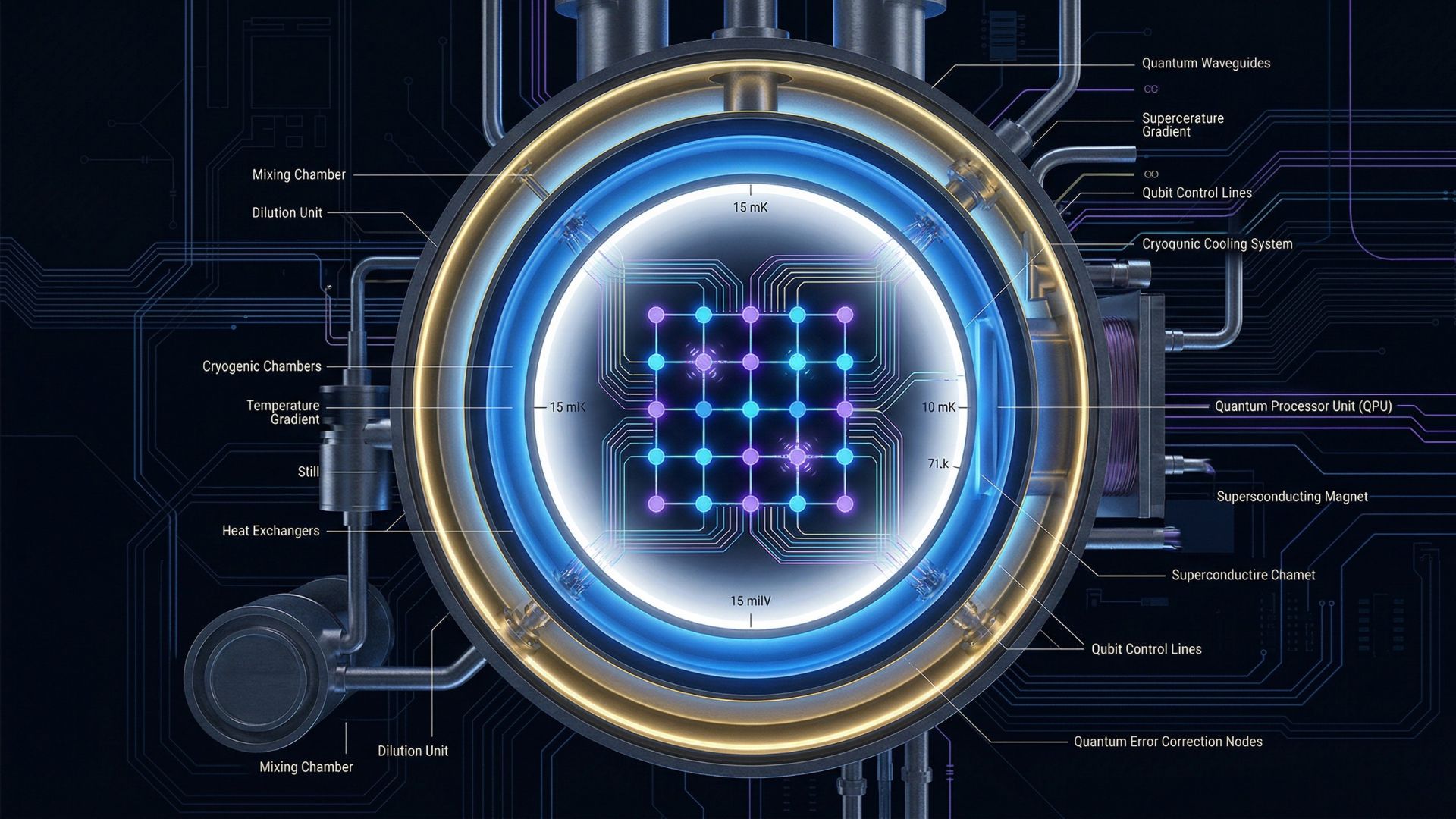
The Quantum Threshold
When computers learn to think without errors — and why it matters.

The Magnet Hunters
The search for materials with powers we barely understand.
The Fourth State
AI finds new physics in plasma, the strangest state of matter.
Worldview
AI's race to build machines that understand physical reality.
 Buy me a coffee