AI & Science · Neurotechnology
The Brain Twin: Inside Meta's New AI Model of the Human Mind — and What It Means to Predict a Thought
Feed it a podcast, a film clip, or a page of text, and Meta's new foundation model will tell you — region by region — how a human brain is likely to light up in response. Trained on hundreds of volunteers' neural data, TRIBE v2 is the most ambitious attempt yet to build something like a working sketch of a mind. It is also a quiet preview of how AI may soon read us before we've finished thinking.
Picture a volunteer lying inside an MRI scanner, headphones on, watching a clip from a nature documentary. Somewhere across the room, a model that has never met this person, never seen this clip, and never scanned this brain is generating — in close to real time — a prediction of which regions of their cortex are about to light up, and by how much. It gets close. Not perfectly, not yet, but close enough that the researchers who built it have started calling it, half-jokingly, a brain twin.
That model is TRIBE v2, a foundation model released this spring by Meta's AI research division — the first system of its kind trained at scale to predict how a human brain responds to the sights, sounds, and language that wash over it every day. It was built on neural recordings from more than seven hundred healthy volunteers, each of whom spent hours inside scanners absorbing images, podcasts, films, and text while researchers mapped, millimeter by millimeter, how their brains reacted. The result is not a mind-reading machine — it cannot tell you what someone is thinking — but it is something almost as strange: a statistical sketch of how thinking, in general, tends to unfold inside a human skull.
Teaching a model to guess what a brain will do
The idea behind TRIBE v2 sounds almost absurdly direct once you hear it stated plainly: show an AI system millions of moments of sensory experience — a face appearing on screen, a burst of orchestral music, a sentence read aloud — paired with the corresponding pattern of activity recorded from a human brain encountering that exact moment, and ask it to learn the relationship. Do that across hundreds of people and thousands of hours, and a statistical structure starts to emerge: not a map of any one person's mind, but a kind of average sketch of how human brains, in general, tend to respond to the texture of being alive.
What makes this approach different from earlier brain-imaging AI is its appetite for combination. Older systems tended to specialize — one model for predicting visual cortex activity from images, another for auditory regions and sound, a third for language areas and text. TRIBE v2 was built to take all three streams at once, the way an actual afternoon at the movies delivers picture, dialogue, and music in a single tangled bundle, and to model how those streams interact inside a brain that doesn't process them separately either. It is, in other words, an attempt to model not just perception, but the messy, overlapping way perception actually arrives.
"We're not building a system that knows what you're thinking. We're building a system that knows, statistically, what a human brain tends to do — which turns out to be a strangely powerful thing to know."— Meta AI research team, on the goals behind TRIBE v2
The unglamorous breakthrough: synthetic neurons
Foundation models like TRIBE v2 depend on an unglamorous prerequisite: enormous amounts of carefully labeled neural data, the kind that traditionally requires years of painstaking manual work from trained scientists tracing individual neurons through dense imaging stacks. This spring, a Google Research team presented a system at the ICLR conference — nicknamed MoGen — that generates richly detailed synthetic neuron shapes and uses them to train reconstruction models faster and more accurately. The gain looks modest on paper: a 4.4 percent drop in reconstruction error. Scaled up to the size of a complete mouse brain, Google estimates that translates into roughly a hundred and fifty-seven person-years of manual proofreading work saved.
That number is worth sitting with. It is not a flashy demo or a viral chatbot transcript — it is a quiet, structural change in how fast an entire scientific field can move. Brain-mapping projects that once required entire careers to complete a single structure can now, in principle, be compressed into a fraction of that timeline. And every acceleration in mapping feeds directly back into the next generation of predictive models like TRIBE, which are only as good as the maps they're trained on.
What a "brain twin" is actually good for
It's tempting to leap straight to science-fiction territory — telepathy, thought-reading, the works — and the researchers behind these systems are visibly tired of having that conversation before the more grounded one. The near-term applications are less dramatic and considerably more useful. A model that can predict, with reasonable accuracy, how a typical brain responds to a given stimulus gives clinicians a baseline to compare against. Deviations from that baseline — a region that should light up during a language task but doesn't, a response that arrives milliseconds later than expected — are exactly the kind of subtle, circuit-level signal that researchers believe could flag neurological conditions years before symptoms become obvious to a patient or their doctor.
There's a research dividend, too. Neuroscience has long been bottlenecked by the sheer difficulty of running experiments — recruiting volunteers, booking scanner time, processing data that arrives in formats that don't talk to each other. A foundation model trained across hundreds of brains and three sensory modalities becomes something like a laboratory instrument in its own right: a tool researchers can query, probe, and stress-test computationally before ever booking another hour of scanner time. It won't replace the scanner. But it may dramatically cut down on how often anyone needs to use one to test a new idea.
"The strongest workflows we're seeing combine segmentation, registration, denoising, atlas alignment, quality control, multimodal fusion — and, crucially, expert review at every stage. The AI accelerates. It doesn't replace judgment."— neuroimaging researcher, on integrating AI into clinical brain-mapping pipelines
The uneasy questions underneath the excitement
Every advance in modeling the brain arrives trailing the same shadow: if a system can predict how your brain is likely to respond to something, how far is that from a system that can predict — and eventually shape — how you are likely to respond? TRIBE v2 works on population-level statistical patterns, not individual private thoughts, and its creators are careful to say so. But the distance between "predicting population averages" and "personalizing those predictions to a single, identifiable brain" is a distance that tends to shrink quickly once the underlying tools exist and the commercial incentives line up.
That tension — useful science on one side, an unsettling extrapolation on the other — is becoming a familiar shape in AI research generally, and brain modeling makes it unusually vivid. Few people would object to a tool that helps a neurologist catch early-stage disease. Many more would have questions about a tool that could, in principle, infer something about a person's emotional state, attention, or receptiveness from the same underlying architecture, deployed in a different context. The technology in both cases may be nearly identical. The application is what will decide whether it earns trust or forfeits it.
A sketch, not a portrait
It's worth ending where the researchers themselves tend to land: with a reminder of how far this still is from anything like reading a mind. TRIBE v2 produces statistical expectations about population-level brain activity — an educated, data-rich guess about what tends to happen, not a transcript of what is happening in any one head, right now, in private. The gap between those two things is enormous, and it is not a gap that simply closes with more data or larger models. Some of it is bound up in genuinely hard, unresolved questions about how subjective experience relates to measurable brain activity at all — the same questions, as it happens, that researchers elsewhere are currently trying to answer with consciousness scorecards of their own.
What TRIBE v2 represents, more modestly and more truthfully, is a sketch — the first rough, smudged, statistically averaged sketch of something humanity has never been able to draw before: a portrait of the relationship between the world arriving through our senses and the storm of activity it sets off inside us. Sketches get refined. This one will too. The question worth sitting with isn't whether the portrait will get sharper — it almost certainly will — but who gets to hold it, and what they'll be allowed to do with what they see.
Sources
- Meta AI — "Introducing TRIBE v2: A Predictive Foundation Model Trained to Understand How the Human Brain Processes Complex Stimuli"
- Google Research — "AI-generated synthetic neurons speed up brain mapping" (MoGen, ICLR 2026)
- Yenra — "AI Neuroscience Brain Mapping: 19 Advances (2026)"
- TRENDS Research & Advisory — "AI in Mapping Neural Pathways for Neuroscience"
- University of Rochester Medicine — "The Interstate of Science: Merging Neuroscience and AI"
- Mass General Brigham — "Looking Ahead: Predictions for Neuroscience and Neurology in 2026"
- PMC — "Editorial: AI innovations in neuroimaging: transforming brain analysis"
- Medium — "5 Mind-Blowing Neuroscience Breakthroughs That Will Transform Mental Health in 2026"
- ScienceDaily — Artificial Intelligence News archive
- Lisa Pedrosa — "The Living Computer: Inside the Strange World of Biological Computing"
- Lisa Pedrosa — "The Robodoc: When AI Becomes Your Second Opinion"
Keep exploring
The Living Computer
Inside the strange new world of biological computing, where living cells start to do the work of silicon.
The Robodoc
When AI becomes your second opinion — and what that means for the future of diagnosis.
AI: The Engine of Discovery
How artificial intelligence became science's newest, strangest research partner.
The Consciousness Meter
A new scientific framework is scoring chatbots, chickens, and bees on the same scale of awareness.
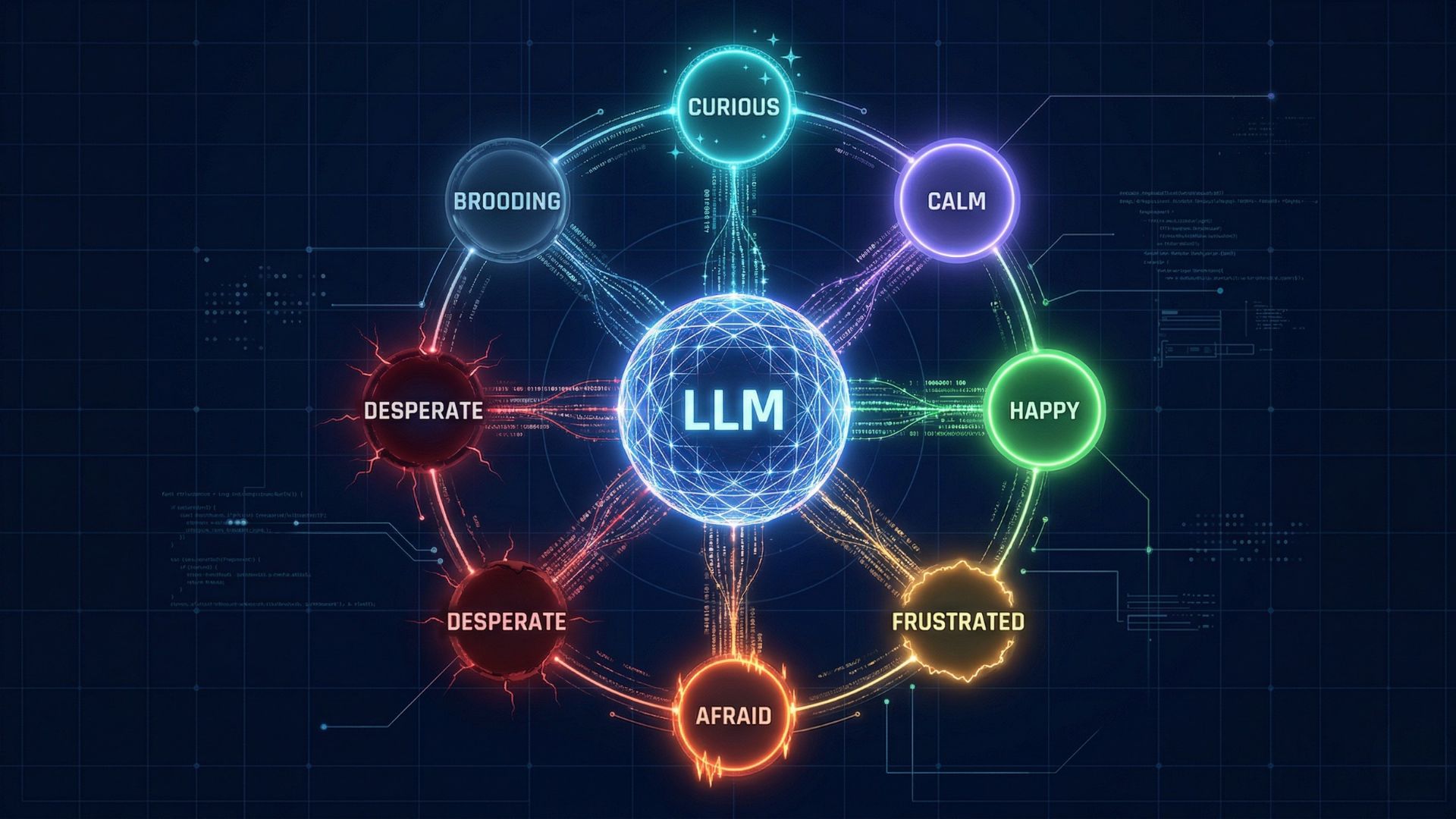
The Emotional Machine
Inside the strange new science of emotion in large language models — and what it reveals about our own.
The Mirror Problem
What happens when machines start reflecting our own minds back at us — and we're not sure what we're looking at.
 Buy me a coffee