In 1932, a 27-year-old Hungarian mathematician named Rózsa Péter stood before the International Congress of Mathematicians in Zürich and presented a paper on recursive functions. What she laid out that day—a rigorous, systematic account of functions that call themselves, building complexity from simple self-referential rules—was the mathematical foundation on which all modern computing would eventually rest. She was not yet famous. She would never become famous, in the way that word gets applied to scientists.
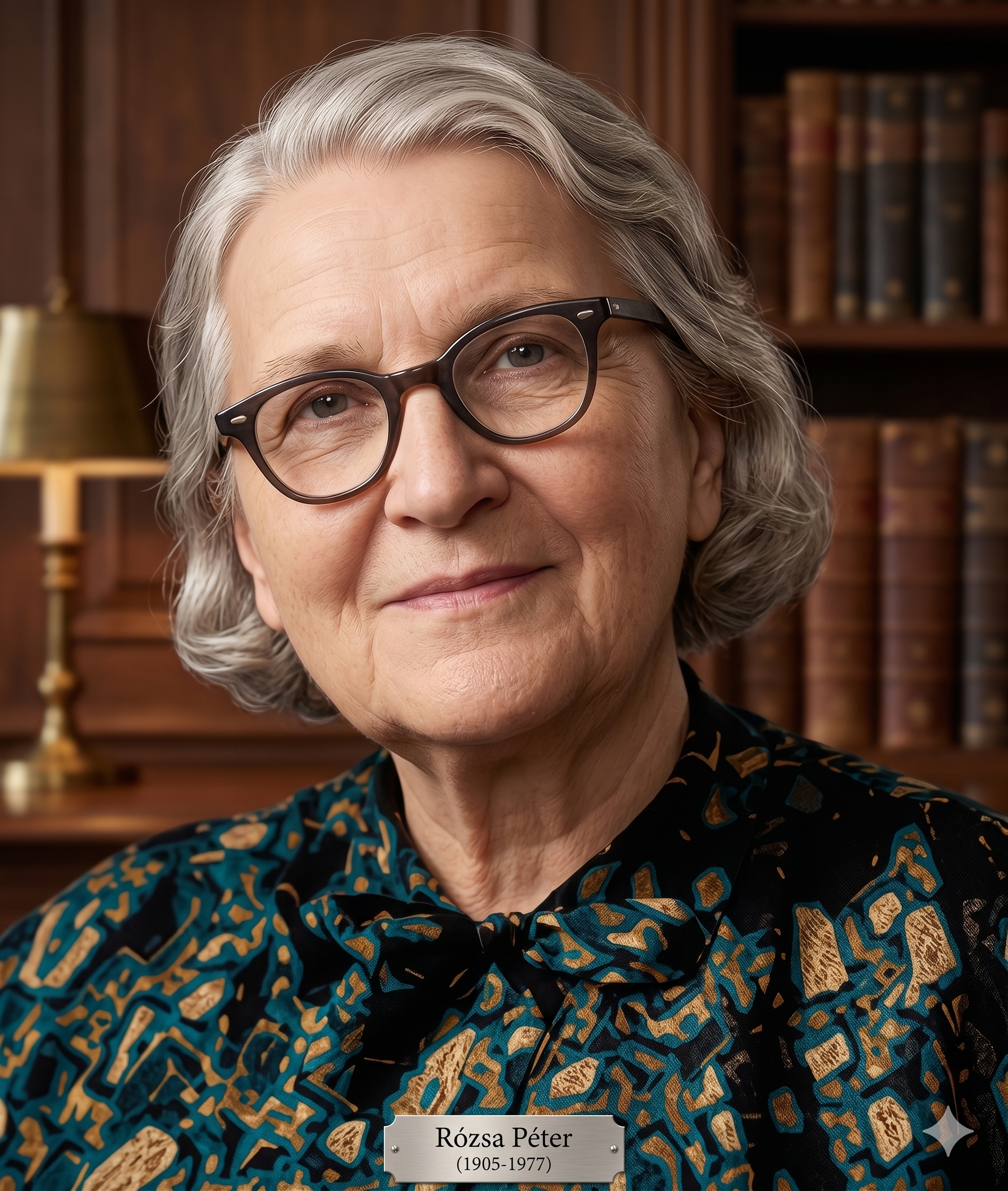
She had arrived at mathematics sideways, enrolling at Pázmány Péter University in Budapest to study chemistry before the mathematics pulled her in. By her late twenties she was working on the foundations of logic independently, devising her own proofs for results that contemporaries who would become far more celebrated were also pursuing. Her 1932 paper was not a detour or a preliminary sketch. It was the opening move of a four-decade research program: a systematic study of recursion, establishing hierarchies of recursive functions, clarifying precisely what it means for a process to be computable at all.
Without her work, there's no loop. There's no function calling another function. There's no programming language with any expressive power. Recursion is why a computer can do anything requiring nesting, repetition, or self-reference. That covers most of what computers do.
A recursive function is one that defines its behavior partly in terms of itself. The classic example: the factorial of n is n multiplied by the factorial of n−1. The function appears in its own definition. Péter spent decades formalizing exactly what this means mathematically, what kinds of functions can be defined this way, and what the limits of that framework are.
In 1951, she published Rekursive Funktionen—the first book on modern mathematical logic ever published by a woman. It remains a foundational text. In 1961 came Playing with Infinity, a popular mathematics book translated into a dozen languages, still in print. She was by all accounts a devoted and inspired teacher at the Budapest Teacher's College, where students called her “Aunt Rózsa.” She wrote and translated poetry. She was a complete person of unusual warmth and intellectual force.
In 1939, Hungary's anti-Jewish laws stripped her of her teaching position. She continued working. She continued publishing. She and her mother survived the war in hiding in Budapest. She returned to teaching in 1945 and was appointed to her alma mater in 1955. She died in February 1977, one day before her seventy-second birthday.
Her name does not appear in most popular histories of computing. The standard genealogy runs from Turing's theoretical machines to von Neumann's architecture to the first programmable computers. Rózsa Péter's recursive functions—the abstract machinery that makes Turing's formalism work—appear as an anonymous foundation. Everyone builds on it. Nobody says her name.
 Buy me a coffee