In a training center outside Shenzhen, a worker straps on a motion-capture suit and folds a stack of hospital linens, over and over, while sensors record every rotation of her wrist. A humanoid robot watches from across the room, cameras tracking her hands. She will fold that same stack several hundred times today. Multiply her by thousands of workers in hundreds of facilities across China, and you have the raw material for what Beijing now calls, without much subtlety, a mandate.
On June 2026, China's Ministry of Industry and Information Technology (MIIT) and the State-owned Assets Supervision and Administration Commission (SASAC) jointly launched a nationwide "real-scene training" campaign for humanoid robots and embodied AI systems. The instruction to industry was blunt: stop perfecting robots in labs and demo halls, and start putting them to work in factories, warehouses, hospitals, retail floors, logistics hubs, and emergency-response settings — then use the mess of the real world to make them better. By the end of 2026, the plan calls for humanoid robots validated and routinely operating across a target of more than 100 high-value application scenarios. By 2027, the national goal is 100,000 humanoid robots deployed in productive roles.
This is not a research grant or a pilot program. It is an industrial mobilization, backed by equity investment, debt financing, and state-brokered insurance products meant to de-risk a technology that, as recently as two years ago, could barely walk down a warehouse aisle without assistance.
Why a Government Is Doing What Markets Usually Do
In the United States, humanoid robot deployment has followed something close to a conventional venture path: Figure AI raising capital to scale its BotQ manufacturing line to roughly one robot produced per hour; Boston Dynamics' Atlas assembling components on a real Hyundai line in Georgia; Unitree pricing its R1 humanoid at around $16,000 and betting volume will follow. These are company-by-company bets, made and unmade by investors and customers one contract at a time.
China's approach inverts that sequence. Rather than waiting for individual firms to find product-market fit, MIIT and SASAC are using state authority to manufacture the market directly: mandating that state-owned enterprises — the hospitals, logistics networks, and manufacturing conglomerates SASAC oversees — host robots on their floors regardless of whether the economics yet pencil out. The theory is that deployment itself is the missing ingredient. Robots don't need more time in a lab; they need the specific, chaotic, unlabeled friction of a real emergency room or a real loading dock, at a scale no single company could otherwise justify buying.
"We train and teach robots by creating realistic, one-to-one scenarios. Trainers may repeat a single action hundreds, thousands, or even tens of thousands of times to teach it."— Project lead, Data Fusion Technology, quoted by Rest of World on China's humanoid data-training centers
The Data Factories Behind the Mandate
The unglamorous engine of this push is what China now calls, semi-officially, "robot schools." These are converted warehouses and studios where human workers perform ordinary tasks — folding fabric, stocking shelves, operating a drill press, wiping down a counter — for hours a day, wearing motion-capture rigs or simply being filmed from multiple angles, so that "egocentric" datasets can be built for imitation learning. It is, in effect, a national data-labeling workforce reoriented around teaching machines to move like people. Euronews and CNBC have both toured facilities where dozens of workers repeat the same domestic or industrial motion thousands of times in a single shift, generating training clips that get fed directly into humanoid foundation models.
This is the part of the story that rarely makes it into press releases about "100,000 robots by 2027": the mandate is as much a labor-data mobilization as a manufacturing one. China's bet is that whoever accumulates the largest, most diverse library of real-world physical demonstrations will end up with the most capable embodied AI — the same scaling logic that built large language models, applied to bodies instead of text.
The Global Supply Chain Fight Underneath
The mandate isn't only about deployment volume. It doubles as industrial policy for the components that make a humanoid robot possible in the first place: high-torque actuators, dexterous multi-fingered hands, force sensors, and the perception stacks that let a robot avoid a person walking into its path. China's stated goal is a complete domestic supply chain for these parts, reducing dependence on imported precision components the way it has already reduced dependence on foreign solar and battery technology.
That ambition sits inside a much larger contest. The International Federation of Robotics has described China's approach as making AI-powered robots "core of national strategy," and Chinese officials have floated a broader target of roughly 100,000 humanoid robots delivering measurable economic output by 2027, part of a longer runway toward mass adoption in the 2030s. Samsung's move to become the largest shareholder in South Korea's Rainbow Robotics, and Amazon and Nvidia's backing of Germany's Neura Robotics, show that other governments and corporations see the same window closing — just through market mechanisms rather than ministerial directive.
What Happens to the Workers Being Filmed
There is a human dimension to this mobilization that deserves more scrutiny than it has received. The workers whose movements are being captured, sliced into training clips, and fed into embodied foundation models are, in a very literal sense, training their own eventual replacements — or at least their robotic understudies. Several of the "robot schools" toured by international press pay workers modestly for repetitive labor whose entire economic value lies in the data it generates, not the task performed. It is a preview of a labor relationship that may become common well beyond China: humans as the training signal for the machines meant to take over their jobs.
Foreign press coverage of these centers has occasionally been undermined by its own hype — a widely shared video purporting to show a "robot army" training in lockstep turned out, on closer inspection by fact-checkers at France 24, to be AI-generated rather than documentary footage. That confusion is itself telling: the real story, workers in motion-capture suits folding towels for a training dataset, is mundane enough that it gets crowded out in international coverage by synthetic spectacle that looks more dramatic. The actual mandate is less a robot army than a very large, very patient data-collection operation wearing an industrial-policy press release.
China's national target of 100,000 humanoid robots deployed by 2027, alongside its push for a fully domestic component supply chain, positions embodied AI as core to the country's next industrial strategy — not a side bet, but a successor to its solar and EV playbooks.— Summary of MIIT/SASAC policy framing, per Xinhua and the International Federation of Robotics
Lessons From the 2025 Humanoid Robot Games
China previewed this ambition in 2025, when it staged the world's first humanoid robot games — a spectacle-driven event where robots from dozens of manufacturers ran races, played soccer, and performed choreographed routines in front of state media. At the time, foreign outlets treated it largely as theater: impressive footage, but a long way from a robot that could be trusted alone in a hospital corridor. The MIIT/SASAC mandate is the sequel state planners clearly always intended — moving from a choreographed stage, where every motion is rehearsed and every fall is edited out of the highlight reel, to environments where nothing is rehearsed and every fall is a real liability question. That shift, from performance metrics to reliability metrics, is a much harder engineering problem, and it's the one the real-scene mandate is explicitly designed to force.
It also explains why the financial mechanisms attached to the mandate matter as much as the deployment target. Equity investment, debt financing, and state-brokered insurance products exist specifically to absorb the cost of the robots that fail in the field — the dropped patient tray, the mishandled hospital cart, the warehouse pallet knocked into an aisle. A market-driven rollout would likely price much of that risk out of reach for any single company. A state-backed one can simply absorb it as a line item, which is precisely the kind of subsidized failure tolerance that let China's solar and battery industries out-iterate slower-moving foreign competitors a decade ago.
Why This Matters Beyond China
Humanoid robots have spent the last three years as a demo-reel technology — backflips, dance routines, folding a single shirt on stage. What the MIIT/SASAC mandate signals is a shift from spectacle to procurement: a government treating embodied AI as infrastructure, on the same tier as high-speed rail or 5G, worth subsidizing into existence before the business case is fully proven. If it works, China will have compressed a decade of trial-and-error deployment into eighteen months, at a scale that gives its models an experiential data advantage no lab-based competitor can match. If it doesn't, it will be one of the more expensive industrial bets of the decade — a lot of very literal robots standing around very real hospitals, not quite ready for the job they were mandated into.
Either way, the rest of the world's robotics industry — still largely waiting for venture-backed unit economics to catch up with the hype — now has a government-scale experiment to watch, whether it wanted one or not.
Sources
- MIIT/SASAC Launch 2026 Humanoid Robot Real-Scene Training Initiative — Pandaily
- China Pushes Humanoid Robots Out of the Lab and Into the Factory — Rare Earth Exchanges
- China's first national standard system for humanoid robotics — Xinhua
- China Makes AI-Powered Robots Core of National Strategy — International Federation of Robotics
- Embodied AI: China's ambitious path to transform its robotics industry —
Related Reading

Rise of the Humanoids
How a $55 billion bet on humanoid robots finally started cashing in for Western manufacturers.
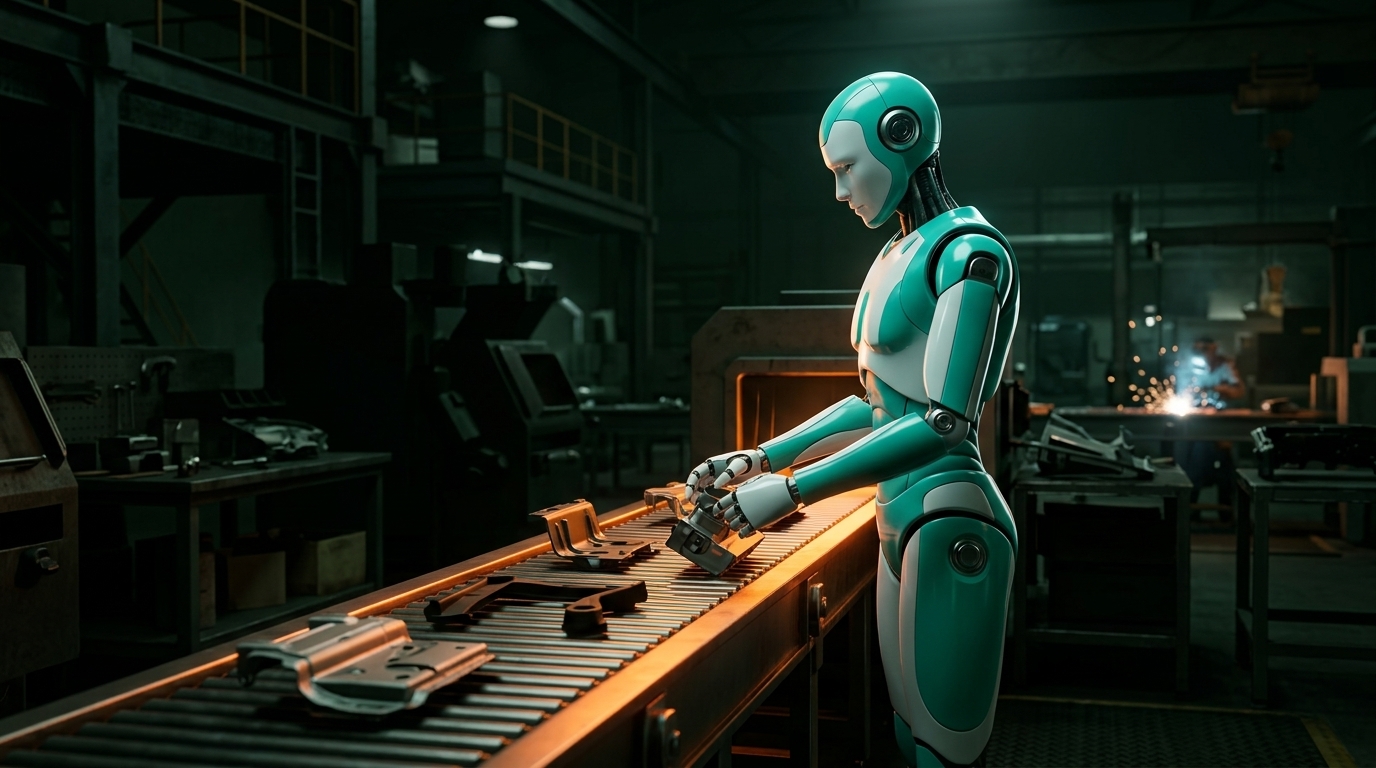
The Robot Workforce
Inside the factories where humanoid robots are quietly becoming full shift-workers.

Europe Builds a Mind of Its Own
Why the EU backed a 400-billion-parameter open-source model as a bet on sovereignty.

The Homegrown Model
How China trained a trillion-parameter AI without a single Nvidia chip.
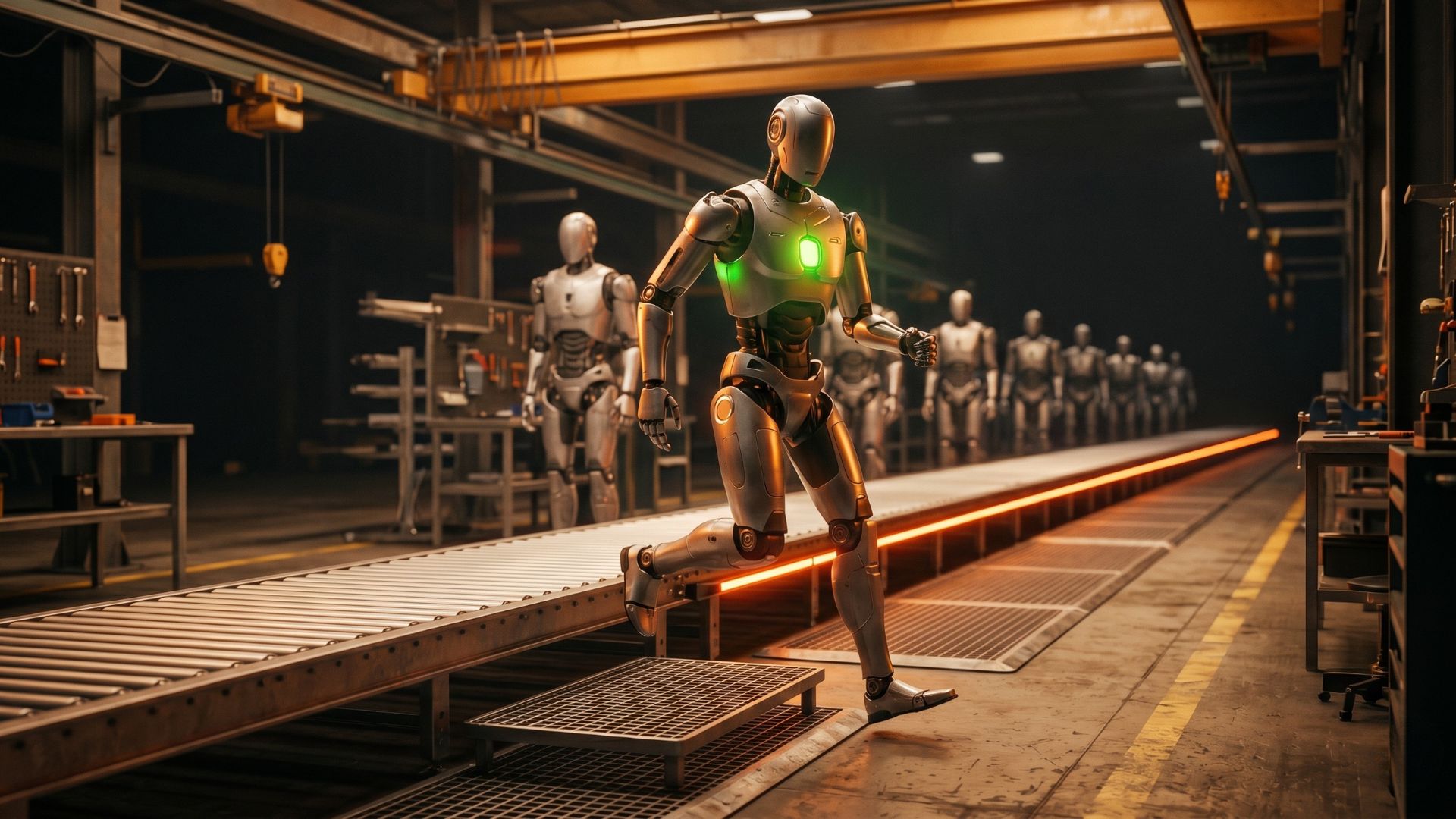
One Robot an Hour
Inside the factory line that scaled humanoid robot production 24x in under 120 days.

After the Transformer
Inside the post-transformer architectures competing to power the next generation of AI.
 Buy me a coffee