Imagine nine of the most well-funded, closely watched companies on Earth sitting for the same exam, graded by the same independent panel, on the single question that matters most about the technology they're building: can it be trusted not to cause catastrophic harm? Now imagine the best score in the room was a C+. That's not a hypothetical. It's the actual result of the Future of Life Institute's Summer 2026 AI Safety Index, published on July 8, and it is the closest thing the industry has to a report card graded by someone other than itself.
The index evaluated nine companies building frontier AI systems — Anthropic, OpenAI, Google DeepMind, Meta, Z.ai, Alibaba Cloud, xAI, DeepSeek, and France's Mistral — across six categories: risk assessment, current harms, safety frameworks, existential safety, governance and accountability, and transparency and communication. Not one of the nine scored an A or a B in any composite ranking. Anthropic came out on top with an overall C+. OpenAI and Google DeepMind each received a C. Everyone else fell further, down to outright failing grades for three of the nine.
Who's Actually in the Room
The nine companies graded span every major geography currently competing at the frontier. Anthropic, OpenAI, and Google DeepMind represent the US labs racing hardest on general-purpose capability. Meta occupies an unusual middle position — a US company that has also positioned itself as the standard-bearer for open-weight models, which changes how some of its governance obligations are assessed relative to closed competitors. xAI, Elon Musk's frontier lab, competes directly with the other American players but has drawn particular scrutiny for its pace of deployment relative to its safety documentation. Z.ai and Alibaba Cloud represent China's largest commercial AI efforts, operating under a domestic regulatory regime that, as this week's separate news about anthropomorphic AI rules demonstrates, is capable of moving decisively on other categories of AI risk even as this index finds its existential-safety practices lacking. DeepSeek, the open-model challenger that stunned much of the industry with its efficiency gains in 2025, and Mistral, Europe's most prominent frontier lab, round out the field. Grading all nine on one shared rubric is itself part of the index's value: it's rare to see companies operating under three entirely different regulatory regimes — American, Chinese, and European — measured against a single, consistent bar.
The Full Ranking
The spread between first and last is instructive on its own. Meta climbed to fourth place with a D+, up from sixth in the previous index — a rare instance of upward movement. xAI went the opposite direction, falling from fourth to seventh. Z.ai and Alibaba Cloud both landed at D-. And at the very bottom, xAI, DeepSeek, and Mistral all received the lowest possible grade: F.
Anthropic's own report card wasn't spotless, either. Reviewers credited the company with the strongest safety framework of the nine but specifically flagged what the index called "questionable military engagements" — a reminder that topping this particular class still means passing a test most of the industry is failing, not acing one that's easy.
It's worth sitting with how narrow the gap actually is between first and, say, third place. A C+ and two C's separated by fractional differences in category scoring is not the wide margin the "Anthropic wins" headlines sometimes imply — it's three companies clustered near the top of a scale where the top itself is mediocre. The more consequential gap in the whole dataset sits lower down, between the C-range cluster and the D-to-F cluster beneath it, where roughly half the industry's most consequential model developers landed. That's the group the index's authors seem most concerned about: not the marginal difference between a "passing" grade and a slightly-better passing grade, but the fact that companies building systems used by hundreds of millions of people are clustered at the bottom of an already lenient curve.
What "Existential Safety" Actually Measures
It's worth being precise about what this index is and isn't grading. This isn't a ranking of which chatbot is most polite or which company has the fewest customer complaints. The "existential safety" category specifically asks whether a company has credible technical and organizational plans for a scenario in which its own systems begin to approach or exceed human-level capability across a broad range of tasks — the point at which most AI safety researchers agree the stakes stop being about product quality and start being about whether anyone remains meaningfully in control. Every single company in the index was judged "entirely inadequate" on this specific measure. Not weak. Not developing. Entirely inadequate.
The Pledges That Quietly Disappeared
Perhaps the most concrete finding in the report isn't a grade at all — it's a pattern of retreat. Reviewers found that Anthropic, OpenAI, Google DeepMind, and Meta have each weakened or eliminated earlier public commitments to pause development if their systems approached specific, pre-defined danger thresholds. These weren't vague aspirations; they were among the more concrete safety pledges the industry had made to itself and to regulators in prior years, and the index's authors treat their quiet erosion as a genuine finding, not a footnote.
Every firm was judged entirely inadequate at managing existential risks such as advanced AGI — and several have reversed earlier bans on military use.— Future of Life Institute, AI Safety Index, Summer 2026
That reversal on military use is its own separate thread. Several companies that once maintained explicit policies against military applications of their models have since loosened or dropped them — a shift that tracks with a broader industry trend toward defense contracts as a growth category, but one that safety researchers argue changes the risk calculus around who ultimately controls how these systems get used, and for what.
Reading the Category Breakdown
The six categories the index scores aren't weighted equally in how they read to an outside observer, and it's worth walking through what each is actually trying to capture. "Risk assessment" asks whether a company has rigorous, third-party-verifiable processes for identifying what could go wrong with a given model before deployment — not just internal red-teaming, but structured evaluation a skeptical outsider could audit. "Current harms" looks backward, at documented problems already caused by deployed systems: bias, misuse, real-world incidents. "Safety frameworks" and "governance and accountability" assess whether the organizational structure around a company — board oversight, internal escalation paths, whistleblower protections — could actually catch and correct a problem if one emerged. "Transparency and communication" measures how honestly a company discloses its own limitations and incidents to the public and to regulators, rather than through curated blog posts. And "existential safety," the category where every company failed outright, asks the hardest question of all: if this technology continues advancing at its current pace, does the company building it have a credible, technical, board-approved plan for what happens if it succeeds beyond its own ability to control the result.
Why the Timing Is Not a Coincidence
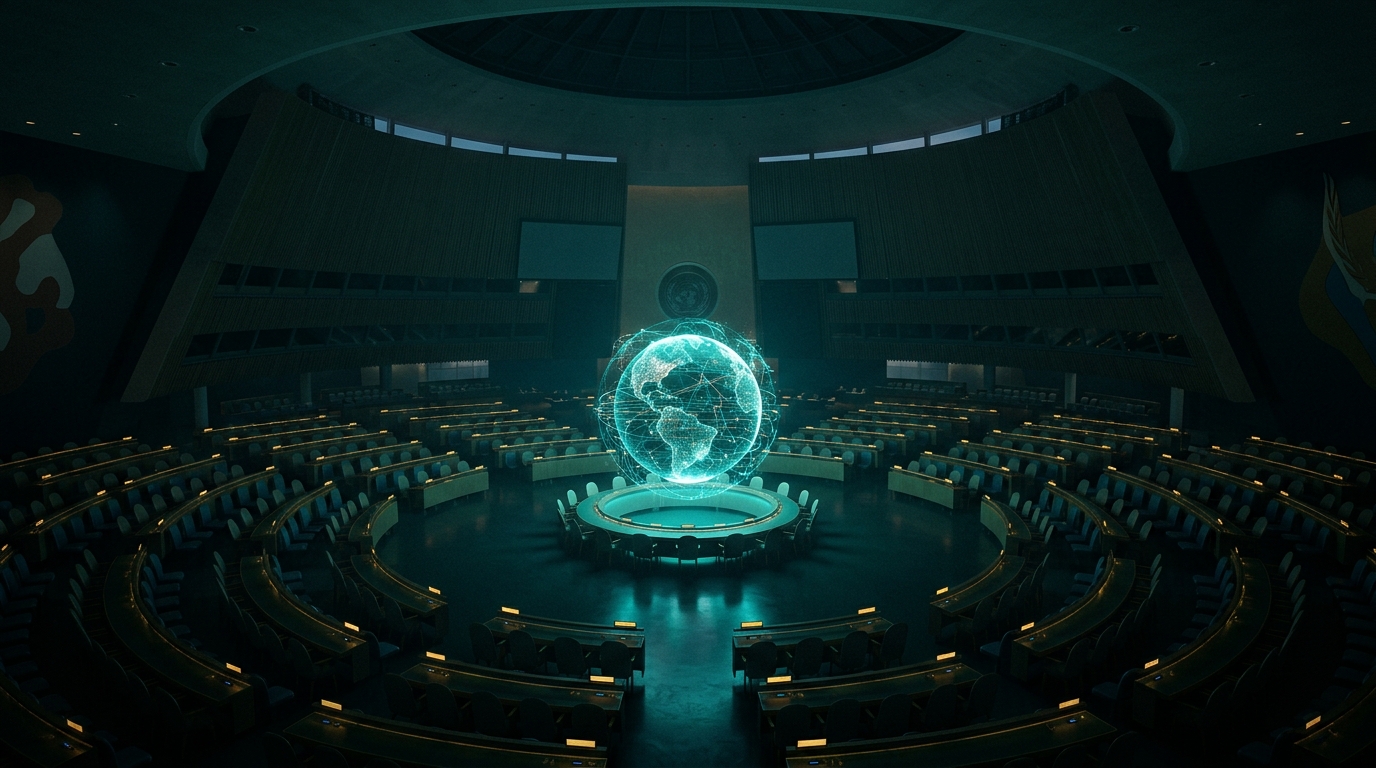
The index landed in the same week as the UN Global Dialogue on AI Governance in Geneva, where Yoshua Bengio, chairing the Scientific Panel behind the UN's own AI assessment, told delegates that AI is approaching or surpassing human capability in many domains — and doing so faster than either the scientific community's understanding or governments' regulatory capacity can keep pace with. The Future of Life Institute's grades give that warning a concrete, comparative shape: it's one thing to say governance is lagging capability in the abstract, and another to see nine specific, named companies scored against the same rubric and watch every single one fail the category that matters most.
AI is approaching or surpassing human capabilities in many domains and is outpacing both scientific understanding and governments' ability to adapt.— Yoshua Bengio, UN Global Dialogue on AI Governance, Geneva, July 2026
None of this happens in a vacuum. This is the same industry moving at the fastest pace of investment in its history — global venture funding hit a record $510 billion in the first half of 2026 alone, with OpenAI and Anthropic together capturing 43 percent of it. The Safety Index's core argument, in effect, is that capital and capability are compounding faster than the internal guardrails meant to contain them, and that the industry's own public commitments are, if anything, moving in the opposite direction from where the risk curve is heading.
How This Compares to Earlier Rounds
The Future of Life Institute has been publishing this index since 2024, and reading the Summer 2026 edition against its predecessors is where the "backsliding" finding really lands. Earlier rounds showed incremental improvement year over year, as companies competed somewhat visibly to be seen taking safety seriously in front of regulators, the press, and each other. This edition breaks that pattern. Meta's climb from sixth to fourth is presented by the index's authors as the exception, not the rule; xAI's fall from fourth to seventh, paired with the documented weakening of pause commitments at four of the largest labs, reads as a broader signal that the season of competitive safety signaling may be ending just as the underlying capabilities keep advancing.
Company responses to the index, where they exist, have mostly been muted. None of the nine firms issued a detailed public rebuttal of their specific category scores in the days immediately following publication, and several have historically noted that the Future of Life Institute's evaluation criteria — built by external AI safety researchers rather than industry insiders — set a bar deliberately calibrated above current regulatory requirements. That's a fair methodological point, and it's also, in a sense, the entire reason the index exists: regulation in most jurisdictions has not yet caught up to what independent researchers consider adequate, which is precisely the gap the UN's own Global Dialogue on AI Governance spent its Geneva sessions this July trying to describe.
What a C+ Is Actually Worth
It would be easy to read "Anthropic tops the index" as a reassurance, and easy to read "every company failed existential safety" as an indictment — both readings are true at once, and that tension is the real story here. An independent panel with no commercial stake in any of these companies looked closely at governance structures, safety frameworks, transparency practices, and existential risk planning across the entire industry, and concluded that the best-performing firm on Earth is still, by its own framework, entirely inadequate at the single task that matters most: making sure that if its systems become powerful enough to matter existentially, there is a credible plan in place before that happens, not after. The report card doesn't say the industry is doing nothing. It says the industry, collectively, hasn't yet done enough to earn better than a gentleman's C — and in several cases, is actively unlearning the safeguards it once promised to keep.
For readers outside the industry, the practical takeaway isn't a call to panic, but a call to recalibrate expectations about who is actually keeping watch. Financial markets have credit rating agencies; food has safety inspectors; pharmaceuticals have regulatory trials before anything reaches a shelf. Frontier AI, as of this index, has a nonprofit research organization publishing letter grades that companies are free to ignore, dispute, or quietly improve against — with no binding consequence attached to any particular score. That gap between "an independent body has identified the risk clearly" and "someone has the authority to require a fix" is precisely where the UN's Global Dialogue on AI Governance and the EU AI Act's rollout are both trying, imperfectly, to build enforcement teeth. Until one of those efforts, or something like them, actually closes that gap, a public report card remains the primary mechanism by which the outside world learns how the industry grades itself, filtered through the closest thing available to an impartial referee.
Sources
- Future of Life Institute — AI Safety Index, Summer 2026 (full report)
- Future of Life Institute — AI Safety Index Summer 2026 (PDF)
- ResultSense — "AI industry fails on existential safety, index warns"
- Tech Xplore — "Global AI industry falls short on safety, think tank warns"
- Axios — "AI companies retreat from safety pledges"
- Inside AI Policy — "Future of Life Institute hands out middling grades for major AI developers' safety efforts"
- BigGo Finance — "Global AI Safety Ratings Flunk: Top Score Barely Reaches C+"
- IEEE Spectrum — "OpenAI, Google DeepMind, and Meta Get Bad Grades on AI Safety"
- Seoul Economic Daily — "Global Big Tech Retreats on AI Safety Pledges, Experts Warn"
- UN News — "Global push for AI governance amid warnings of 'catastrophic harm'"
- Lisa Pedrosa — "The Safety Reckoning: AI Governance Goes Live"


 Buy me a coffee