The Machine That
Needs a Planet
AI is consuming energy faster than civilizations can generate it, and chips faster than the world can manufacture them. This is the race to build the infrastructure of an intelligence age -- and the extraordinary measures being taken when Earth itself begins to run out of room.
In Veldhoven, a small city in the south of the Netherlands, there is a factory that every artificial intelligence on Earth depends on. It employs roughly 40,000 people and occupies a campus the size of a small university. It manufactures, in a good year, approximately 60 machines. Without those 60 machines -- without that one factory, in that one city, run by that one company -- no advanced AI chip anywhere in the world gets made. The company is ASML. Most people have never heard of it. The machines it builds are called EUV lithography systems, and they are among the most complex objects ever manufactured by human hands. Understanding why that factory exists, what it constrains, and what the world is attempting to build around that constraint is to understand the most consequential infrastructure race of the 21st century.
A Hunger With No Off Switch
In 2025, global data center electricity consumption surged by 17 percent in a single year. That was not a rounding error or a statistical anomaly. It was the measurable signature of an entire civilization deciding, simultaneously, to run its operations through artificial intelligence. The International Energy Agency now projects that data center electricity consumption will triple by 2030. Goldman Sachs puts AI-driven power demand growth at 165 percent over the same period. McKinsey has calculated that keeping pace with AI's physical appetite will require $6.7 trillion in data center capital expenditure by 2030 -- $5.2 trillion of that specifically for AI-capable infrastructure.
The numbers are easier to grasp with a comparison. By some current projections, AI data centers will consume more electricity by 2026 than the entire nation of Japan -- a G7 economy of 125 million people with one of the most energy-intensive industrial bases on the planet. By 2030, data centers will represent nearly 3 percent of all global electricity consumption. And that is the base case. The AI-specific scenario, accounting for the explosive growth of agentic AI systems that run continuously rather than answering queries on demand, pushes the number considerably higher.
The United States faces this challenge in its most acute form. The nation's grid interconnection queue -- the pipeline of energy projects waiting for approval to connect to the transmission network -- currently stands at 2,100 gigawatts. That is a number that exceeds the total installed generating capacity of the entire United States. Data center developers are filing for power they cannot receive, on timelines that stretch years into the future. Industry analysis suggests that 30 to 50 percent of planned 2026 US data center capacity will slip to 2028 for exactly this reason. You can fund the hardware. You can hire the engineers. You cannot move the grid any faster than the grid decides to move.
Figure 1 — Global data center electricity consumption (TWh), 2022-2035 projected. Sources: IEA, Goldman Sachs, Oxford Energy Institute. Lines represent approximate trajectories; shaded region = growth envelope.
needed by 2030
(McKinsey)
by ASML per year --
the ceiling on all AI compute
queue -- exceeds total
US installed capacity
This is not simply a problem of ambition outrunning infrastructure. It is the physical signature of a transition that has no historical precedent: the industrialization of cognition. Every large language model training run, every inference call, every autonomous agent deciding how to reroute a supply chain or sequence a protein -- all of it requires electricity, cooling, silicon, and copper. The more capable the AI becomes, the more of all four it demands. And the curve is not linear.
One Dutch Town. Every Chip on Earth.
To understand the chokepoint, it helps to understand what EUV lithography actually is. A semiconductor chip is built by projecting patterns onto silicon -- the way a photographic negative is projected onto film -- at resolutions smaller than a virus. At the 2-nanometer scale required for the most advanced AI chips, the wavelength of visible light is far too large to form the pattern. Extreme ultraviolet light, with a wavelength of 13.5 nanometers, is required. Generating it requires firing a high-powered laser at tiny tin droplets at a rate of 50,000 per second, vaporizing them into a plasma that emits the necessary wavelength. The optics that focus and direct this light must be polished to a flatness of a fraction of an atom across a mirror the size of a dining table. The entire machine stands roughly two storeys tall and contains more than 100,000 precision components. Building one takes approximately 18 months. ASML is the only company in the world that has ever successfully built one, and it ships approximately 60 per year.
That monopoly is not an accident or a market quirk. It is the crystallized result of 30 years of development and roughly 5,000 suppliers contributing specialized components that no other organization knows how to integrate. ASML's backlog currently stands at €38.8 billion. South Korea -- home to SK Hynix and Samsung -- now accounts for 45 percent of ASML's quarterly revenue, driven almost entirely by HBM memory expansion for AI. SK Hynix recently placed a single order worth $8 billion, the largest publicly announced single order in the company's history. ASML is attempting to scale to 60 units per year in 2026, a 36 percent increase. It will not be enough.
The chip shortage is not a single problem. It is three independent bottlenecks hitting their ceilings simultaneously, each with a different owner and a different timeline to relief: ASML EUV production (physical manufacturing limit); TSMC 2nm node capacity (booked solid through 2028); and SK Hynix HBM memory (entire 2026 global supply sold out). Relief in any one layer does not unblock the other two. All three must expand in parallel.
Figure 2 — AI chip supply chain constraint severity by layer. Red = critical (>90%); Orange = severe (>80%). Sources: TSMC, Paradox Intelligence Research, SK Hynix, AINVEST, IEA.
The consequence of this stack is that even governments with unlimited budgets cannot simply buy their way to more AI compute. The constraint is physical and sequential. You cannot have more advanced chips without more EUV machines. You cannot have more EUV machines without ASML building them. ASML cannot build them faster than the complexity of the machine allows. This is not a market failure. It is a physics problem wearing a supply chain's clothes.
"The world has built an economy on a chip supply chain that runs through a single factory in Veldhoven. That is not a supply chain. That is a prayer."
-- Lisa Pedrosa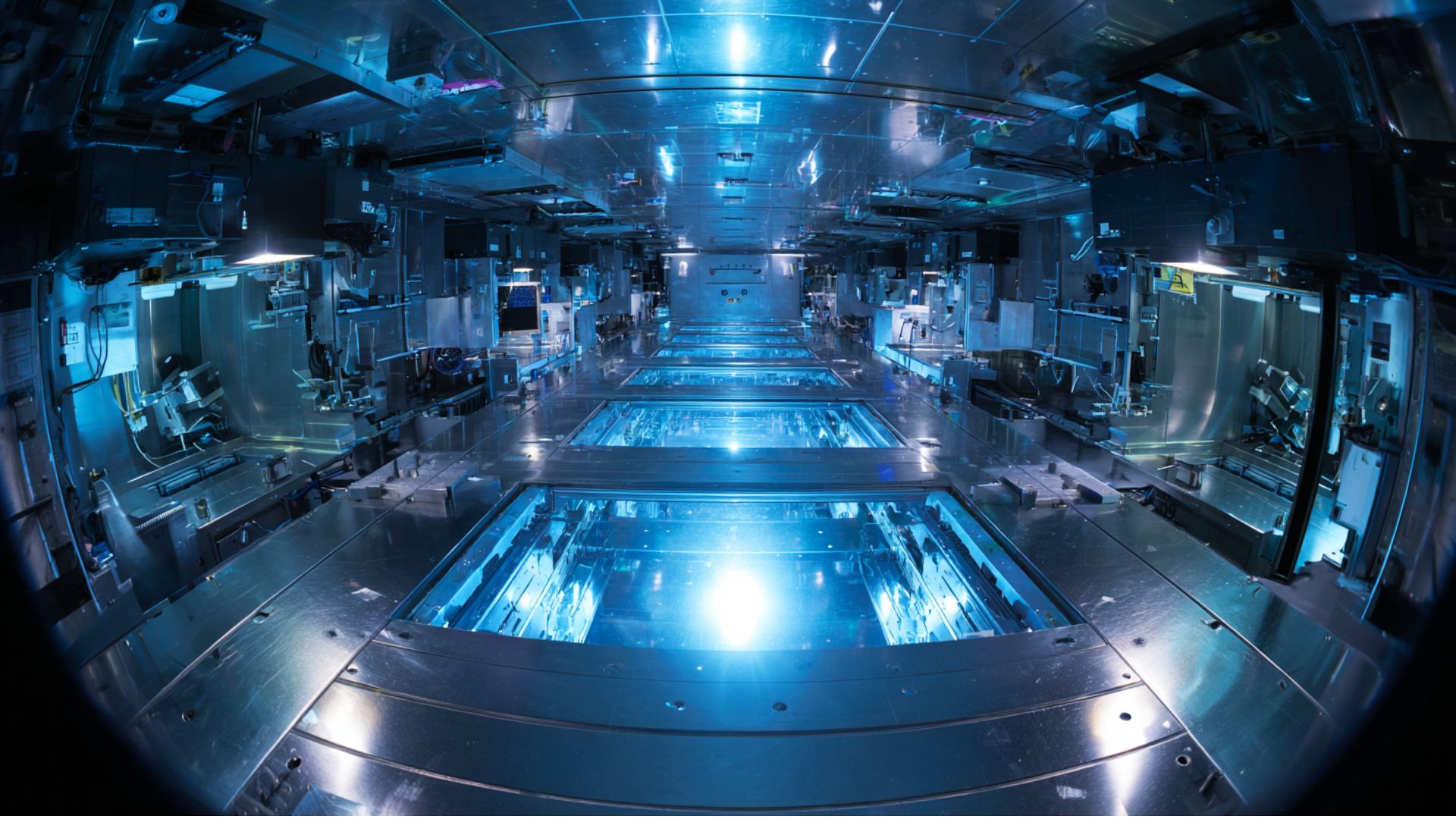
Simulated AI-rendered visualisation of an ASML extreme ultraviolet lithography machine interior. No real EUV machine interior has been publicly photographed -- the machines operate in near-total vacuum and are sealed during production. This image is AI-generated for illustrative purposes only.
China is acutely aware of this dependency -- and has been banned from receiving ASML's EUV machines by Dutch export controls. Its chipmaker SMIC is manufacturing at the 7-nanometer node using older deep ultraviolet (DUV) technology and a technique called extreme multi-patterning: running the same wafer through the lithography machine multiple times with slightly shifted patterns to achieve smaller feature sizes. It is a workaround that works -- the Huawei Mate 60 Pro, which shocked Western analysts in 2023, used exactly this approach. But it is expensive, slow, and does not easily scale below 5nm without EUV.
Two Civilizations, Two Bets
The United States and China have arrived at the same diagnosis -- the physical infrastructure of AI is running out of headroom -- and drawn diametrically different conclusions about how to escape it. The divergence is not merely tactical. It reflects different assumptions about where intelligence should live, who should control the machines that generate it, and how much of the existing physical world needs to be rebuilt.
The American bet is vertical -- literally. In March 2026, Elon Musk announced Terafab: a $20 to $25 billion chip fabrication facility at GigaTexas, built as a joint venture between Tesla, SpaceX, and xAI, using Intel's 14A process technology under a licensing arrangement that makes SpaceX responsible for high-volume manufacturing. The stated target is one terawatt of AI compute annually -- a number that dwarfs anything currently in production. Intel joined the partnership in April 2026, contributing process expertise while SpaceX contributes the manufacturing ambition that TSMC has been too constrained to satisfy.
But the detail that most clearly reveals the strategic logic is not the chip process or the dollar figure. It is the allocation of output: 80 percent of Terafab's compute production is directed at space-based orbital AI satellites. Only 20 percent is reserved for ground-based applications. Musk is not trying to solve the terrestrial grid problem. He is trying to move the problem off the planet entirely.
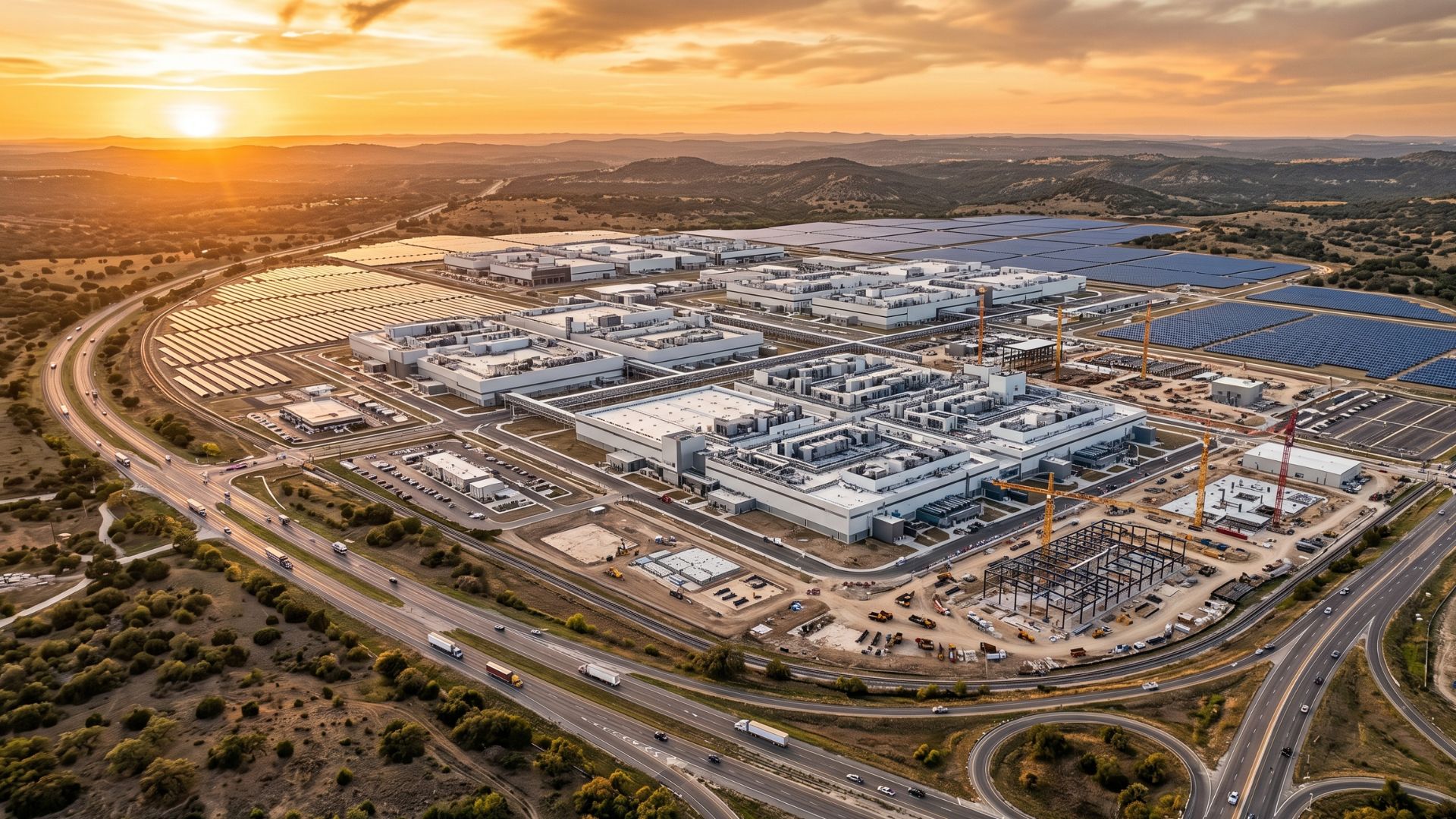
Terafab at GigaTexas, Texas. The $20--25B facility targets one terawatt of AI compute annually using Intel's 14A process, with 80% of output directed to space-based orbital AI satellites.
The physics case for orbital compute is real. Satellites in low Earth orbit receive uninterrupted solar power, limited only by the size of their panels, with no grid to connect to, no land to acquire, no permitting queue, and no water required for cooling. SpaceX has already filed with the Federal Communications Commission for a constellation of up to one million orbital data center satellites. Starcloud, a startup, has already trained the first large language model in space and deployed an NVIDIA H100-class system in orbit. Google published a feasibility study for Project Suncatcher -- solar-powered satellites carrying tensor processing units -- in November 2025. Axiom Space deployed a data center unit on the International Space Station in late 2025, and the first two commercial orbital nodes reached orbit in January 2026.
The unsolved engineering problem is thermal management. Earth's atmosphere does a remarkable job of cooling hardware through convection. Space, a near-perfect vacuum, does not. Data centers generate enormous heat, and in orbit, the only mechanism for shedding it is radiation -- a far less efficient process. At the compute densities required for frontier AI training, the heat rejection problem is not trivial. It is the central unresolved challenge of the orbital compute concept, and as of mid-2026, no deployed system has demonstrated the capability to train frontier models at scale in orbit.
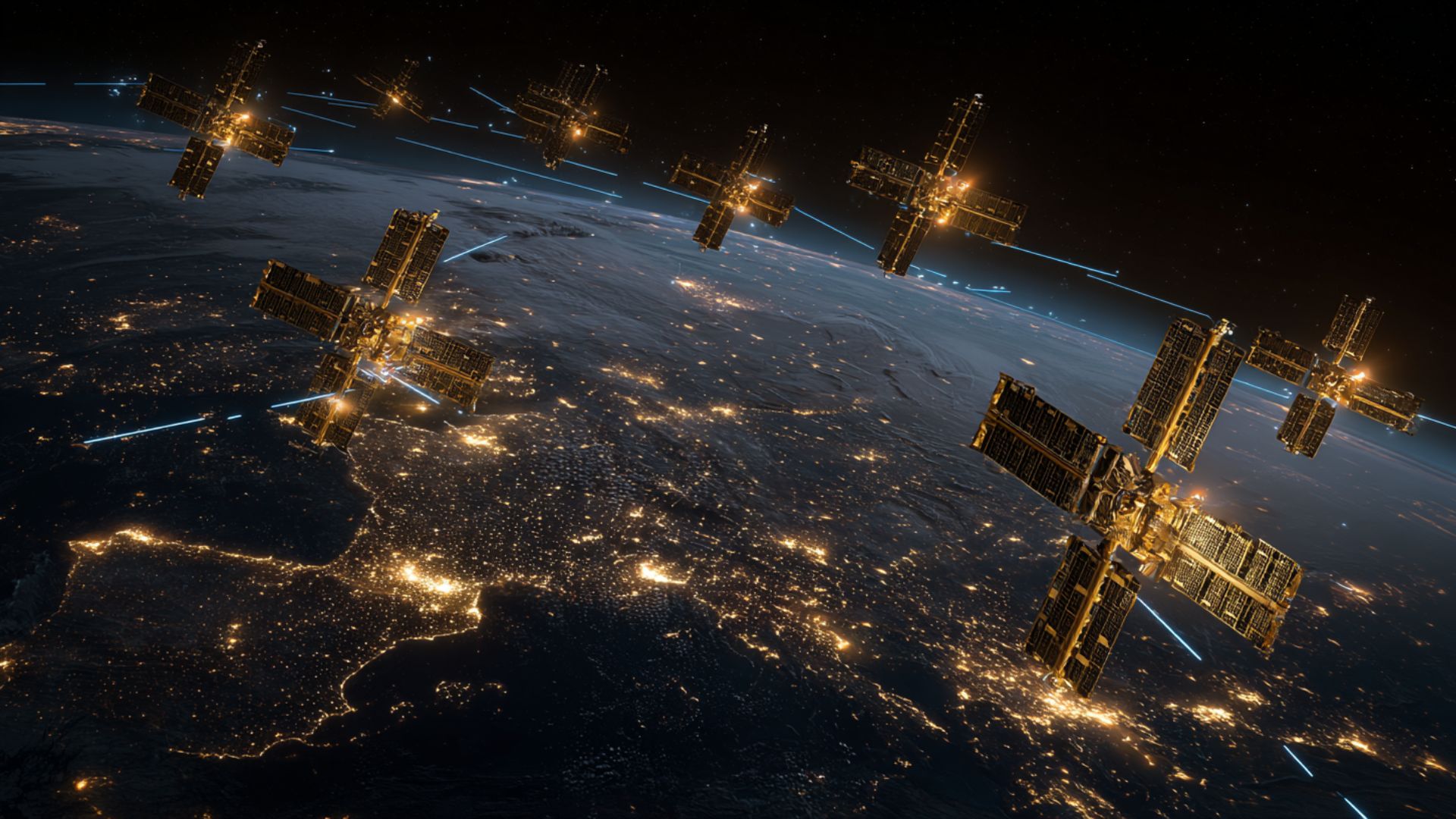
SpaceX has filed with the FCC for a constellation of up to one million orbital data center satellites. The first commercial orbital compute nodes reached orbit in January 2026. Thermal management remains the central unresolved engineering challenge.
Microsoft's Project Natick explored the obvious alternative: seal data center modules inside pressurized cylinders and sink them to the ocean floor, where the cold water provides passive cooling. The results were extraordinary -- Natick achieved a Power Usage Effectiveness (PUE) of 1.07, against an industry average of 1.67, meaning it delivered 56 percent more compute work per unit of energy. The project was nonetheless shut down. Noelle Walsh, head of Microsoft's Cloud Operations, confirmed: "I'm not building subsea data centers anywhere in the world." The reason: a sealed pod on the ocean floor cannot be opened to upgrade GPUs. As AI accelerators refresh on 12-to-18 month cycles, any system that cannot be upgraded becomes obsolete before it earns back its deployment cost. The ocean is efficient but inflexible.
The Chinese bet is geographic and nuclear. Where the US is reaching for orbit, China is executing a land-based energy arbitrage that is more immediately achievable -- and in some respects more strategically coherent. The "East Data, West Compute" initiative relocates computationally intensive workloads to eight national computing hubs in western China, where solar and hydroelectric power is abundant and cheap. All new data center projects within those hubs must source at least 80 percent of their power from renewables. The result is a systematic decoupling of AI compute from the coastal energy grid -- a strategy that requires no new physics and no unsolved engineering problems.
On the nuclear side, China is moving simultaneously on two fronts. The Linglong One small modular reactor -- the world's first commercial SMR of its type -- completes construction in 2026. China already brought the world's first commercial fourth-generation high-temperature gas-cooled reactor online in 2023. And in the most remarkable development in AI energy infrastructure reported anywhere in the world this year, China is actively testing truck-mounted nuclear reactors designed specifically to provide portable, deployable power for AI data center clusters. You drive the reactor to the data center site. You do not wait for grid interconnection. You do not file for permits. You plug in.
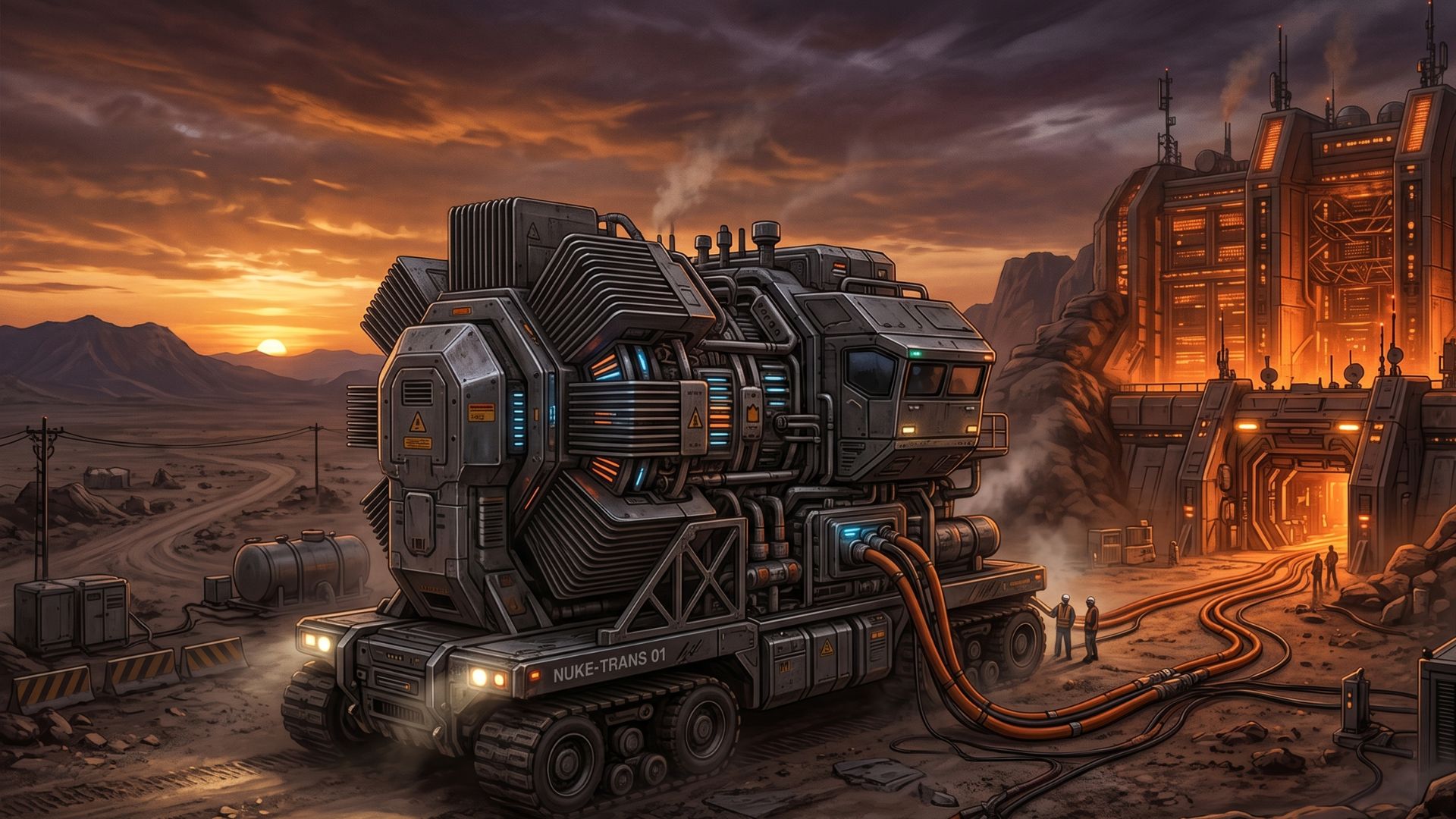
China is testing truck-mounted nuclear microreactors designed to deliver portable power directly to AI data center sites -- eliminating grid interconnection queues that run to 5--10 years in the United States. Source: South China Morning Post, 2026.
On chips, SMIC is executing what might generously be called a siege strategy. Denied EUV access, it has scaled 7nm capacity to 45,000 wafers per month and is targeting 80,000 by 2027. Three dedicated fabrication facilities are being built exclusively for Huawei's Ascend AI chip line, targeting 600,000 Ascend 910C units in 2026 alone. SMIC and Alibaba are collaborating on a 5nm chip for AI inference workloads. Beijing has declared a target of 100 percent semiconductor self-sufficiency by 2027 -- a goal that most independent analysts consider aggressive but directionally serious.
The AI model layer tells an important part of this story. Kimi K2.6, released in April 2026 by Moonshot AI, is an open-weight model with a 256,000-token context window that became the first open-weight model to surpass GPT-5.4 on SWE-Bench Pro, a rigorous software engineering benchmark. DeepSeek V4 competes in the same tier. China has, in measurable terms, achieved parity at the frontier model level -- not despite its chip constraints, but partly because of them. Compute scarcity drives efficiency. The models being trained on domestically available hardware are becoming more efficient per floating-point operation. This is not a consolation prize. It is a compounding advantage.
Who Controls What -- and When
The US-China framing, while accurate at the level of strategic competition, obscures the degree to which the actual physical infrastructure of AI is held by smaller nations that neither country controls. The Netherlands makes the only machine that prints advanced chips. South Korea makes the memory that makes those chips useful. Japan hosts critical diversification of the foundry capacity the West depends on. The UAE is deploying sovereign AI infrastructure at a scale that would have seemed implausible five years ago. None of these countries are passive bystanders in a bilateral contest. They are chokepoints, partners, and -- in some cases -- swing votes.
| Country | Critical Leverage | Chip Strategy | Energy Strategy | Governance Posture |
|---|---|---|---|---|
| 🇺🇸United States | Hyperscaler capital, NVIDIA design, Terafab manufacturing | Terafab (Intel 14A), TSMC Arizona expansion, orbital compute R&D | Grid-constrained; SMR planning; orbital solar (long-term) | FRAGMENTED Export controls loosening; AI OVERWATCH Act pending |
| 🇨🇳China | Scale, speed, state coordination; frontier model parity | SMIC 7nm→5nm, Huawei Ascend, 100% self-sufficiency goal 2027 | East Data West Compute; Linglong One SMR; truck-mounted nuclear | EMBEDDED Architecture-level control; Supply Chain Security Regs 2026 |
| 🇳🇱Netherlands | ASML: sole producer of all EUV lithography machines on Earth | Equipment monopoly; 60 EUV units/yr; €38.8B backlog | EU grid (renewable transition) | EU AI ACT Enforceable Aug 2, 2026; EUV export controls on China |
| 🇰🇷South Korea | SK Hynix + Samsung: global HBM memory monopoly; ASML's largest market | HBM expansion; $8B ASML order; advanced packaging scale-up | Grid-dependent; nuclear baseload | BILATERAL US-allied; critical to both sides' supply chains |
| 🇯🇵Japan | Geographic diversification; precision materials; gov't subsidies | TSMC $17B Kumamoto fab; Micron advanced memory; Rapidus 2nm | Nuclear restart; renewable expansion | COOPERATIVE AI safety institute; US-Japan chip partnership |
| 🇦🇪UAE | Capital, geography, neutral compute jurisdiction; G42 | US-UAE 5GW AI campus; Microsoft $15.2B commitment; xAI tenancy | Solar + grid; energy-rich sovereign financing | NEUTRAL Positioned as bridge compute between US and Global South |
| 🇮🇳India | Talent pipeline; $210B AI infrastructure commitment | UAE 8-exaflop supercomputer deployment; domestic fab nascent | Solar scale; coal transition; nuclear expansion | DEVELOPING Sovereign AI framework; non-aligned compute strategy |
| 🇪🇺European Union | AI Act regulatory standard-setting; Intel EU fabs | Intel Ireland/Germany; IMEC R&D; no frontier compute cluster | Renewable mandate; offshore wind expansion | LEADING AI Act fully enforceable Aug 2026; ISO/IEC 42001 |
The UAE case deserves particular attention because it represents a new category of actor: a sovereign wealth state using oil revenue to buy a position in the AI infrastructure stack before the window closes. The US-UAE AI Campus announced in May 2025 -- a 5-gigawatt, 10-square-mile facility in Abu Dhabi, the largest AI infrastructure project outside the United States -- reflects a calculation that physical compute infrastructure is to the 2030s what oil fields were to the 20th century. Microsoft's commitment to the UAE alone totals $15.2 billion through 2029. G42, Abu Dhabi's state AI company, is the coordination vehicle. The UAE's ambition is not to develop frontier AI. It is to own the land and power that frontier AI runs on.
India's $210 billion AI infrastructure commitment -- combined with the UAE's deployment of an 8-exaflop supercomputer specifically to build out India's sovereign AI capability -- signals a third category of actor: nations investing heavily not to compete at the frontier, but to ensure they are not wholly dependent on either the US or Chinese AI stack as those stacks mature. The sovereign AI logic is straightforward: a country that trains its critical systems on foreign infrastructure is not sovereign in any meaningful sense.
The Road Ahead -- and Who Gets to Drive
The trajectory of AI infrastructure over the next decade will be shaped less by which models are most capable than by which physical supply chains are most resilient, which energy strategies are most executable, and -- critically -- whether international governance frameworks emerge fast enough to prevent the infrastructure race from becoming a destabilizing force in its own right.
| Region | Short-Term 2026-2027 | Mid-Term 2028-2030 | Long-Term 2031-2035 | Key Risk |
|---|---|---|---|---|
| 🇺🇸United States | Terafab construction; grid crisis slips 30-50% capacity to 2028; orbital prototypes deploy | Terafab volume production; TSMC Arizona at scale; early orbital compute nodes operational | $1T+/yr infrastructure spend; orbital tier functional; AGI-era compute demands emerge | GRID DELAY |
| 🇨🇳China | Huawei 1.6M Ascend dies; SMIC 5nm pilot; Linglong One SMR; East Data hubs operational | Near-full chip self-sufficiency; 80K wafers/mo SMIC; nuclear+solar 40% of DC power | 60% renewable+nuclear DC supply; potential 3nm without EUV via advanced patterning | HBM GAP |
| 🇳🇱🇰🇷Netherlands + Korea | ASML at 60 EUV/yr; HBM sold out; SK Hynix $8B expansion underway | ASML High-NA EUV deployment; HBM capacity doubles; South Korea = ASML's largest market | ASML's successor-generation tools define the next compute ceiling globally | GEOPOLITICAL |
| 🇯🇵Japan | TSMC Kumamoto Phase 1 live; Micron memory fab under construction; Rapidus 2nm R&D | Kumamoto Phase 2; Rapidus first 2nm wafers; Japan = key diversification node | Mature diversified fab ecosystem; critical materials supplier to global stack | SCALE-UP |
| 🇦🇪🇮🇳UAE + India | UAE 5GW campus construction begins; India 8-exaflop deployment; G42 hyperscaler deals | UAE largest non-US AI campus operational; India sovereign compute at exascale | UAE as neutral global compute exchange; India as AI talent+infrastructure superpower | ACCESS |
| 🇪🇺European Union | AI Act enforceable Aug 2026; Intel EU fabs marginal; no frontier model cluster | AI Act shapes global enterprise standards; EU compute investment accelerates post-2028 | EU as regulatory standard-setter; potential EU sovereign AI compute cluster | COMPUTE GAP |
On governance, the situation is best described as institutionally active and practically insufficient. The most significant development of 2026 is the EU AI Act becoming fully enforceable on August 2 -- the first comprehensive, binding AI law anywhere in the world. It mandates documented AI inventories, risk classification, algorithmic auditing, and third-party due diligence. It is real law with real teeth. Its central limitation is that the EU has no frontier AI models, no competitive compute infrastructure, and no leverage over the companies and governments driving the AI infrastructure race. The EU is regulating a game in which it is not a top-tier player.
The United States presents a different kind of incoherence. The AI OVERWATCH Act would grant Congress veto power over chip export licenses -- authority currently held by the Department of Commerce. Simultaneously, the Trump administration is loosening export controls on H200-equivalent chips as a trade-negotiation concession to China, even as Applied Materials was fined $252 million in February 2026 for illegally exporting semiconductor equipment to China -- the second-largest export control penalty in US history. The signal is simultaneously tightening and loosening, depending on which part of the government you are watching.
China's governance approach is architecturally embedded rather than legally post-hoc. Its April 2026 Regulations on Industrial Chain and Supply Chain Security create a unified legal framework for economic statecraft -- mirroring US export control mechanisms while building in symmetric retaliatory capacity. The OECD now tracks more than 1,000 AI policy initiatives across 69 countries. ISO/IEC 42001 is emerging as a universal enterprise standard. Singapore has pioneered agentic AI governance frameworks. The institutional architecture of global AI governance exists in outline. What does not exist is meaningful enforcement coordination between jurisdictions -- and without that, the frameworks are advisory documents in a race that moves at commercial speed.
The most intellectually serious governance concept currently in development is the compute audit mechanism: the idea that advanced AI chips, like fissile material, can and should be tracked from manufacture through deployment. Chips have serial numbers. CoWoS packaging creates unique physical signatures. The technical capability to monitor where compute is, what it is running, and at what scale is not speculative -- it exists. The political will to implement it internationally does not yet. Researchers at CSIS and Chatham House have published frameworks for what a Compute Non-Proliferation Treaty equivalent might look like. No government has yet adopted one.
Three Things That Are Now Clear
First: this is not US versus China. It is the US-allied supply chain -- running through Veldhoven, Seoul, Hsinchu, and Kumamoto -- versus China's self-sufficiency project running through Shanghai, Wuhan, and the Gansu corridor. The competition is not primarily at the model layer, where both sides have reached functional parity. It is at the physical infrastructure layer, where the constraints are measured in EUV delivery schedules, grid interconnection timelines, and the number of tons of cooling water available per megawatt of compute.
Second: energy is the binding constraint, and no terrestrial solution is fast enough. The US grid cannot absorb what AI demands in the timeframes the technology requires. China's geographic energy strategy is more immediately executable, but it is ultimately still constrained by the same planet. The orbital compute bet -- moving the problem off-world, where solar power is unlimited and land is free -- is longer-dated, the thermal engineering is unsolved, and the latency physics are real. But it is also the only approach that does not, in principle, have a ceiling. Both Musk's 80-percent-orbital Terafab allocation and SpaceX's million-satellite FCC filing suggest that the people with the most skin in the game believe the ceiling is terrestrial, and the answer is above it.
Third: governance is not absent -- it is fragmented and outpaced. The EU has the law but not the compute. The US has the compute but not coherent law. China has both, but only for itself. The world does not have a Compute Non-Proliferation Treaty. It does not have an agreed framework for tracking where frontier AI hardware is deployed, at what scale, and for what purposes. The window to build one is closing as infrastructure concentrates in fewer hands, on fewer continents, behind higher walls. The machine that needs a planet has no global management structure. It has only the race.
There is one thing worth holding onto as this unfolds. The same computation that strains grids and empties HBM stockpiles is also, in the IEA's own analysis, among the most powerful tools available for designing the next generation of energy systems, modeling climate interventions, and accelerating the materials science that could build better batteries, cheaper solar cells, and more efficient reactors. The machine that is consuming the planet's energy may also, if the infrastructure race does not collapse into pure strategic competition, be the instrument that extends the planet's capacity. That is not a guarantee. It is a possibility that depends entirely on whether the people building the infrastructure can agree on more than who gets to own it.
- International Energy Agency. "Energy and AI." 2026. iea.org/reports/energy-and-ai
- Goldman Sachs. "AI to drive 165% increase in data center power demand by 2030." goldmansachs.com
- McKinsey Global Institute. "The cost of compute: A $7 trillion race to scale data centers." mckinsey.com
- Paradox Intelligence Research. "TSMC 2nm Orders Run to 2028: The Compound Constraint." 2026. paradoxintelligence.com
- ASML. "€38.8 Billion Backlog Tests EUV Supply Constraints." AINVEST, 2026. ainvest.com
- TechCrunch. "Intel signs on to Elon Musk's Terafab chips project." April 7, 2026. techcrunch.com
- Tom's Hardware. "Elon Musk says TeraFab will use Intel's 14A process technology." 2026. tomshardware.com
- Data Center Dynamics. "SpaceX files for million satellite orbital AI data center megaconstellation." 2026. datacenterdynamics.com
- South China Morning Post. "China testing truck-mounted nuclear reactor that could power AI data centre." scmp.com
- Oxford Institute for Energy Studies. "The China data centre advantage." February 2026. oxfordenergy.org
- Data Center Dynamics. "US and UAE plan to build 5GW AI data center campus." 2025. datacenterdynamics.com
- Chatham House. "AI export controls are not the best bargaining chip." April 2026. chathamhouse.org
- Techzine. "ASML receives $8 billion mega order from SK Hynix." 2026. techzine.eu
- Digitimes. "China reportedly plans to triple AI chip output by 2026, with 3 fabs for Huawei." 2025. digitimes.com
 Buy me a coffee