The Robot Workforce
Humanoids spent a decade as demos. In 2026 they started clocking shifts — and the question stopped being whether they work and became what happens to the people beside them.
For ten months, a humanoid robot showed up to work at BMW's plant in Spartanburg, South Carolina, five days a week, ten hours a shift. It did not eat, did not tire, and did not complain about the job — which was the kind of job that grinds human bodies down: lifting sheet-metal parts and seating them onto welding fixtures, over and over, with two seconds and five millimetres of margin for error.
By the time BMW retired that first-generation Figure robot this spring, it had helped build more than 30,000 X3s, moved over 90,000 parts, and logged roughly 1,250 operating hours on a live assembly line. No press-release stunt, no choreographed demo on a conference stage. Just a machine doing a real industrial job for the better part of a year — and a carmaker deciding, on the strength of that record, to order more.
That is the quiet hinge the robotics industry turned in 2026. For a decade, humanoids lived in the genre of the demo: a robot folding a shirt for the cameras, threading a needle, pouring a drink. The story this year is different and far less cinematic. It is the story of the pilot becoming the platform — of humanoids crossing from "look what it can do" to "it did a full shift and we're scaling the order."
From demo to deployment
The clearest signal of the shift is volume. Figure AI says its BotQ factory has reached a cadence of roughly one robot per hour — a manufacturing rhythm, not a hand-built prototype line. Boston Dynamics began initial deployments of its all-electric Atlas, with early units heading to partners including Hyundai. In China, AgiBot produced its 10,000th humanoid in late March, scaling from about a thousand units in 2025 to ten thousand within months, while Unitree shipped more than 5,500 units last year and unveiled its G1 humanoid at a startling price point of around $16,000.
Price is the part that should make everyone sit up. A piece of capital equipment that costs roughly as much as a modest used car, works multiple shifts, and never books vacation changes the arithmetic of automation in a way that a million-dollar industrial arm never could. Japan Airlines, partnering with GMO AI & Robotics, began trialing Unitree-based humanoids priced near $15,400 a unit for baggage handling, container transport, and cabin cleaning. The robots are no longer too expensive to consider; in some roles they are starting to look cheaper than the alternative.
The breakthrough was software, not steel
What changed was not chiefly the hardware. The legs, hands, and actuators improved, but the decisive leap came from the control software — the layer that turns a pile of motors into something that can understand an instruction and act on a cluttered, unpredictable world. NVIDIA's new Isaac GR00T models let robots parse natural-language commands and chain together the messy multi-step tasks real workplaces demand, using what researchers call vision-language-action reasoning: see the scene, interpret the goal, generate the motion.
This is why the same hardware platform can now be re-tasked from welding fixtures to baggage carts to warehouse shelves without a team of engineers hand-coding every motion. The robot is becoming a platform you program with examples and words rather than a single-purpose machine bolted to one station. That generality is the whole reason the humanoid form — awkward, expensive, top-heavy — is worth pursuing at all: a machine shaped like us can, in principle, slot into the world we already built for ourselves.
The hard part was never the body. It was giving the body something that could look at a strange situation and know what to do next.— The lesson of the vision-language-action era
Pilot to platform, in numbers
Analysts now expect somewhere between 50,000 and 100,000 humanoid shipments in 2026 alone, with unit costs sliding toward the $15,000–$20,000 band as manufacturing scales. The market today is small — on the order of two to three billion dollars — but projections reach as high as $200 billion by 2035. Those long-range numbers deserve a healthy dose of salt; the history of robotics is littered with curves that bent later and flatter than promised. But the near-term trajectory, grounded in actual deployments rather than slideware, is real.
BMW's bet, and what it signals
The most telling detail in the BMW story is not that the robot worked, but that the company doubled down after the trial ended. BMW is evaluating Figure's next-generation model for additional jobs and running separate humanoid pilots at its German plants in Munich, Regensburg, and Leipzig. When a manufacturer with BMW's engineering discipline moves from "let's test one" to "let's put them in three more plants," it is making a statement about return on investment that no vendor demo could.
The economics that justify it are blunt. The tasks humanoids are taking first are the ones humans least want: repetitive lifting, awkward postures, jobs that produce repetitive-strain injuries and high turnover. In that narrow band, the robot is not competing with a craftsperson; it is competing with a position that factories struggle to keep filled at all.
The reliability gap nobody advertises
For all the momentum, it is worth being clear-eyed about what humanoids still cannot reliably do. The BMW deployment is impressive precisely because the task was narrow: a single, repeatable motion at a fixed station, in a controlled environment engineered around the robot. The gulf between that and a machine that can handle the unpredictable mess of a typical workplace — a dropped part, a re-arranged shelf, a co-worker stepping into its path — remains wide. Dexterity in a demo is not the same as dependability across thousands of hours, and the industry's most honest engineers will tell you that the last ten percent of reliability is where robotics projects go to die.
This is why the vision-language-action models matter so much, and why their limits matter just as much. A robot that can generalize from words and examples is far more flexible than a hand-coded one, but generalization also means a longer tail of strange failures — the robot confidently doing the wrong thing because it misread an unfamiliar scene. In an industrial setting, a confident error near a human body is not a software bug; it is a safety incident. The deployments scaling fastest in 2026 are, tellingly, the ones in caged or clearly bounded zones, where a misstep is contained.
A geopolitical race, not just a market
The humanoid surge is also a contest between national industrial strategies, and the numbers tell that story plainly. The most aggressive scaling figures of 2026 — AgiBot's leap to ten thousand units, Unitree's volume and its $16,000 price point — come from Chinese firms, backed by government agencies explicitly moving to accelerate development. American players like Figure, Boston Dynamics, and Tesla are racing on capability and integration with marquee manufacturers. The result is a familiar pattern: a Western lead in the hardest software and systems, a Chinese lead in manufacturing scale and cost.
That dynamic will shape who actually puts robots on the world's factory floors. A platform that is slightly less capable but half the price, produced by the tens of thousands, can win a great deal of the market while the more sophisticated rival is still ramping. The lesson of consumer electronics, drones, and electric vehicles is that manufacturing scale tends to compound, and the humanoid field is now early in exactly that kind of race. For the countries involved, this is not merely a commercial question; it is about who supplies the physical labour of the next industrial era.
The harder question
Which brings us to the part the shipment charts cannot answer. If a $16,000 machine can do a growing share of physical labour across two or three shifts, what happens to the people who do that labour now? The most-cited estimate, from the McKinsey Global Institute, suggests automation broadly could displace somewhere between 400 and 800 million jobs worldwide by 2030, forcing up to 375 million workers — around 14 percent of the global workforce — to change occupations entirely. Humanoids are only one input into that number, and such forecasts are notoriously elastic. But the direction is not in doubt.
The robots are taking the jobs that wreck human backs first. Whether they stop there is a choice we make, not a fact the technology decides.— On the limits of the optimistic case
There is an optimistic reading, and it is not naive. Many of the first roles being automated are genuinely hazardous or chronically unfilled; freeing people from them, while moving them into supervision, maintenance, and higher-skill work, is the pattern previous waves of automation eventually produced. But "eventually" did a great deal of work in that sentence, and it was rarely gentle for the workers caught in the transition. The difference this time is speed: a platform that re-tasks with words, manufactured at one unit per hour, can diffuse far faster than a bolted-down assembly robot ever did.
Who captures the gains
Strip the robotics story down to its economic core and a single question remains: when a $16,000 machine does the work of a worker who cost far more, where does the saved money go? That is not a technical question, and the technology will not answer it. History offers both endings. Automation can lift everyone, funding shorter hours, higher wages for the roles that remain, and entirely new categories of work — or it can concentrate the windfall among the owners of the machines while the displaced are left to find their own way down.
What makes the humanoid wave distinctive is its breadth. Earlier automation took specific, predictable tasks; a general-purpose machine that re-tasks with words threatens to reach into far more of the economy at once, and faster. That speed compresses the timeline in which societies have to make choices about retraining, wage support, and how the productivity dividend is shared. The robots arriving on factory floors in 2026 are a genuine engineering triumph. Whether they become a broad prosperity or a narrow one is a decision that belongs entirely to people — to companies, unions, and governments — and it is being made, mostly by default, right now.
What to watch next
The numbers to track over the next year are not the viral clips but the boring industrial ones: how many plants move from one robot to ten, how fast the price keeps falling, and whether uptime in messy real-world settings holds up outside the controlled lane of a single welding station. If 2025 was the year humanoids learned to move like us, 2026 is the year they started to be employed like us. The machines have clocked in. The more interesting story now belongs to the people standing next to them on the line — and to whether the societies building these robots decide to share the productivity they unlock, or simply pocket it.
Sources & further reading
- iIoT World — "Physical AI Deployment ROI: BMW's 30,000-Car Proof," June 2026.
- TheStreet — "BMW doubles down on humanoid robots after a U.S. test run," 2026.
- BMW Group — "First humanoid robot introduced in Plant Leipzig," 2026.
- KraneShares — "Humanoid Robotics In 2026: The Race From Pilot To Platform," 2026.
- CNBC — "Humanoid robots touted as next AI investment opportunity," June 3, 2026.
- NVIDIA Blog — "National Robotics Week: Latest Physical AI Research and Isaac GR00T," 2026.
- Memeburn — "Physical AI Is Sending Humanoid Robots to Real Factory Floors in 2026."
- Keyirobot / Loona Blog — "Humanoid Robot Updates 2026: Latest News, Breakthroughs, and Industry Trends."
- Gasgoo Auto News — "Two government agencies move to accelerate humanoid robot development," 2026.
- Figure AI overview — Thomasnet Insights, "Figure AI: Bringing Humanoid Robots Into Industry."
- McKinsey Global Institute — workforce automation and occupational transition estimates.
- RAISE Summit — "Who's Leading the Way in Robotics, Humanoids & Physical AI in 2026."
- Robozaps — "Humanoid Robots & Jobs: Economic Impact," 2026.
More from Lisa Pedrosa
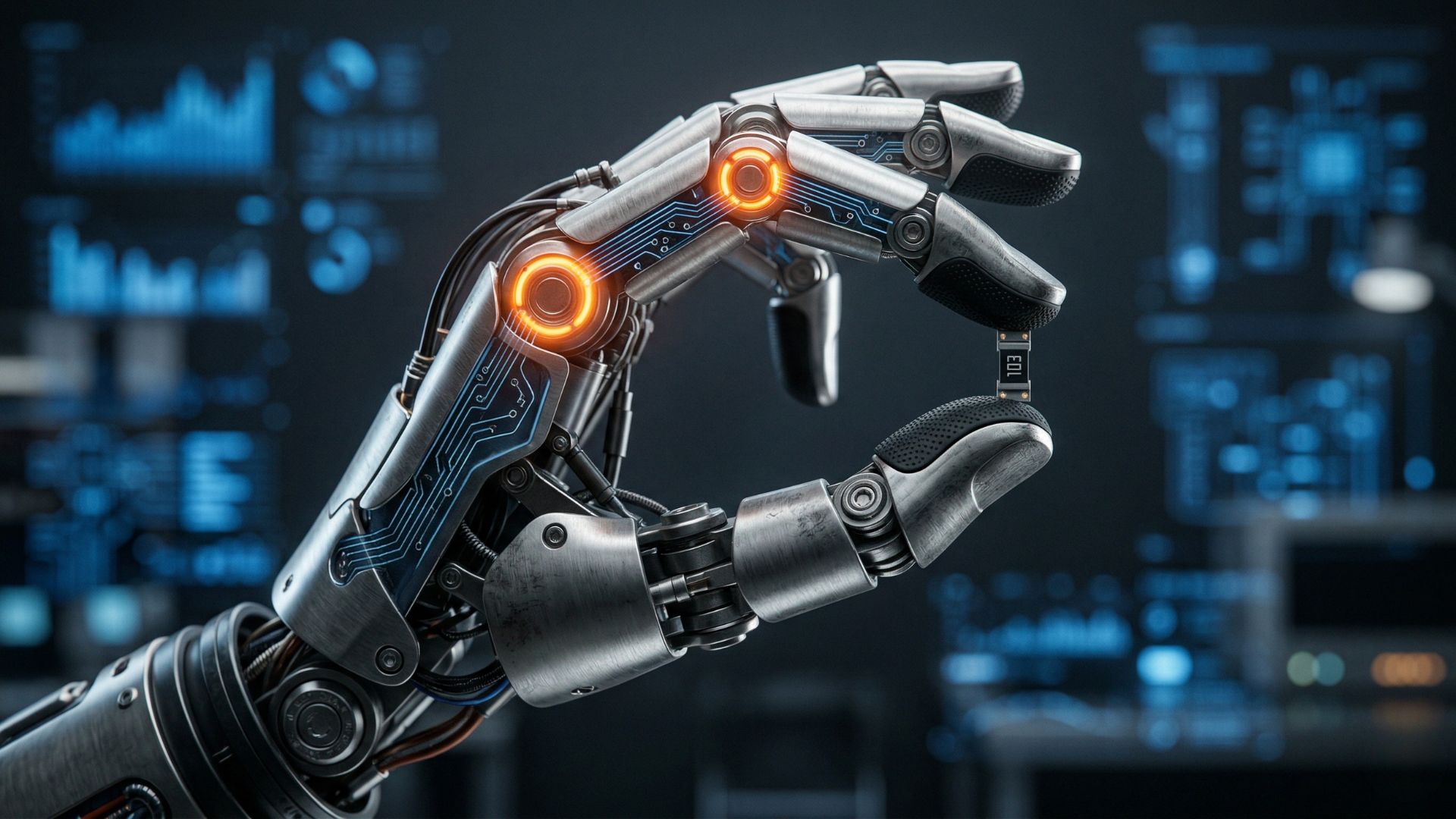
The Physical Turn
How humanoids learned dexterity — and why the breakthrough was an algorithm.

The Living Computer
When biology becomes the substrate for computation itself.
Autonomous Weapons
The other place we are handing machines physical autonomy.

AI, the Engine of Discovery
The quiet revolution turning AI into a scientific instrument.
The First Mind Online
The strange birth of the systems we now call intelligent.

The Safety Reckoning
How the world started trying to govern minds it doesn't fully understand.
 Buy me a coffee