For 200,000 years, every human being who has ever lived, loved, fought, or died has done so on a single pale blue dot orbiting an average star in an unremarkable corner of the Milky Way. That may be about to change. The question is not merely whether we can get to Mars. It is whether we should — and what it will cost us, in every sense of that word, if we do not.
In November 2026, if schedules hold, up to five Starship V3 rockets will ignite at Starbase in South Texas and begin a journey of 225 million kilometres to Mars. They will carry no humans — not yet. Their cargo will include scientific experiments, Italian Space Agency instruments, and a small contingent of Tesla Optimus humanoid robots, the first autonomous AI-driven machines any private company has ever attempted to send to another planet. If they arrive intact in mid-2027, the plan — still evolving, still contested, still marked by Elon Musk's own 50-50 probability assessment — is for crewed missions to follow within five to seven years.
The window is brief. Every twenty-six months, the orbital mechanics of the inner solar system align in a configuration that allows Earth-to-Mars travel at the lowest possible fuel cost. Miss it, and you wait more than two years for the next one. This is not a deadline invented by ambition. It is written into the physics of the solar system itself.
What happens in that window — and what we collectively decide to think about it — matters far beyond the rockets. It touches the oldest question humans have ever asked of themselves: what are we for?
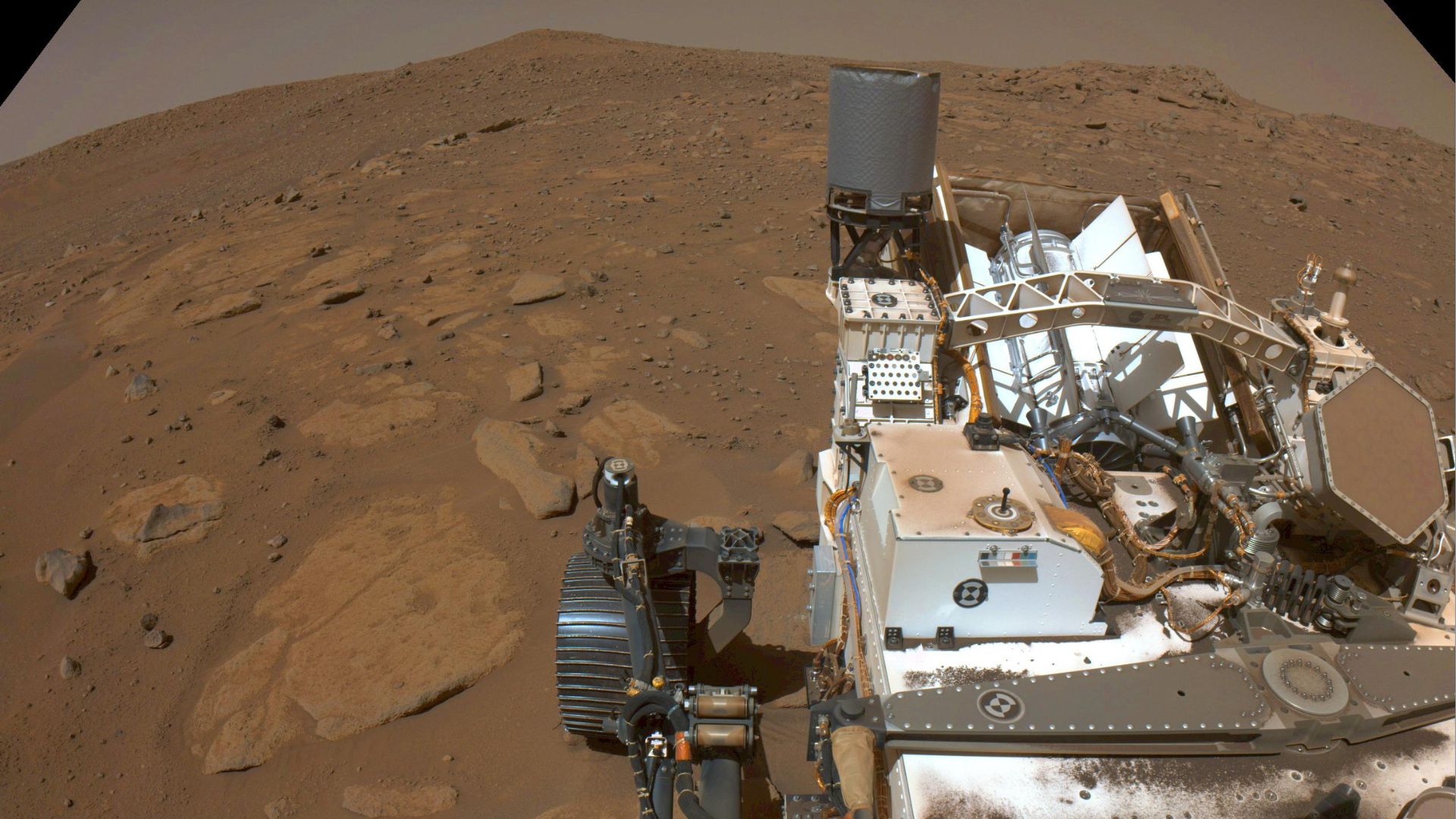 Perseverance rover on the floor of Jezero Crater — the ancient river delta that is humanity's deepest look yet into whether Mars once harboured life
The mathematics of an impossible world
Mars is not a hospitable place. A visitor stepping outside without a pressure suit would experience almost immediate death: the atmospheric pressure at the surface is less than 1% of Earth's, the average temperature is minus 60 degrees Celsius, radiation from cosmic rays and solar events bathes the surface continuously, and dust storms capable of encircling the entire planet erupt with seasonal regularity and can last for months. The soil contains perchlorates — toxic salts that would need to be removed before crops could be grown. There is no global magnetic field to deflect charged particles from the Sun. The gravity is 38% of Earth's, which over years and decades produces documented degradation of bone density and cardiovascular function in ways we don't fully understand.
None of this is a reason not to go. It is a reason to go with clear eyes about what the numbers actually say.
The cost estimates for a sustainable Mars programme span one of the widest ranges in the history of engineering estimates. A 2025 NASA Ames Research Center analysis put the cost of transporting humans to Mars — using traditional government contracting models and expendable hardware — at approximately $500 billion for a first crewed mission. Musk himself has put his own range at $100 billion to $10 trillion for the full colonisation programme, which is less an estimate than an acknowledgement that nobody yet knows. His Mars-specific formulation, however, is more precise: a self-sustaining Martian city would require at least one million tonnes of equipment and infrastructure delivered to the surface. At current Mars delivery costs of approximately $1 billion per tonne of useful payload, that calculus produces a figure of $1,000 trillion — a number so large it exists only in theoretical space.
The entire point of Starship, SpaceX's fully reusable Starship-SuperHeavy system, is to collapse that per-tonne figure by a factor of one thousand. If it succeeds — and this remains the largest engineering if in the programme — the colonisation budget drops to somewhere in the $1 trillion range, spread over forty years, which Musk has argued would amount to less than $25 billion annually: a rounding error in global GDP, roughly equivalent to one month of global military spending.
"Building a self-sustaining city would require at least a million tons of equipment. Rocket technology needs to improve by 1,000 times. Starship is designed to achieve exactly that improvement."
— Elon Musk, on X, 2024That "if" is not trivial. The SpaceX IPO prospectus, filed with the SEC in May 2026 and running to 270 pages, lists Mars-colony technologies under a section called "Our Challenges" and acknowledges they involve technologies that are "unproven" or "do not exist." The board has nonetheless tied Musk's executive compensation to a permanent colony of one million people — not as aspiration but as formal vesting condition. A trillion-dollar company has legally committed its CEO's paycheque to the survival of a Martian city. Whatever this is, it is not casual.
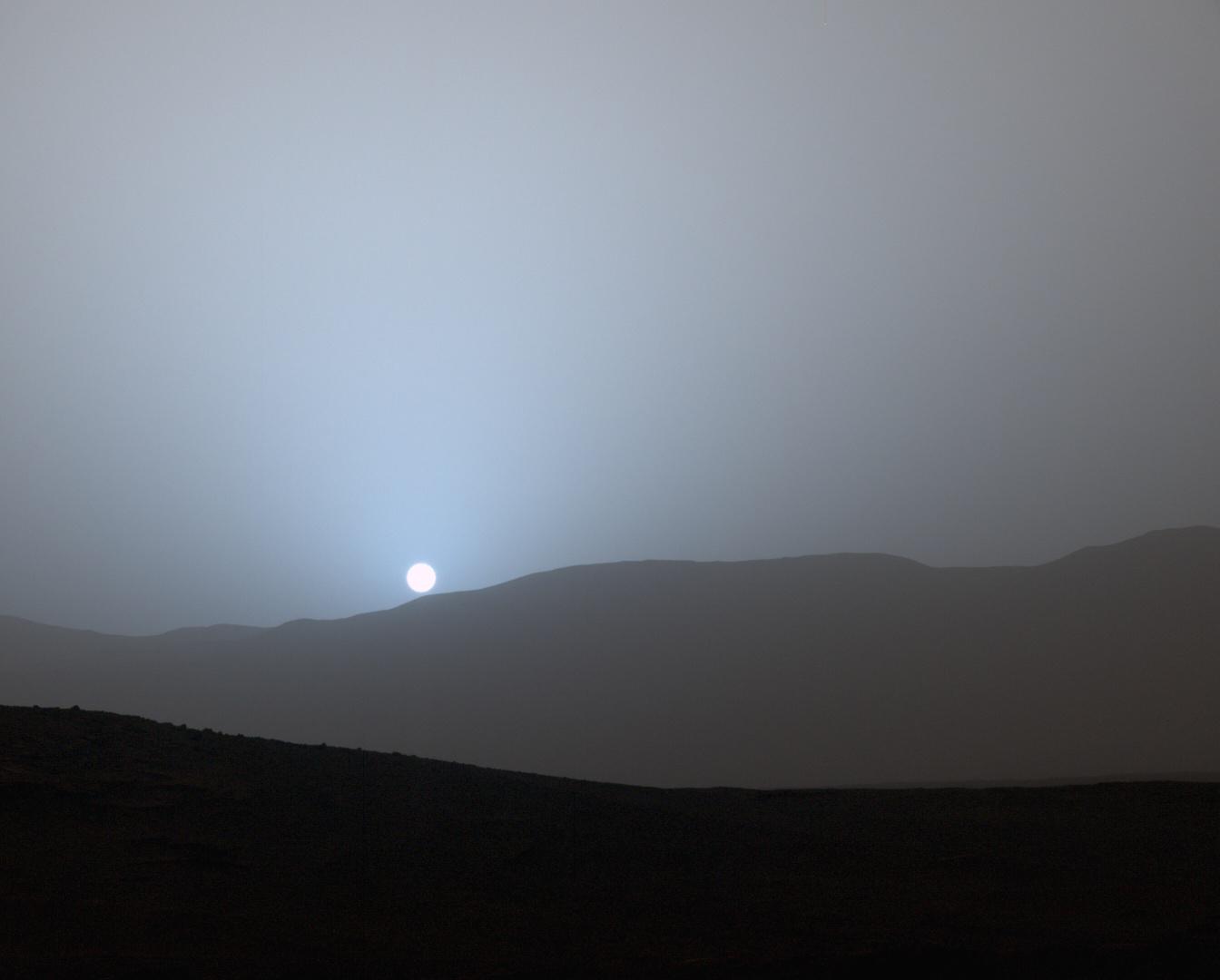 A Martian sunset — the sky turns from butterscotch to blue as the Sun sinks, a consequence of fine dust scattering light in the opposite way to Earth's atmosphere
A Martian sunset — the sky turns from butterscotch to blue as the Sun sinks, a consequence of fine dust scattering light in the opposite way to Earth's atmosphere: NASA/JPL — "Blue Sunset on Mars" · Curiosity Rover, Gale Crater
What we gain from the attempt — whether we land or not
The case for a Mars programme is not made only by what happens on Mars. It is made by what the attempt compels us to invent here.
Since the 1970s, NASA's Spinoff programme has documented thousands of technologies that began as engineering solutions for the hostile conditions of space and found their way into civilian life. The list is genuinely remarkable in its mundanity: wireless medical cameras and surgical arthroscopes derived from spacesuit battery technology. Cancer and COVID diagnostic tools developed from space biology research. Life-saving sutures whose material was originally engineered for Mars missions. Water recycling systems, closed-loop air filtration, aeroponics, robotic surgery, modern disc brake materials, fuel cells now entering terrestrial power grids. Even some formulations of toothpaste trace their origin to crystal-growing experiments for space electronics.
These are not lucky accidents. They are the predictable consequence of engineering under extreme constraint. When you cannot accept failure — because the person who needs the device is 225 million kilometres from the nearest repair shop — you engineer differently. You design for zero waste, total redundancy, radical miniaturisation, and autonomous function. Every requirement that makes Mars habitation technically necessary generates a category of innovation that eventually diffuses back through civilian life. The ISS alone has produced applications in protein crystal growth, combustion science, fluid dynamics, robotic surgery, and air purification. Mars — vastly more demanding — would produce vastly more.
There is also a harder scientific argument. Mars is geologically and climatically a brother world to Earth, which diverged from a possibly habitable state roughly 3.5 billion years ago. Understanding why Mars lost its magnetic field, why its oceans evaporated, why its atmosphere thinned to near-nothing, and whether microbial life persisted in subsurface refugia after the surface became hostile — these are not merely curiosity questions. They are planetary threat-assessment. Earth's own magnetic field, its climate systems, and its atmospheric chemistry are not guaranteed. Understanding what went wrong on Mars, in forensic geological detail, is one of the most valuable things we could do to understand the long-term habitability of our own planet. Perseverance's findings in Jezero Crater — an ancient river delta, organic molecules, sedimentary signatures consistent with past water flows — have already reframed what we know about Mars's early history. Human geologists on the surface, with sample return capability and the ability to make real-time judgements, would advance that science by decades in a single season.
Arguments in favour of Mars colonisation
- Species-level insurance: a second inhabited world cannot be wiped out by a single asteroid impact, pandemic, or civilisational collapse. The Chicxulub impactor that ended the Cretaceous would have been an inconvenience if humanity had been present on two planets.
- Technology spillover: extreme engineering requirements for Mars habitability generate broad-spectrum innovation in medicine, energy, food production, water management, and closed-loop systems — all of which are needed on a warming Earth.
- Planetary science: direct human investigation of Mars geology, climate history, and subsurface habitability provides irreplaceable data for understanding Earth's own long-term risks.
- Resource discovery: Mars is rich in carbon dioxide, water ice, iron, and possibly rare minerals. Understanding those deposits informs strategies for Earth resource management and future space-based manufacturing.
- Economic stimulus: the space economy was valued at over $420 billion globally in 2019 and has grown sharply since. A Mars programme drives manufacturing, engineering employment, satellite infrastructure, and entirely new industries.
- The Musk cost argument: at $25 billion per year over 40 years, the total colonisation cost is equivalent to roughly 1.5% of current annual global defence spending — a rounding error for a species-level insurance policy.
- Exploration as cultural engine: every great expansion of the human frontier — across oceans, into polar regions, to the Moon — has produced cultural and intellectual vitality that compounds far beyond the original mission. The frontier itself changes the people who commit to it.
Arguments against, or for a slower approach
- Opportunity cost: the World Bank estimates over 700 million people still live in extreme poverty. Investing $1 trillion in Mars colonisation rather than climate adaptation, renewable energy transition, or global health infrastructure represents a moral allocation choice that cannot be avoided by rhetoric about the long term.
- Climate urgency: researchers estimate that transitioning to renewables could avoid $5–10 trillion in climate damages by 2050. Diverting engineering talent and capital toward Mars while Earth's atmospheric systems are destabilising is a race run in the wrong direction, critics argue.
- Elite capture: a Mars colony built and controlled by a single private company raises profound questions about governance, access, and who decides the terms of the second Earth. There is no democratic mandate for SpaceX's definition of what a million-person Martian city should look like.
- Radiation risk: a round-trip Mars mission exposes crew to a minimum of 0.66 sieverts of radiation — substantially above the lifetime occupational limit for most nuclear workers, and a level associated with meaningfully elevated cancer risk. This is not an engineering problem with a known solution yet.
- Speculative returns: the assumption that spinoff technologies justify the investment requires a faith in unpredictable innovation that doesn't easily withstand cost-benefit analysis against direct Earth-side investment.
- The Musk track record: the 2026 target is the fourth or fifth time a major Mars milestone has been announced and missed. Investors are buying economic exposure without meaningful governance rights, at a valuation Morningstar analysts have rated as carrying "very high" uncertainty.
- The "escape hatch" critique: climate justice advocates argue that framing Mars as humanity's long-term survival plan enables the political and corporate imagination to treat Earth as expendable — to invest in exit rather than repair.
The numbers on the table
| Scenario / Estimate | Cost | Basis |
|---|---|---|
| NASA traditional model — first crewed Mars missionGovernment contracting, expendable systems | ~$500B | NASA Ames Research Center |
| NASA Artemis Moon programme through 2025Stepping-stone architecture | ~$93B | Congressional Budget Office |
| SpaceX full colonisation programme, pre-Starship cost structureCurrent $1B/tonne to Mars surface | $1,000T (theoretical) | Musk's own per-tonne mathematics |
| SpaceX full colonisation programme, post-StarshipIf 1,000× cost reduction achieved | ~$1T over 40 years | Musk estimate, X post 2024 |
| Avoided climate damages — renewable transition by 2050 | $5–10T saved | Seto et al. 2017 / climate economics literature |
| SpaceX IPO raise — June 2026 | $75B raised | Nasdaq SPCX listing prospectus |
| Annual global defence spending (2025) | ~$2.4T/year | SIPRI estimates |
The table above does not produce a verdict. It illustrates the scale of the choice. A full Mars colonisation programme at SpaceX's optimistic cost estimate is approximately forty times the annual NASA budget, and roughly equivalent to the global military spending of about six months. Whether that is outrageous or obvious depends entirely on how you value the insurance policy it represents.
Why the machines go before we do
Here is the part of the Mars plan that quietly changes the entire strategic calculus: the first inhabitants of Mars will not be human. They will be machines — and specifically, humanoid machines with autonomous AI decision-making built to survive in an environment where the communication delay from Earth ranges between 3 and 22 minutes each way. You cannot remotely drive a robot on a planet where your steering command arrives ten minutes after you sent it.
The Optimus variable — why bipedal robots are a strategic gamechanger
The choice of humanoid robots — rather than purpose-built Mars machinery — is not accidental. It reflects a core engineering logic: Mars infrastructure will be built from components designed for human hands, human-scale spaces, and human tools. A robot that can grip, lift, climb, open a door, and use a drill — tasks humans perform by instinct — can operate in a habitat built for human occupancy without requiring the entire base to be redesigned around robot morphology.
The critical challenge is autonomy. Optimus on Mars cannot wait for instructions from Earth. It will need to observe a broken pipe, assess structural risk, determine the correct repair sequence, and execute it — all before the 10-minute signal delay has passed once. Its AI will need to be trained not on warehouse floors or factory lines, as current Optimus deployments are, but on environments where every error carries a potential catastrophic consequence. Aerospace America's analysis of the SpaceX Mars programme notes the stark contrast between demonstration videos of Optimus in "well-prepared environments" and the raw, unpredictable, abrasive, electrostatically charged surface of Mars. The demonstration is not the Mars robot yet. But the trajectory from current capability to necessary capability is, in engineering terms, plausible within a decade.
This is, in its own right, a scientific prize of enormous value. Developing truly autonomous humanoid AI capable of independent multi-step problem-solving in an environment without any human oversight will produce the most capable autonomous AI systems in human history — and those systems will not stay on Mars. Every advance in Martian autonomy is an advance in terrestrial robotics: in surgery, in disaster response, in industrial safety, in elder care. The most cognitively demanding AI training environment imaginable is, by definition, also the most productive forcing function for AI capability we could design.
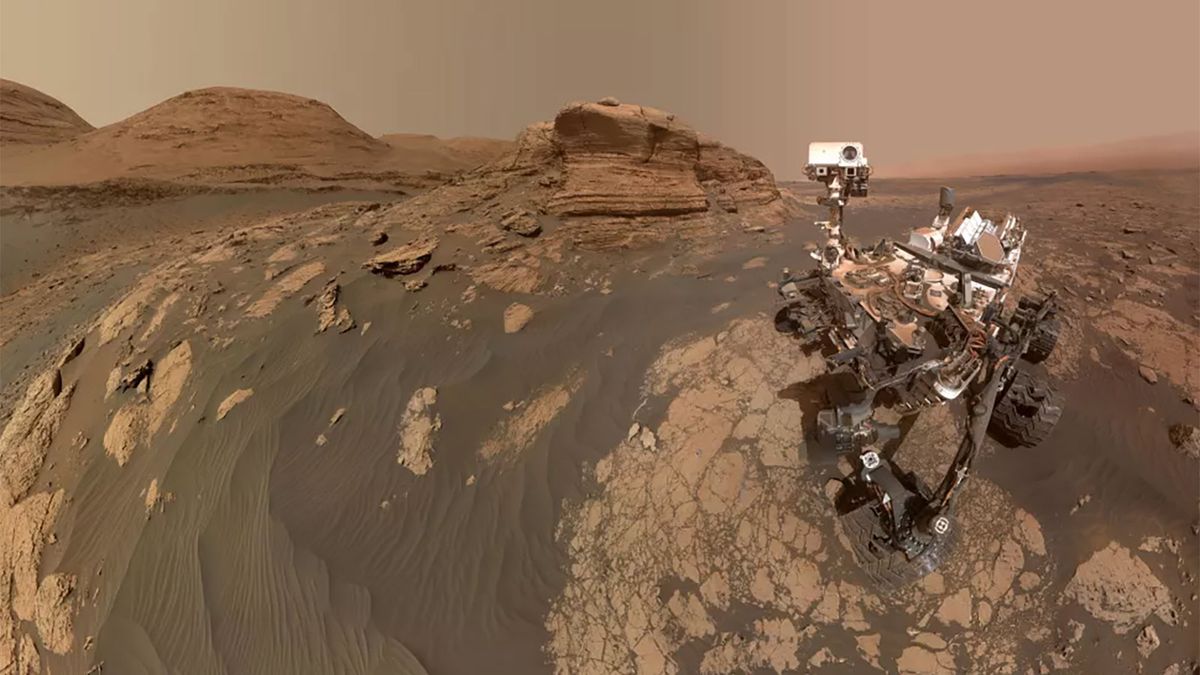 Mars rover — the autonomous geological field agents that have been our surrogates on the Martian surface since 1997, returning 5 terabytes of data and rewriting our understanding of planetary history
Conquest is in our DNA — and so is the cost of it
There is something worth saying plainly about the deeper impulse behind all of this, because it is neither new nor purely rational, and pretending otherwise produces a dishonest argument.
Human beings have been crossing every frontier they could find for as long as they have existed. The earliest anatomically modern humans walked out of Africa and into Asia and Europe in conditions that make Mars look merely inconvenient. The Polynesian navigators who crossed the Pacific in outrigger canoes, navigating by stars and wave patterns and the behaviour of birds, were making journeys of thousands of kilometres into waters they knew could kill them and very often did. The Elizabethan and Portuguese seafarers who mapped the ocean basins did so on ships carrying diseases that would kill half their crews, in the certain knowledge that many would not return. The first mountaineers did not calculate the economic return on summiting Everest. Scott and Amundsen did not go to Antarctica because the supply chains looked sustainable.
These were not irrational acts. They were expressions of something that appears to be structurally embedded in human cognition: the drive to know what is beyond the visible edge, and the willingness to pay an extraordinary cost to find out. Every one of those explorations produced catastrophes and tragedies. And every one of them changed the world — not always in the ways the people who funded them imagined, but in ways that compounded across centuries.
The argument that this drive should now be suppressed in favour of a rational allocation of resources to known problems — while coherent as economics — has never actually characterised how human civilisations operate at their most generative. The Apollo programme was not an efficient allocation of Cold War defence spending. It was an act of collective imagination that produced GPS, kidney dialysis, scratch-resistant lenses, memory foam, digital image sensors, and the first generation of miniaturised electronics that eventually gave us the modern computer. These were not the things NASA was trying to build. They were the debris of an attempt at something much more audacious.
"The solar system can support a trillion humans. A trillion humans would have a thousand Einsteins, a thousand Mozarts, and for all practical purposes unlimited resources."
— Jeff Bezos, Blue Origin, 2021The question before our generation is not whether exploration is in our nature. It clearly is. The question is whether we can do it responsibly — with enough honesty about the costs, enough genuine accountability for the people left behind, and enough structural commitment to ensuring that the knowledge gained by the attempt returns genuine benefit to the billions of people who will never leave this planet.
The exploration timeline: what the data says about where we actually are
The honest verdict
The data does not produce a clean answer. It produces a set of genuine tensions that a civilisation has to decide, collectively, how to weigh.
Going to Mars is not free. It is not consequence-free. The resources required are real, the opportunity costs are real, the risks to early crews are real, and the history of Musk's timelines is a pattern that deserves respect as evidence, not dismissal as cynicism. The people who argue that $1 trillion over forty years would save more lives if directed at climate adaptation, malaria eradication, or clean water infrastructure are not wrong — as a matter of arithmetic, they are almost certainly correct. The counterargument is not that they are wrong. It is that civilisations do not actually work that way, and that the choice is rarely as binary as the framing suggests.
The Apollo programme cost roughly $25 billion in 1960s dollars — approximately $260 billion today — and it was funded during a decade when millions of Americans lived in poverty and the Vietnam War was consuming comparable resources. Nobody seriously argues today that the Moon programme was the wrong choice, because its consequences extended so far beyond the mission itself that the original moral accounting was simply the wrong unit of measurement.
The case for Mars is ultimately a case about the length of your time horizon. In the short term — the next decade, the next generation — the opportunity cost argument is powerful and deserves to be heard without condescension. Seven hundred million people in extreme poverty is not an abstraction. A destabilising climate is not a distant risk. These demand investment, urgency, and moral seriousness that a Mars programme cannot replace.
In the long term — the next century, the next millennium — the calculus reverses. A species that occupies one planet is vulnerable in ways that a species with two planets is not. The knowledge generated by the attempt will flow back through every human institution it touches. The technology required to keep people alive on Mars will be the same technology required to keep people alive on a warming, resource-stressed Earth. And the act of reaching another planet — of building a city on a world that has no mercy for human error — will change what it means to be a human being in ways we cannot predict and should not try to contain.
The window opens in November. Whether the rockets light on schedule, whether they arrive intact, whether the robots roll out onto the dust and begin the work — none of that is certain. But the weight of the attempt, the commitment of a company worth $2 trillion, and the legal binding of a CEO's fortune to the survival of a human city on another world — that is already a different world than the one we woke up in last year.
Two hundred thousand years of this species on one rock. The next chapter is being written now, in fire and rust and the soft hum of bipedal machines preparing to walk where no living thing has walked in three and a half billion years.
That seems worth the attempt.
Sources and data references: Space Daily (June 2026), NASA Ames Research Center Mars cost estimates, SpaceX S-1 Registration Statement (SEC, May 2026), CNBC IPO coverage, CNN Business IPO reporting, PBS NewsHour/AP, Fortune, Aerospace America/AIAA Mars programme analysis, NASA Spinoff 2024 publication, PMC — "Space exploration as a catalyst for medical innovations" (2023), PMC — "Towards sustainable horizons: A comprehensive blueprint for Mars colonisation" (2024), Seto et al. (2017) climate adaptation economics, World Bank extreme poverty data (2024), SIPRI global defence spending estimates, Musk / X posts on Mars timeline and cost (2024–2026), Digital Trends, Newsweek, Benzinga (Musk Mars cost mathematics).
 Buy me a coffee