A payslip is a small, dull piece of paper. Gross pay at the top. Tax withheld. In Australia, a line for superannuation, 12% of ordinary earnings since July 2025, quietly buying the worker a sliver of the country’s companies. Net pay at the bottom. Most people glance at the last number and throw the rest away. But the slip records something it never prints: that somebody needed you. An employer, and behind the employer an entire economy, could not run this fortnight without your hands or your judgement. That need is the oldest lever ordinary people have ever held. This is an article about what happens when it lets go.
The Thread Starts Loosening
It doesn’t unravel all at once. It starts at the edges, with the people who haven’t been hired yet.
In August, Erik Brynjolfsson, Bharat Chandar and Ruyu Chen at Stanford’s Digital Economy Lab updated their study of ADP payroll records, the monthly pay data of millions of American workers. Their finding: employment for 22-to-25-year-olds in the occupations most exposed to AI now sits about 19% below where it would be had it kept pace with young workers in less-exposed jobs. A year earlier the gap was 15%. The damage runs mainly through hiring that never happens rather than firings, and it concentrates in roles where AI automates the task instead of assisting the person doing it. Experienced workers show no comparable gap, and the authors are careful to say there’s no sign of economy-wide displacement.1 Not yet a flood. A tide line.
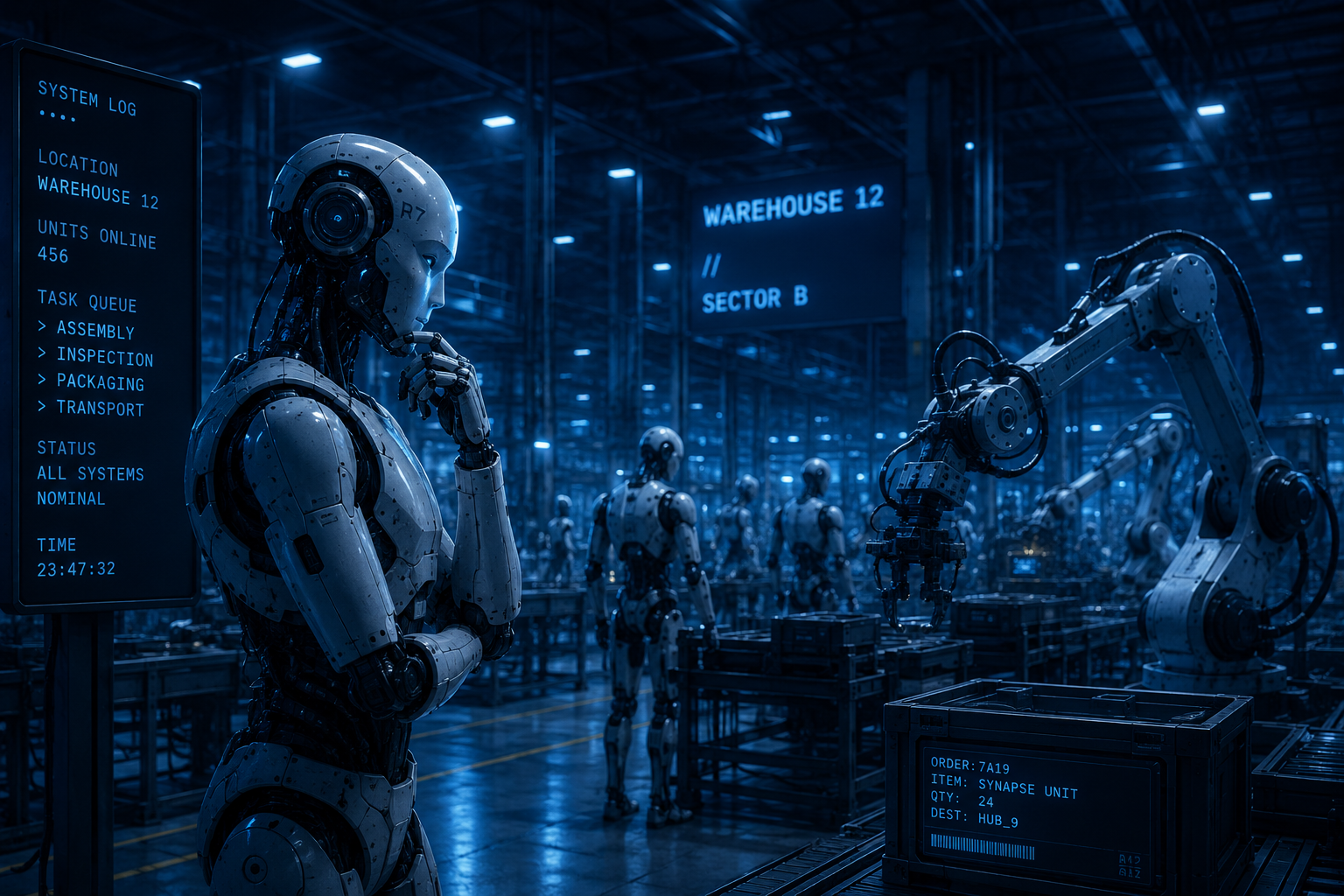
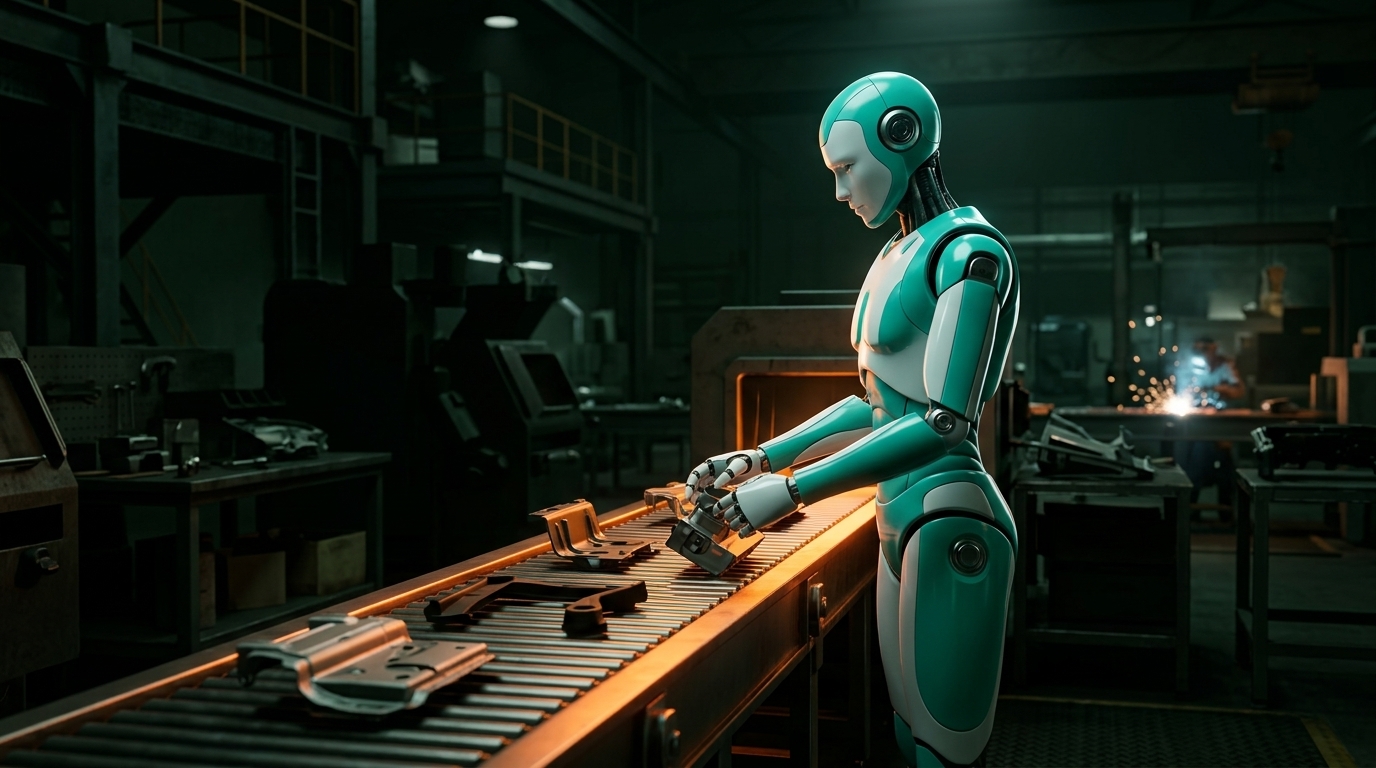
The global picture is wider and blurrier. The International Labour Organization’s 2025 index put one in four jobs worldwide in occupations with some exposure to generative AI, rising to 34% in high-income countries, while stressing that exposure means transformation far more often than replacement.2 On the physical side, the humanoid robots we covered in After the Job are moving from pilot lines into warehouses and car plants. Knowledge work and manual work are being approached from both ends at once, which has never happened before. The Industrial Revolution came for muscle. The computer came for routine clerical work. This wave is coming for judgement and muscle in the same decade.
The people building the systems have stopped pretending otherwise. In May 2025 Anthropic’s chief executive, Dario Amodei, told Axios that AI could wipe out half of all entry-level white-collar jobs and push unemployment to 10–20% within one to five years. He also floated a fix: perhaps 3% of every dollar an AI company earns from its models should go to the government to be redistributed. “Obviously, that’s not in my economic interest,” he said. “But I think that would be a reasonable solution to the problem.”3 Whether his timeline proves right or wrong, a frontier-lab CEO proposing a tax on his own revenue was a signal.
Then, on 13 July 2026, the economists moved. Stanford’s Digital Economy Lab published a four-sentence statement titled We Must Act Now. It warns that AI “may become radically more powerful over the next 10 years” and could drive a transformation of the economy “larger than the Industrial Revolution, but unfolding over a vastly shorter time frame.” Its signatories include Daron Acemoglu, Joseph Stiglitz, Paul Krugman, Ben Bernanke and Philippe Aghion among 16 Nobel laureates, and the list has since grown past 600 names.4 The statement proposes no policy. It asks for “incentives, guardrails, and institutions” and leaves the blueprint blank. Other people have started drawing it.
Figure 1 · The year the labour transition became a policy question, 2026
The Leash We Never Noticed
Most talk about AI and jobs treats the problem as a question of fairness. Who gets the money? It’s a real question. But a paper published in January 2025 by Jan Kulveit, Raymond Douglas, Nora Ammann, Deger Turan, David Krueger and David Duvenaud argues it is also a question of survival, and it is the clearest link anyone has drawn between a lost payslip and the phrase “existential risk.”5
They call it gradual disempowerment. The argument goes like this. Every large system that shapes our lives (markets, states, cultures) stays roughly pointed at human interests for two reasons. The first is explicit: we vote, we buy, we protest. The second is implicit, and we almost never think about it. These systems run on us. A government needs taxpayers and soldiers. A company needs workers and customers. That dependence keeps them honest in ways no law could, because a system that starves the people it runs on stops running.
Now remove the dependence. If AI systems can do the labour and the cognition, the implicit channel goes quiet. A state funded by taxes on AI firms doesn’t need a healthy, educated population the way a state funded by income tax does. A company whose output comes from agents doesn’t need to keep its customers’ neighbours employed. No one has to turn against humanity for this to go badly. Each step can be locally sensible, cheaper and faster. The paper’s authors warn the endpoint could be “an effectively irreversible loss of human influence over crucial societal systems.”5
The significance of the implicit alignment can be hard to recognize because we have never seen its absence.
Jan Kulveit et al. · “Gradual Disempowerment,” arXiv · January 2025
This is why the dramatic image of extinction (a rogue superintelligence, a switch nobody can reach) may be the less likely failure. The quieter one looks like a world where humans are fed, housed and entertained, but have become decorative. Kulveit’s team is blunt about the economics: without “unprecedented changes in redistribution,” a falling labour share becomes a structural fall in household spending power, “as humans lose their primary means of earning the income needed to participate in the economy as consumers.”5
Split everything an economy earns into two piles: what goes to people for their work (wages, salaries, super) and what goes to the owners of capital (profits, rents, dividends). The first pile is the labour share. When machines do more of the work, output can soar while the labour pile shrinks, because the earnings flow to whoever owns the machines.
So the real question isn’t whether AI makes the world richer. It’s which pile the richness lands in, and whether the people in the shrinking pile still have any way to change that.
Put those two ideas together and the frame shifts. Wealth distribution stops being a charity question bolted onto AI safety. It becomes part of AI safety. A civilisation that shares the gains keeps humans holding at least some of the reins. One that doesn’t may find that its alignment problem was never only about the machines.
A Toolkit Drawn in Pencil
Universal basic income gets most of the attention, and its history (from 1795 Speenhamland to the Kenyan cash trials) is its own story, told in The Income Floor. But a monthly cheque is only one tool. The most useful map of the others comes from Deric Cheng and Jacob Schaal, writing in AI Frontiers in June. They split the transition into three phases, each building the plumbing for the next.6
Phase one: cushion the shock
The near-term tools already exist, and one has been tested at national scale. Germany’s Kurzarbeit (“short work”) scheme lets firms cut hours instead of staff, with the state replacing 60% of the lost pay as standard. In the first two months of the pandemic, applications covered more than 10 million workers, about a fifth of the German labour force, and the IMF credits it with keeping people attached to their jobs through the shock.8 Cheng and Schaal list it alongside wage insurance (topping up pay for workers forced into lower-paid jobs), expanded unemployment benefits, reskilling and a public job guarantee.6
OpenAI’s April blueprint adds a clever twist: pre-agreed triggers. Governments would define displacement metrics in advance, and a package of expanded safety nets would switch on “automatically when these metrics exceed pre-defined thresholds.”7 No emergency legislation, no months of argument while households drain their savings. It’s the policy equivalent of a sprinkler system.
Phase two: follow the money
Welfare states are mostly funded by taxing wages. If wages shrink as a share of the economy, so does the tax base that pays for pensions, hospitals and the safety net itself. The medium-term tools therefore move the tax onto whatever is growing. Cheng and Schaal list consumption taxes, globally coordinated corporate taxes and “token taxes” on leading AI companies, which is essentially Amodei’s 3% idea with a name.6 OpenAI’s paper suggests “exploring new approaches such as taxes related to automated labor,” plus benefits that travel with the worker rather than the employer: portable accounts for healthcare, retirement and training.7
The same phase also redistributes something other than money. Time. OpenAI proposes employer and union pilots of a 32-hour, four-day week “with no loss in pay” that hold output constant.7 If a machine makes each hour of human work more productive, the gain can arrive as a smaller workload instead of a smaller workforce.
Phase three: own the machines
Here the ideas get large. If labour stops being the main way ordinary people accumulate wealth, Cheng and Schaal write, “core aspects of the social contract may break down.”6 The long-term answer on almost every list is ownership: give citizens a direct stake in the capital that does the work. Universal basic capital, sovereign wealth funds holding AI equity, even international dividend funds for all of humanity.
The boldest version is now a bill. Senator Sanders’ American AI Sovereign Wealth Fund Act would impose a one-time levy of 50% of the outstanding equity of companies with at least $200 million a year in revenue from AI data centres, computing infrastructure, AI services or advanced robotics, paid in shares. An independent seven-member commission would run the fund and pay out 5% of its value each year for direct payments and other measures. At current valuations his office puts the fund at about $7 trillion, enough, it says, for “more than $1,000” a year to every American.9 “When a public resource generates wealth, the public should share in that wealth,” Sanders said.9 Fortune reported that polling in June found 70% of Americans backed forcing AI firms to share stock with a sovereign fund, and that Vice President JD Vance had signalled openness to government stakes in AI companies.11
The models already exist, in miniature. Alaska has paid every resident a share of its oil fund for decades; the 2025 dividend was $1,000.12 Norway’s Government Pension Fund Global, built from North Sea oil, was worth 22,683 billion kroner at the end of June 2026.13 And Australians hold a version already: compulsory super has built a A$4.8 trillion pool, as of June 2026, that gives most workers a slice of the stock market.16,17 That last example contains a warning, though. Super is bolted to the payslip. Contributions are a percentage of wages, so if wages thin out, so does the one mechanism that already hands ordinary Australians a share of capital. Any ownership plan for the AI era has to cut that link.
The critics have sharp points. Writing in World Politics Review, Candace Rondeaux noted that the most durable AI wealth may sit not in today’s model companies but in compute, energy and physical infrastructure, just as the internet’s winners turned out to be Google rather than Netscape or AOL. Her sharpest line: “Alaska’s fund was capitalized by oil that had already been discovered. His AI fund would be capitalized by an estimate of wealth that does not yet exist.”10
An older idea tries to dodge that problem by waiting for the wealth to exist first. In 2020, Cullen O’Keefe and colleagues at the Centre for the Governance of AI proposed the Windfall Clause: a legally binding pledge by AI firms, signed in advance, to give away a rising share of any truly extraordinary profits.14 Nothing is owed unless a company becomes astonishingly rich, measured against the whole world economy.
Then there’s the option that skips cash entirely. In 2017, University College London’s Institute for Global Prosperity costed universal basic services for the UK: free social housing for 1.5 million households, food for 2.2 million food-insecure households, free local buses, and basic phone and internet access. Price tag: £42 billion, about 2.3% of GDP. A basic income at jobseeker rates, by their estimate, would have cost just under £250 billion, around 13%.15 Services are cheaper because they buy things in bulk, and harder to erode because a bus route is more visible than a cheque quietly shrinking with inflation.
| Tool | What people get | Funded by | Main weakness |
|---|---|---|---|
| Kurzarbeit / wage insurance | Kept jobs, topped-up pay | Payroll & general tax | Built for temporary shocks, not permanent loss of work |
| Automatic triggers | Benefits that switch on by rule | Pre-committed budgets | Needs trusted displacement metrics |
| Token / automation tax | A funded state | AI revenue or “automated labour” | Hard to define; firms can relocate |
| 32-hour week | Time | Productivity gains | Helps those still employed |
| Universal basic income | Cash for all | Tax | Expensive; says nothing about ownership |
| Universal basic services | Housing, transport, food, internet | Tax | Doesn’t cover every need; state as provider |
| AI sovereign wealth fund | Dividend + collective ownership | Equity from AI firms | Values future wealth that may land elsewhere |
| Windfall Clause | Share of extreme profits | Voluntary binding pledge | Only bites if a firm becomes astonishingly rich |
Figure 4 · The toolkit at a glance. Sources: Cheng & Schaal; OpenAI; IMF; UCL IGP; Sanders; O’Keefe et al.6–10,14,15
Read down the last column and a pattern shows. Every tool works best in combination, and every one assumes something that doesn’t exist yet: a way to measure displacement fast enough, a tax base that can’t flee, a stake in wealth before we know where it pools.
What the Paper Can’t Print
Go back to the payslip. Imagine the one someone in their twenties might hold in 2040, if the most generous plans on the table all passed.
Figure 5 · A thought experiment, not a forecast. All figures invented for illustration.
Fewer hours. A wage, still. A dividend line from a shared fund. A services credit. A safety net that stayed dormant because the triggers weren’t hit. That’s a decent document. Many people alive today would trade theirs for it.
But notice what’s missing. None of those lines says the system needs this person. Every one of them arrives because an institution decided to send it, and institutions can decide differently. This is the deepest point in the gradual-disempowerment argument, and it’s why the paper’s proposed remedies read less like an economics textbook than a civics one: measure how much influence humans are losing, system by system; limit excessive AI influence through regulation and taxation; strengthen democratic processes and institutional design so human voice doesn’t depend on human usefulness.5
So co-existence has at least three layers, and money is only the first. Income keeps people fed through the transition. Ownership gives them a claim on the machines rather than a gift from them, which is why sovereign funds, universal basic capital and windfall pledges matter more over time than any cheque. Voice is the hardest: democratic institutions sturdy enough that the people still steer when they no longer do the work. Underneath all three sits the technical project the rest of this site keeps returning to, making sure the systems themselves pursue what we actually want (see The Alignment Gap). A perfectly obedient AI owned by a handful of firms would still leave most of humanity with nothing to bargain with.
Amodei’s image for all this was a train: you can’t stop it by standing in front of it, he said, so “the only move that’s going to work is steering the train.”3 The steering is what these proposals are really about. Sanders’ fund, OpenAI’s triggers, the windfall brackets, the free bus route. Each is an attempt to wire new controls into the cab before the old ones, our labour, our being needed, go slack.
None of it is inevitable, in either direction. The Stanford gap is 19%, not 90%. The ILO still expects transformation more than replacement. There is time, and in 2026 there are finally blueprints. The question is whether we sign them while the payslip still carries weight. Because the last one, whenever it comes, will look like every other. Gross pay at the top. Net pay at the bottom. And somewhere in the white space between, the quiet fact that for all of human history, the world has needed us. We should decide what replaces that fact before it expires.
 Buy me a coffee