The Body Electric
On April 19, 2026, a Chinese robot crossed the finish line of a half-marathon seven minutes faster than any human ever has. What that race reveals about how machines learned to move — and what comes next.
Thousands of humans and more than a hundred machines lined up in Beijing's Yizhuang district on the morning of April 19, 2026. The machines were in their own lane, which was, in retrospect, appropriate — because they were about to leave every human on the course behind.
The robot that won was built by Honor, a Chinese smartphone manufacturer that entered the robotics race the way a lot of Chinese technology companies have lately: abruptly, ambitiously, and with striking results. Its machine — nicknamed Lightning — stood on legs 95 centimeters long, equipped with a liquid cooling system largely developed in-house. It crossed the finish line of the 21-kilometer half-marathon in 50 minutes and 26 seconds. Jacob Kiplimo, from Uganda, holds the human world record: 57 minutes flat, set in Lisbon in March 2021. Lightning beat it by more than six minutes.
The crowd that had gathered along the route was, by multiple accounts, stunned. Not just by the time, but by something harder to quantify — the quality of the movement. The gait was not perfect, not quite human in its fluidity, but it was recognizably running. There was swing, there was lean, there was what the engineers would later call "coordinated dynamic balance." When the robot's left leg lifted behind it, the right arm swung forward. When it hit a slight incline, the torso adjusted. This is what six years of intensive reinforcement learning in simulated physics engines looks like when it finally comes outside.
Why Running Is the Hard Problem of Physical AI
For most of computing history, the intuition has been backwards. We assumed that the things that felt effortless — walking, catching a ball, threading a needle — would be trivially easy to automate, while the things that required years of study, like chess or radiology, would remain uniquely human. Hans Moravec, the roboticist, identified this inversion in the 1980s, and it became known as Moravec's Paradox: the things that feel easy to us encode billions of years of evolutionary refinement and are genuinely difficult to replicate in silicon.
Running is the most demanding version of the locomotion problem. Unlike walking, where at least one foot is always on the ground, running involves periods of complete aerial suspension. The body is falling forward, then catching itself with one leg while the other swings through. A human runner at marathon pace is constantly making micro-corrections across dozens of joints — ankle, knee, hip, spine, shoulders — many of them unconscious, handled by the spinal cord's reflexive architecture before the signal ever reaches the brain. To train a robot to do this requires either years of hand-tuned control theory, or enough simulated experience to develop something like the reflexes directly.
The modern approach is almost entirely the latter. Teams build physics simulations that run thousands of times faster than real time, put their robot models through billions of simulated footsteps, and use reinforcement learning to develop policies that generalize across terrain variations, wind, and unexpected perturbations. When the robot graduates from simulation to the physical world, it carries those policies in its onboard neural network — running inference at hundreds of hertz, adjusting torque commands to each motor before any human feedback loop could intervene. This is what makes the Beijing result significant. It is not a controlled demonstration. The robots ran 21 kilometers through real Beijing air, over real pavement, in real wind, past real crowds.
The Architecture of Lightning
Honor has not published a detailed technical paper on Lightning's design, but from the specifications released to race organizers and subsequent interviews with the development team, a picture emerges. The robot stands 1.72 meters tall and weighs 57 kilograms — lighter than the average adult male, which matters because every gram of mass requires torque to accelerate. Its legs account for 95 centimeters of that height, well above the human proportion, and were designed explicitly to maximize stride length at speed. Longer legs mean fewer steps per kilometer and less actuator wear over a 21-kilometer run.
The liquid cooling system was, according to the engineers, the breakthrough that made the record possible. The motors in humanoid robots generate substantial heat under sustained load, and thermal throttling — when a motor reduces power to prevent damage — is the invisible enemy of endurance performance. Honor's in-house cooling circuit runs coolant through the actuators in the hips and knees, the joints under the greatest sustained load. The robot completed the race without a single thermal event.
"We didn't design Lightning to beat the human world record. We designed it to run 21 kilometers without falling over. The record was a side effect of solving the endurance problem."— Honor Robotics engineering team, post-race briefing, April 2026
One Hundred Teams, One Year
The scale of the 2026 race is itself a data point. The previous year's Beijing humanoid marathon drew roughly 20 teams, and the winner finished in two hours and 40 minutes — almost twice the human marathon record rather than better than the human half-marathon record. In a single year, the participating teams increased fivefold and the winning time dropped by more than half. This is not incremental progress. It is the characteristic acceleration of a technology that has found product-market fit.
The commercial numbers tell the same story. AgiBot, a Chinese humanoid manufacturer, produced its 1,000th unit in 2025. By late March 2026, it had produced its 10,000th — a tenfold increase in roughly eight months. Boston Dynamics committed its entire 2026 production run of the electric Atlas humanoid to Hyundai and Google DeepMind. BMW reported in April that its two Figure AI robots had contributed to the production of more than 30,000 BMW X3 vehicles at its Spartanburg plant over 11 months, loading more than 90,000 sheet metal components. Japan Airlines announced a three-year commitment to Unitree Robotics-based humanoids at Tokyo's Haneda Airport.
These are not pilot programs. These are manufacturing decisions, with multi-year timelines and major financial commitments. The question of whether humanoid robots could be practically deployed has been answered. The remaining questions are about reliability, maintenance cycles, edge case handling — the long tail of practical problems that only surface at scale.
"The race is a show. But what's behind the race — the supply chains, the production floors, the airport corridors — that's the real story."— IDC Humanoid Robotics Commercialization Report, 2026
China, the United States, and the Physical AI Race
It is tempting to read the Beijing result as a geopolitical scorecard, and the temptation is not entirely misplaced. Chinese companies — AgiBot, Unitree, Fourier, Honor, UBTECH — have collectively accelerated faster than any other national cluster in humanoid manufacturing. They benefit from a domestic supply chain for motors, sensors, and actuators, and from government procurement signals that reduce commercial risk. The Beijing race, held in Yizhuang — a technology development zone in Beijing's south — was not merely a sporting event. It was a demonstration of capability to an audience that included investors, policymakers, and international buyers.
But the American position is more complicated than a simple narrative of being overtaken would suggest. Boston Dynamics, despite being owned by Hyundai, remains a technology leader in legged robot dynamics. Figure AI and Agility Robotics have secured major commercial contracts. And NVIDIA's Physical AI research program, which provides the simulation infrastructure that underlies many of the world's top robotics training pipelines, runs largely on American hardware and software. The locus of production may be shifting, but the locus of the fundamental science has not clearly moved.
The 38 Percent Problem
The most honest number from the Beijing race is the one that got the least attention. Thirty-eight percent of the 2026 entries ran fully autonomously. The majority were piloted remotely by human operators — watching camera feeds and sending movement commands over wireless links. The winning robot ran on its own. So did a meaningful fraction of the others. But more than half still needed a human in the loop to navigate a flat, well-marked urban course on a calm spring morning.
This is not a failure. It is a frontier. The gap between demonstration capability and reliable autonomy is exactly where most of the hard engineering in physical AI is happening. The problem is not speed — it is the long tail of edge cases: an unexpected piece of debris, a wet patch of road, a course marshal stepping into the lane. Human reflexes handle these automatically. Robot perception-and-control pipelines, trained on smooth physics simulations, can fail in ways that are sudden and undignified.
The researchers and engineers who watched the race know this better than anyone. The 38 percent figure will almost certainly be higher next year. The question is how close to 100 it needs to be before the machines are trusted in the environments where it matters most: the factory floor, the hospital corridor, the household. The Beijing course may be a proxy for progress, but the real test is always quieter, and harder, and far less photographed.
What the Body Knows
There is a philosophical subplot running underneath the robotics numbers. As machines become better at moving through the world, they begin to accumulate something that looks like embodied understanding — a relationship to physical space and momentum and consequence that has historically been the province of animals. We do not yet know whether this kind of physical competence generates something like awareness. But we do know that it generates something like skill: an ability to handle the unexpected that cannot be fully specified in advance, that must be learned through accumulated experience rather than programmed through explicit rules.
The robots in Beijing did not know they were racing. They had no experience of the cheering crowd, no sense of personal achievement when they crossed the line. But their legs knew something about the road — about weight transfer and ground reaction force and the geometry of a banked curve — that no engineer explicitly taught them. They discovered it in simulation, across billions of training steps, and carried it with them into the world. Whether that constitutes knowledge in any meaningful sense is a question for philosophers. The engineers are busy on the next version.
The global market for physical AI is projected to grow from $1.5 billion in 2026 to more than $15 billion by 2032 — a compound annual growth rate of 47 percent. Those numbers are extrapolations, as all such numbers are, and they will certainly be wrong in their specifics. But the direction seems clear. The machines are learning to move. And they are learning faster than anyone predicted.
Sources
- NPR: A humanoid robot sprints past the human half-marathon world record in Beijing race (April 2026)
- Scientific American: What did the Beijing robot race actually prove? (April 2026)
- Smithsonian Magazine: A Humanoid Robot Just Beat the Human World Record (April 2026)
- Al Jazeera: Humanoid robot breaks half marathon world record in Beijing (April 2026)
- NBC News: Robot breaks human half-marathon world record in China race (April 2026)
- PBS NewsHour: Humanoid robot wins Beijing half-marathon (April 2026)
- KraneShares: Humanoid Robotics in 2026 — The Race From Pilot to Platform
- Memeburn: Physical AI Is Sending Humanoid Robots to Real Factory Floors in 2026
- NVIDIA Blog: National Robotics Week — Latest Physical AI Research (2026)
- Medium: Humanoid Robots in 2026 — Where the Industry Actually Stands
- IDC: From Task Execution to Value Creation — What the 2026 Humanoid Robot Half Marathon Reveals
- Loona Blog: Humanoid Robot Updates 2026 — Latest News, Breakthroughs, and Industry Trends
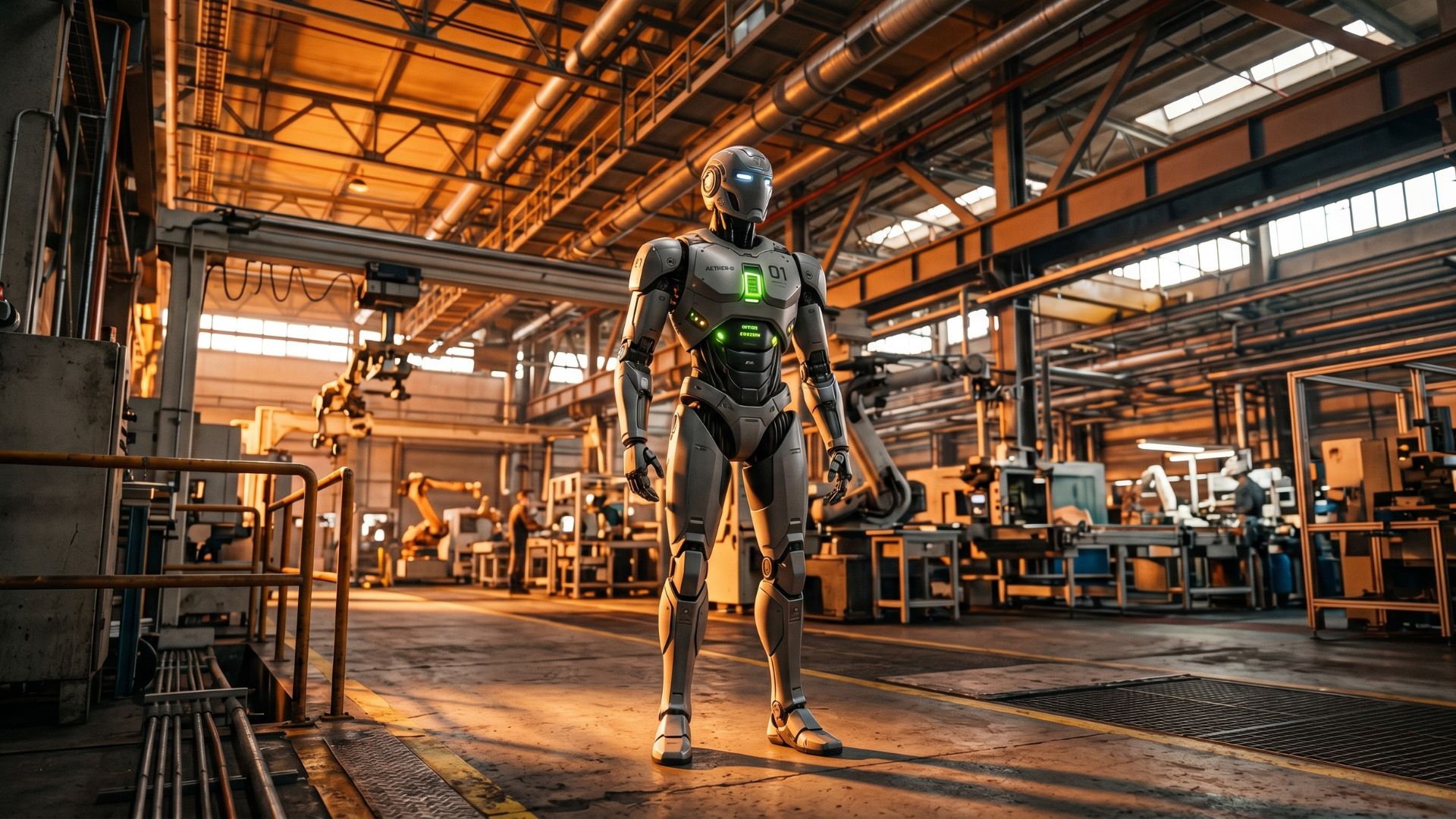
The Iron Workers
Humanoid robots are entering the workforce — not as science fiction, but as a measured deployment across factories, warehouses, and hospitals.

Worldview
Inside AI's race to build machines that truly understand the physical world — not just describe it.

The Safety Reckoning
The European AI Act is live. The labs are scaling. What happens when the rules and the technology move at different speeds?
The Brain Twin
Meta built an AI model that can predict thoughts from brain scans. What does it mean when a machine knows what you're thinking before you say it?

After the Transformer
The transformer dominated a decade of AI. The architectures that may replace it are already running in research labs.
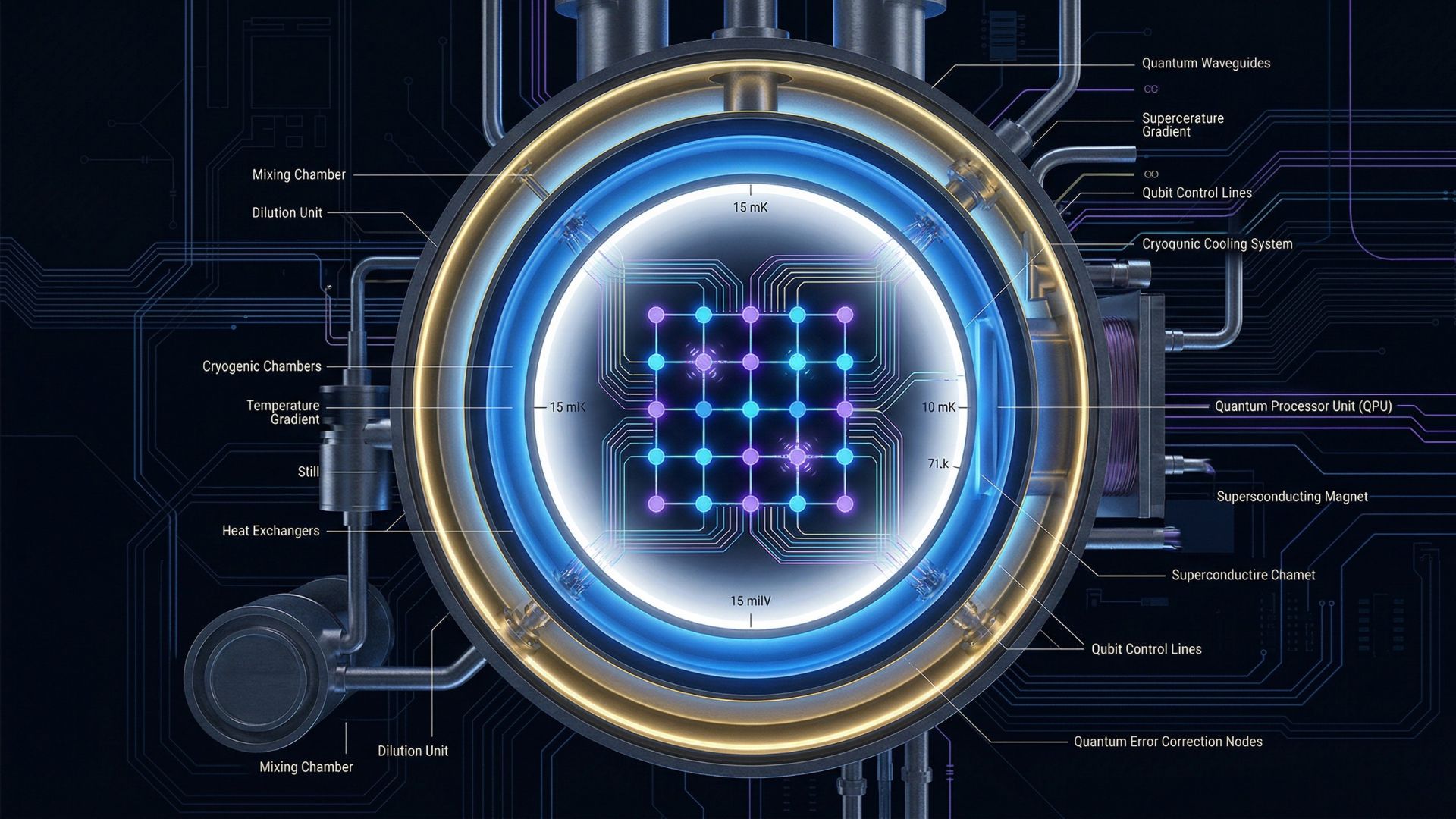
The Quantum Threshold
Fault-tolerant quantum computing crossed a threshold. Here's what changes when the machines stop being wrong.
 Buy me a coffee