Ask most Western readers what China thinks about artificial intelligence and you'll hear one of two answers. China is building the ultimate surveillance state. Or China is sprinting to overtake America in a race for the most powerful technology ever made. Both answers have real evidence behind them, and both have been repeated so often that they now pass for a Chinese point of view. They aren’t one. They’re what the West sees when it looks at China. To hear what Chinese writers, investors and philosophers actually imagine, you have to read their books, and those books disagree with each other far more than the West’s picture of China allows.
A Race With One Finish Line
Start with the case for the familiar story, because it’s a strong one.
On 20 July 2017, China’s State Council published its New Generation Artificial Intelligence Development Plan. It didn’t hedge. By 2030, it said, China’s AI theories, technologies and applications should reach world-leading levels, “making China the world’s primary AI innovation center,” with a core AI industry worth more than 1 trillion yuan.7 Few national technology plans put a date and a podium position in writing. Western analysts read it as a declaration of intent, and they weren’t wrong to.
The following year, one of the most influential books about Chinese AI arrived from inside the industry. Kai-Fu Lee, a Taiwan-born computer scientist who had run Google China before becoming a Beijing venture capitalist, published AI Superpowers: China, Silicon Valley, and the New World Order. His most quoted line fed straight into the race narrative: “If data is the new oil, then China is the new Saudi Arabia.”8 China, he argued, had more data, fewer privacy constraints, a fiercer startup culture and a government willing to spend. Foreign Affairs criticised the book for zero-sum thinking. It became required reading anyway.
By the 2020s the Western shelf had settled on its frame. In October 2023, Henry Kissinger and Graham Allison wrote in Foreign Affairs that “at this moment, there are just two AI superpowers: the United States and China.”6 Allison had already given the relationship a name in his 2017 book Destined for War: the Thucydides Trap, the danger that arises when a rising power threatens to displace a ruling one.
Then the frame hardened. In June 2024 Leopold Aschenbrenner, a former OpenAI researcher, published Situational Awareness, a long essay that circulated through Silicon Valley and Washington. Superintelligence, he wrote, “will give a decisive military advantage, perhaps comparable only with nuclear weapons,” and it is “a matter of national security, and the United States must win.”4
The free world must prevail over the authoritarian powers in this race.
Leopold Aschenbrenner · Situational Awareness, chapter IIId · June 2024
A year later came AI 2027, a detailed scenario written by Daniel Kokotajlo, Scott Alexander and colleagues and published on 3 April 2025. China plays a starring role. In their story, Beijing concentrates its computing power in a single national development zone, and in early 2027 “China steals the model weights” of the leading American system, which tightens the race and pushes both sides to cut corners on safety.5 In one ending, a misaligned AI eventually kills everyone. In the other, the United States slows down, brings in outside oversight and ends up negotiating with China’s AI.
Put these side by side and the consensus looks well earned. There’s a Chinese plan with a 2030 deadline. A Chinese insider says China’s data is the world’s oil. Serious Western strategists describe two superpowers on a collision course. If you only read the Western shelf, China appears in almost every book, but almost always as the rival.
That’s the gap. The rival rarely gets to speak.
Six Writers, No Party Line
Pull the Chinese books off the shelf and read them in order, and the first surprise is how little of it is about beating America. The second is how much of it is frightened, but not of the thing Western books fear.
Liu Cixin: the forest, and the way out of it
China’s most famous science fiction writer gave the world its bleakest theory of strangers. The Dark Forest, the second book of the Three-Body trilogy, sets out two axioms of “cosmic sociology”: survival is a civilisation’s primary need, and civilisations keep expanding while the total matter in the universe stays fixed.1 Add two more ideas, a chain of suspicion (you can never be sure what another civilisation intends, and it can never be sure about you) and technological explosion (a weak civilisation can become a strong one faster than you can react), and the conclusion is chilling. The universe is a dark forest. Every civilisation is an armed hunter moving silently between the trees, and the safest thing to do with any light you see is to put it out.
It’s easy to read that as a Chinese strategic doctrine in disguise, and plenty of Western commentators have. The dark forest now turns up regularly in writing about the US–China AI race, and the trilogy’s sophons, alien devices that stop human physics from advancing, get compared to American export controls on advanced chips. Those comparisons belong to the commentators, not to Liu.
When Liu talks about AI himself, he sounds nothing like a hunter. In April 2023 he said that if AI “could really replace writers and provide readers with better literary works, it’s not necessarily a bad thing.” His warning was about human weakness rather than machine malice: “If humanity hands over the power to operate society to artificial intelligence, chooses to live in the comfort of technology, and loses its vitality and exploratory spirit, then humanity will ultimately be eradicated by artificial intelligence.”2 By October 2025, speaking at the Hong Kong University of Science and Technology, he was describing AI as the thing that might carry human civilisation to the stars.3
Kai-Fu Lee and Chen Qiufan: the optimist and the witness
Lee’s second book changed register. AI 2041: Ten Visions for Our Future, written with the novelist Chen Qiufan, pairs ten short stories set in 2041 with ten explanatory essays. The stories range from Mumbai to Lagos to Seoul, and only one takes place in China. Their message is that AI will be the defining technology of the century and that “humankind remains the author of its destiny.”9 The book is warm, humane and relentlessly solution-minded. That’s also its weakness. Reviewing it for the Los Angeles Review of Books, Virginia L. Conn summed up its logic: “If there is a problem in society, Lee and Chen posit, some form of AI will solve it.”10
Chen’s own novel is much darker. Waste Tide is set on Silicon Isle, an electronic-waste dump off China’s southern coast, where migrant workers pick apart the world’s discarded gadgets in toxic smoke.11 Its question is who pays for technological progress, and its answer is the people with the least power. When the novelist Hao Jingfang set off a row in June 2026 by saying AI had helped write her latest books, Chen described his own stance as somewhere between “embracing it and remaining vigilant.”12 That phrase could stand for a whole generation of Chinese writers.
Hao Jingfang: the economist’s nightmare
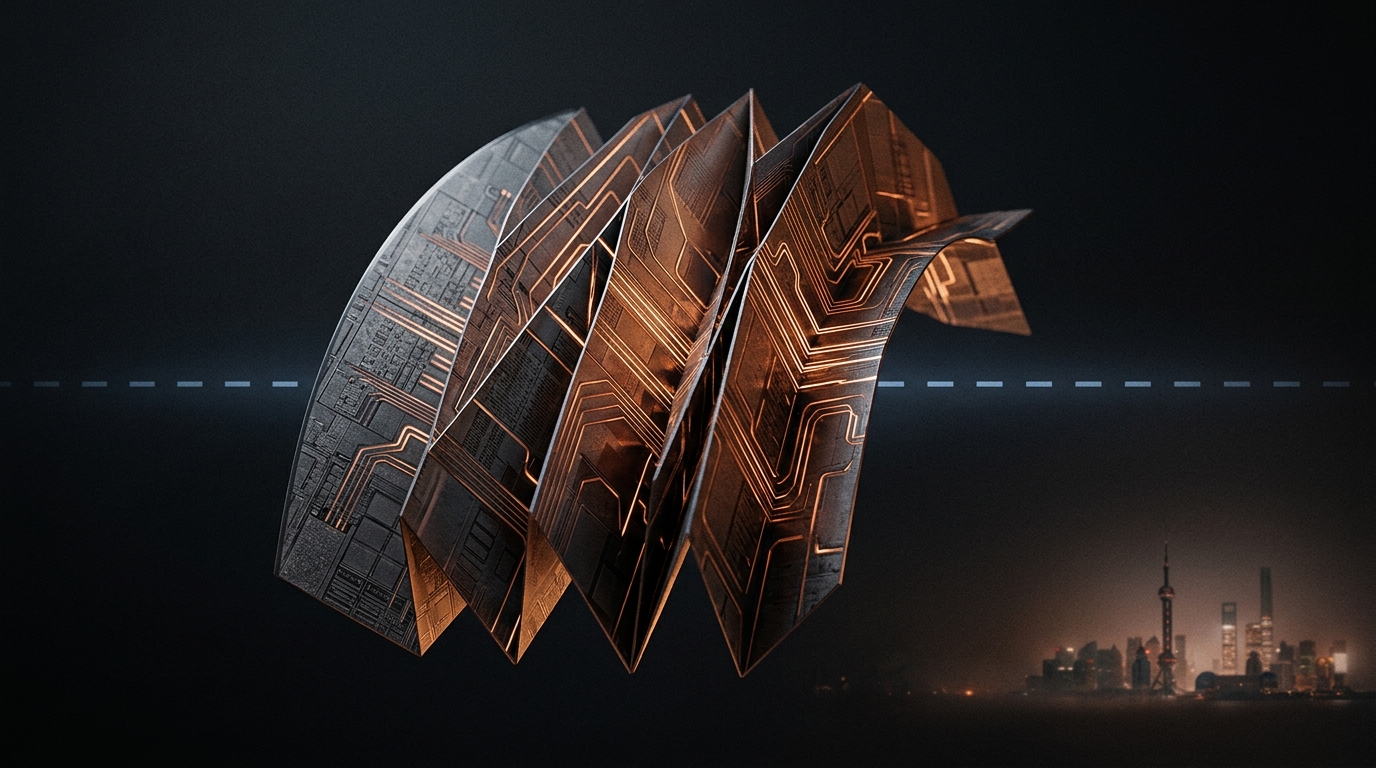
Hao holds a doctorate in economics from Tsinghua University and has worked as a researcher at the China Development Research Foundation, and it shows.13 In “Folding Beijing” the city physically folds itself away every 48 hours so that three social classes can share it without ever meeting. The lowest class gets the night shift and sorts rubbish. Automation could do their jobs, but the jobs exist to keep them occupied. It’s one of the sharpest stories about technological unemployment ever written, and it won Hao the Hugo in 2016, making her the first Chinese woman to receive the award. What frightens her is a society that no longer needs most of its people and quietly folds them out of sight, rather than a machine that turns on us.
Her 2026 disclosure is a small coda to that story. In early June she said that “half” of her latest work, the closing books of her Galaxy Academy children’s series, had been “written with AI” and that “readers can’t tell which parts.” After criticism she clarified that “every line was ultimately written by me,” with AI used for research and plotting, and said future books would carry a label.12
Zhao Tingyang: all under heaven, and an elegy
If Liu supplies the Chinese shelf’s darkest image of how powers relate, Zhao Tingyang supplies its most hopeful. A philosopher at the Chinese Academy of Social Sciences, Zhao revived the ancient idea of 天下 tianxia, “all under heaven,” as a model for world order. It starts from the whole world rather than from competing nation states, includes everyone by design, and treats harmonious mutual dependence as the route to lasting peace.14 It’s the direct opposite of the dark forest: a world with no outside, and so no one to hunt.
Zhao has also written a short book on AI, published by the Commercial Press in Beijing in 2022, and it’s more cautious than anything in Lee. Today’s narrow AI, he argues, is manageable. Superintelligence that goes beyond the Turing machine would be extremely dangerous, though for now it is “only a metaphysical question.” His deeper worry is modern humanity’s urge to redesign nature, including our own. In his words (our translation): “The myth of humanity, or the myth of subjectivity, including the myths of artificial intelligence and genetic science, may hide within it humanity’s elegy.”15
Yuk Hui: there is more than one road
The Hong Kong philosopher Yuk Hui asks the question underneath all the others: is there only one kind of technology? The Western story of AI assumes a single track, and the only question is who gets to the end first. Hui argues that different civilisations have had different cosmotechnics, ways of joining the order of the cosmos and the moral order through technical activity, and that the world needs “technodiversity” rather than one universal path.16 In race terms, that’s heresy. If there are many roads, there is no single finish line.
Figure 1 · Map of the shelf. An editorial reading of each book’s centre of gravity, not measured data. The Western dots bunch on the rivalry side; the Chinese dots scatter across the whole map.
Plot the books this way and the pattern is hard to miss. The Western writers disagree about whether AI will save or doom us, but most of them agree that the world is a contest and China is the other team. The Chinese writers don’t even agree on that. Liu’s forest sits on the far left of the map. Zhao’s heaven sits on the far right. Lee is cheerful, Chen and Hao are worried about who gets left behind, and Hui questions whether the race has one finish line at all.
Different Fears, Different Shelves
Why would two literatures about the same technology come out so differently? Four reasons stand out, and none of them requires believing that one side is naive and the other sinister.
The first is mood. In the Ipsos survey reported in Stanford’s 2025 AI Index, 83% of people surveyed in China said AI products and services have more benefits than drawbacks. In the United States the figure was 39%.17 Writers write for readers. A public that expects AI to raise living standards buys different books from a public that expects it to take their job.
The second is the kind of state each side lives in. Dan Wang, who grew up in Canada and spent 2017 to 2023 in China as a technology analyst, puts the difference bluntly in his 2025 book Breakneck: “China is an engineering state, which brings a sledgehammer to problems both physical and social, in contrast with America’s lawyerly society, which brings a gavel to block almost everything, good and bad.”18 In an engineering state, AI looks like another piece of infrastructure to build and deploy. In a lawyerly one, it looks like something to litigate, regulate and fear.
The third is what each side thinks winning means. The Western race story is about the frontier: who builds the most capable model first. Jeffrey Ding, a political scientist at George Washington University, argues in Technology and the Rise of Great Powers (Princeton, 2024) that history rewards something else. In past industrial revolutions, the powers that pulled ahead weren’t necessarily the ones that invented the breakthrough technology. They were the ones whose institutions spread it fastest through the whole economy.19 China’s own policy reads as if it agrees. The “AI+” plan the State Council released in August 2025 is less about building a god-like model than about getting AI into factories, hospitals, farms and city management.20
The fourth, and the most interesting, is where the fear lives. Western books tend to fear the machine: misalignment, loss of control, a superintelligence with goals of its own. Chinese books tend to fear the society around it. Hao fears a surplus population, Chen fears exploitation, Zhao fears human arrogance, and Liu fears comfort. Chinese regulation follows the same instinct. Its most striking recent rule is about emotional life, not rogue AI. Interim measures on human-like AI services, issued on 10 April 2026 and in force since 15 July, ban “virtual family members, virtual partner, and other virtual intimate-relationship services” for anyone under 18, and require parental consent for children under 14.23 (We covered the fallout, as companion apps with hundreds of millions of users switched off, in The Vanishing.)
Chinese scientists do worry about catastrophic AI. In March 2024, at the Summer Palace in Beijing, the Turing Award winner Andrew Yao, the founding chairman of the Beijing Academy of Artificial Intelligence, Kai-Fu Lee and others signed a joint statement with Geoffrey Hinton and Yoshua Bengio. It called for international red lines against AI systems that copy or improve themselves on their own, seek power, deceive their creators, or help build weapons of mass destruction.21 The Chinese shelf is less alarmist than the Western one. It isn’t indifferent.
| The question | The Chinese shelf | The Western shelf |
|---|---|---|
| What is AI for? | Abundance and better lives (Lee); spreading into every sector (“AI+”); carrying civilisation outward (Liu, 2025) | A decisive strategic lead (Aschenbrenner); a force that must be contained (Suleyman) |
| Who is the rival? | Rarely a nation. Liu’s hunters are cosmic; Zhao’s world has no outside | China, explicitly (Aschenbrenner, AI 2027, Allison) |
| What’s the worst case? | A society that discards people (Hao, Chen); human hubris (Zhao); losing our vitality (Liu) | Losing control of a superintelligence (Bostrom, AI 2027); losing the race |
| Who should govern it? | The state at home; a global body abroad (Li Qiang, 2025); a world order above nations (Zhao) | Two superpowers negotiating arms control (Kissinger & Allison); a US-led coalition (Aschenbrenner) |
| How do readers feel? | 83% see more benefits than drawbacks | 39% (United States) |
Figure 2 · Two shelves, five questions. Survey figures: Ipsos via Stanford AI Index 2025.
- 2005Zhao Tingyang publishes The Tianxia System in Chinese (English edition 2021).
- 2008Liu Cixin’s The Dark Forest introduces cosmic sociology (English 2015).
- 2014Nick Bostrom’s Superintelligence makes loss of control the West’s central AI fear.
- 2016Hao Jingfang wins the Hugo for Folding Beijing; Yuk Hui publishes The Question Concerning Technology in China.
- Jul 2017State Council plan: China to be the world’s primary AI innovation center by 2030.
- Sep 2018Kai-Fu Lee’s AI Superpowers.
- Sep 2021Lee and Chen Qiufan’s AI 2041.
- 2022Zhao’s The Myth or Elegy of Artificial Intelligence (Commercial Press, Chinese only).
- Oct 2023Kissinger and Allison: “just two AI superpowers.”
- Mar 2024Chinese and Western scientists sign the Beijing red lines statement.
- Jun 2024Aschenbrenner’s Situational Awareness.
- Apr 2025AI 2027 scenario published.
- Jul 2025Premier Li Qiang calls AI “an international public good” and proposes a global AI cooperation body.
- Jul 2026China’s rules on human-like AI take effect, banning virtual partners for minors.
Figure 3 · Two shelves in time. Jade rings: Chinese books · Steel rings: Western books · Filled: Chinese state policy.
China’s Role, Read From Both Sides
None of this means the race story is false. China does have a national plan with a deadline, its government does censor and surveil, and the rivalry with the United States over chips and models is real. What reading both shelves adds is a clearer view of the role China is actually trying to play, economically and geopolitically. It looks less like a sprinter and more like three other things at once.
An installer. If Ding is right that diffusion beats invention, China’s bet is on spreading AI through its economy faster than anyone else, and the “AI+” targets are the evidence. It’s the engineering state doing what Wang says it does.
A supplier to everyone else. Chinese labs have released powerful models with open weights at a fraction of Western prices, which we tracked in The Flood. For much of the world, the most affordable AI now comes from China. That’s economic influence of a kind the frontier race doesn’t measure.
A would-be rule-writer. At the World AI Conference in Shanghai on 26 July 2025, Premier Li Qiang said “AI should become an international public good that benefits humanity,” pledged to share expertise with the Global South, and proposed a global AI cooperation organisation.22 Some of that is diplomacy, of course. But it sounds more like Zhao’s tianxia than Liu’s forest, and it puts China forward as the country offering a seat at the table while Washington talks about winning. (We looked at that pitch, and at how China worked around US chip limits, in The Workaround.)
Which brings us back to the forest. In Liu’s novel no civilisation has to be evil for the forest to turn deadly. The chain of suspicion is enough: when no one can verify anyone else’s intentions, even peaceful players end up behaving like hunters. The most useful thing the Chinese shelf offers Western readers may be that warning, turned back on the race narrative itself. A story in which each side is certain the other will cheat is exactly the story that makes corner-cutting rational. The authors of AI 2027 make the same point about their race ending. So does the Beijing red-lines statement. On this, at least, the two shelves meet.
For readers in Australia and other middle powers, the fuller picture matters for practical reasons. If AI is a two-team race, the only choice is which team to join. If it’s also a question of diffusion, open models and who writes the rules, there’s room to build and choose, which is the argument we made in Own the Engine Room.
Humanity undoubtedly faces inherent limits, both intellectual and physical. Artificial intelligence, however, may have the capacity to transcend these boundaries, disseminating human civilization across the cosmos and realizing dreams that have long eluded us.
Liu Cixin · Hong Kong University of Science and Technology · 18 October 2025
That’s the author of the dark forest, the bleakest theory of strangers in modern fiction, describing AI as the thing that might carry us out into the universe. It’s a useful place to stop. The writer the West most often quotes as proof of China’s hard-edged worldview turns out to hold a more hopeful view of the technology than most of the Western books about the race. If you’ve only read one shelf, read the other. The picture of China, and of our own side, will change.
 Buy me a coffee