The Robot That Refused to Look Human
Genesis AI's Eno rolls instead of walks, and reasons with a foundation model called GENE. It is a wager that the future of robotics lives in the brain, not the silhouette.
For three years the robotics industry has been gripped by a single image: a machine with two legs, two arms, a torso, and a face — a metal echo of ourselves, walking the halls of a warehouse. Then, on June 17, 2026, a startup called Genesis AI pulled the cover off its first product and quietly proposed that the whole industry had been chasing the wrong shape. Its robot, named Eno, does not walk. It rolls. It has no face. And its makers think that is exactly why it will work.
Eno is what the field calls a general-purpose robot — a machine meant not for one repetitive task but for the open-ended messiness of real human environments. Where the marquee humanoids from Figure, Tesla, and Boston Dynamics balance on two legs, Eno sits on a wheeled base topped by an adjustable tower that telescopes up and down, changing its height and reach in real time and folding into something compact when idle. Its one concession to human form is the part that matters most: a pair of robotic hands built to match the dexterity of our own, so that Eno can pick up the tools, open the drawers, and operate the equipment of a world designed entirely around five fingers and an opposable thumb.
But the body is not the headline. The headline is the brain. Eno is powered by GENE, Genesis AI's foundation model for the physical world — what the company, with characteristic startup modesty, calls "the industry's most advanced robotic brain." And it is GENE, not the wheels, that explains why this launch matters.
The bet against legs
To appreciate Eno's contrarianism, you have to understand the orthodoxy it rejects. The case for humanoids is seductive and simple: our world is built for human bodies, so a human-shaped robot can slot into it without redesigning the world first. Stairs, door handles, ladders, the cab of a forklift — all assume a creature with legs and arms in human proportion. Build the robot to match, and it inherits the entire built environment for free.
Genesis AI's counterargument is that legs are an enormous tax you pay for a capability you rarely need. Bipedal balance is one of the hardest problems in robotics; it devours computation, battery, and engineering effort, and it introduces a constant risk of falling that wheeled machines simply do not face. The overwhelming majority of valuable work in a factory, a warehouse, or a lab happens on flat floors, at bench height, with the hands. So why not put your engineering budget where the value is — into manipulation and intelligence — and let wheels handle the locomotion that wheels have always handled better?
That adjustable tower is the clever resolution. By telescoping, Eno can present its hands at floor level to lift a box and then rise to reach a high shelf — recovering much of the vertical range a humanoid gets from its height, without ever leaving the ground. It is a design that treats the human form not as a template to copy but as a set of requirements to satisfy by whatever means are cheapest and most reliable.
"Eno's most human feature is its hands. Everything else is an argument that the rest of the body was never the point."— On Genesis AI's design philosophy
GENE and the race for the robotic mind
The deeper story of 2026 robotics is the arrival of the foundation model for physical action. For decades, robots were programmed: every motion scripted, every gripper position specified by an engineer for one task in one setting. Move the part two inches, change the lighting, hand the robot an unfamiliar object, and the whole brittle edifice collapsed. The promise of a model like GENE is to do for physical action what large language models did for text — to learn general competence from vast and varied experience, so that a robot can reason about a task it has never seen, adapt on the fly, and carry out long, multi-step jobs without a human writing the steps in advance.
Genesis AI describes GENE as letting Eno operate as "a true physical agent: reasoning, adapting and owning outcomes beyond pre-defined tasks," with "human-level dexterous manipulation" precise to the millimeter. The language is aspirational, and the demonstrations will need independent verification — this is, after all, a company selling a product. But the architectural bet is the one the entire frontier is converging on. Nvidia has built an entire physical-AI stack around the idea, pairing simulation environments that generate synthetic training data with humanoid foundation models and onboard inference chips. The field now even has a name for the dominant approach — vision-language-action models, systems that take in what the robot sees, fold in an instruction in plain language, and output the actual motor commands.
This is why GENE — and the wheeled body around it — is more than a product. It is a claim about where the value in robotics actually concentrates. If the brain is general enough, the body can be cheap, simple, and purpose-built. The hard, expensive, defensible part is the model: the years of manipulation data, the reasoning that survives contact with an unscripted world. A startup that owns a strong physical foundation model can, in principle, drop it into many different bodies. A company that has only built an exquisite humanoid chassis has built a beautiful vessel still waiting for a mind.
The company and the credibility
Genesis AI is not a garage operation. It was co-founded by Zhou, who holds a PhD from Carnegie Mellon, and Théophile Gervet, a former researcher at the French AI lab Mistral — a pairing of robotics and frontier-model pedigree that mirrors the company's own brain-plus-body thesis. It has raised $105 million in seed funding from a roster that reads like a who's-who of the field: Eclipse, Khosla Ventures, Bpifrance, and HSG, with backing from Eric Schmidt, the French telecom billionaire Xavier Niel, and the academic AI pioneers Daniela Rus and Vladlen Koltun. When researchers of that caliber put their names on a robotics startup's contrarian bet, the bet deserves a serious hearing.
The plan is deliberately unglamorous. Genesis AI says it will begin production and targeted customer deployments before the end of 2026, starting in manufacturing, logistics, and laboratory settings — the flat-floored, repetitive, high-value environments where wheels and hands are plainly enough — before moving toward hospitality and healthcare. It is the same staged rollout the humanoid companies are pursuing, which makes the comparison clean. Within a year or two we will have real-world data on whether the legs were worth it.
"The contest that will define embodied AI is not humanoid versus wheeled. It is whoever builds the most capable physical brain — and then chooses the cheapest body that lets it work."— The wager beneath the Eno launch
The hard problem is the hand
If there is a place where Eno's bet could falter, it is the same place the entire field strains hardest: dexterous manipulation. Wheels solved locomotion decades ago, but getting a robotic hand to grasp an unfamiliar object — to judge how much force a paper cup can take versus a steel bolt, to re-grip mid-motion when something slips, to thread a cable into a port it has never seen — remains one of the deepest unsolved problems in robotics. This is precisely the capability Genesis AI claims GENE delivers "with millimeter precision," and it is the claim that most demands scrutiny. Manipulation is where demos are easiest to stage and hardest to generalize; a robot that flawlessly folds one company's towels in a lab can fail completely on the next company's boxes.
What makes the foundation-model approach genuinely promising here is the same thing that made it work for language: scale and diversity of experience. A model trained on millions of grasps across thousands of objects and settings can, in principle, develop a general intuition for contact and force the way a language model develops an intuition for grammar — not by memorizing rules but by absorbing patterns too numerous to write down. Whether GENE has crossed that threshold, or merely points toward it, is the question that will decide Eno's fate. The wheels are a sideshow. The hands, and the brain that drives them, are the whole game.
It is also why Genesis AI's full-stack strategy — building the model and the body together rather than buying one and bolting it to the other — is more than vertical-integration vanity. Manipulation data is generated by manipulation hardware; the better your hands, the better the experience your model learns from, which makes your next hands smarter still. Own both ends of that loop and it compounds. That flywheel, more than any single spec, is the bet the company's investors are really making.
Why this moment matters
Robotics is having the year language had in 2023. The market reached $38 billion in 2026, growing 34 percent — its fastest pace in a decade — as foundation models finally gave machines a way to handle the unpredictability that always defeated hand-written code. Figure's factory is reportedly producing a robot an hour; Boston Dynamics' electric Atlas is shipping to early partners. Into that frenzy of human-shaped ambition, Genesis AI has dropped a wheeled machine and a foundation model and a quiet, pointed question: what if you have been over-investing in the body and under-investing in the mind?
It is too early to know who is right. Humanoids may yet prove that their universality justifies their cost; Eno may reveal limitations that only a leg can solve. But the launch reframes the entire conversation in a way that will outlast this one product. The robot that finally lives among us may not be the one that looks like us. It may be the one that thinks well enough that we stop caring what it looks like at all — and notice only that the work, somehow, is getting done.
Sources & Further Reading
- Robotics & Automation News — "Genesis AI unveils Eno, a general-purpose robot powered by its GENE foundation model" (June 17, 2026). roboticsandautomationnews.com
- PR Newswire — "Introducing Eno: Genesis AI's First General-Purpose Robot is Challenging Traditional Humanoid Design." prnewswire.com
- Interesting Engineering — "Eno humanoid robot debuts as general-purpose worker for industries." interestingengineering.com
- The Robot Report — "Genesis AI launches Eno general-purpose robot." therobotreport.com
- The Next Web — "Genesis AI bets wheels beat legs in the robot race." thenextweb.com
- Humanoids Daily — "Genesis AI Unveils Eno: The Minimalist Robot Making an 'Opposite Bet' on Humanoid Design." humanoidsdaily.com
- The AI Insider — "Genesis AI Launches Company's First General-Purpose Robot 'Eno.'" theaiinsider.tech
- TechCrunch — "Khosla-backed robotics startup Genesis AI has gone full stack, demo shows." techcrunch.com
- NVIDIA Newsroom — "NVIDIA Releases New Physical AI Models as Global Partners Unveil Next-Generation Robots." nvidianews.nvidia.com
- Robotics Center of Silicon Valley — "State of Robotics 2026 Report: $38B Market, 12 Humanoids, VLA Adoption." roboticscenter.ai
- SVRC — "Physical AI in 2026: What It Is, Key Models, and How to Build It." roboticscenter.ai
- KraneShares — "Humanoid Robotics In 2026: The Race From Pilot To Platform." kraneshares.com
- NVIDIA Blog — "National Robotics Week: Latest Physical AI Research, Breakthroughs and Resources." blogs.nvidia.com
Keep Reading
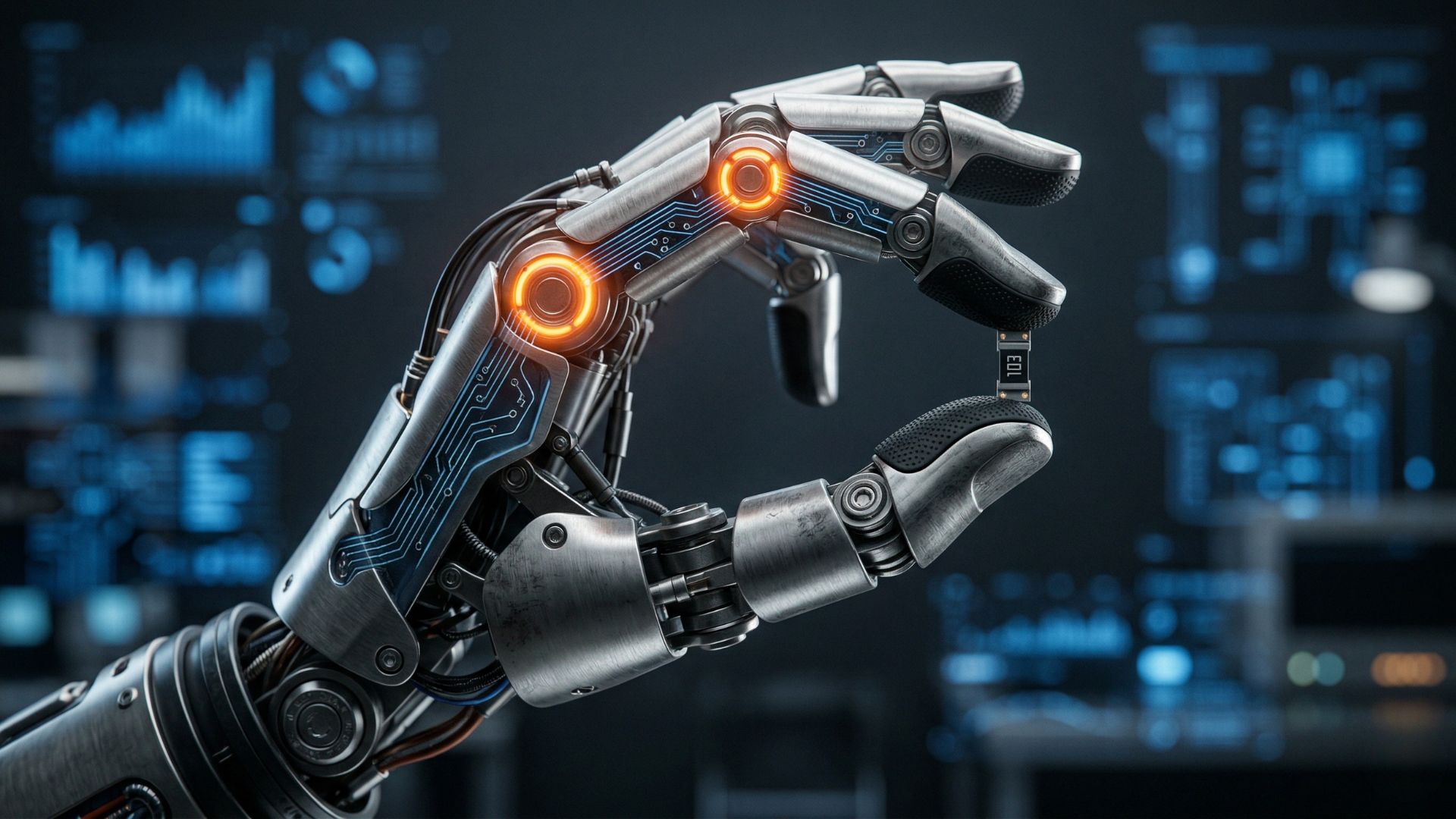
The Physical Turn
Humanoid robots, dexterity, and the 2025–26 inflection point in embodied AI.
Rise of the Humanoids
The companies racing to put a human-shaped robot on every factory floor.
Robodoc
When the surgeon, the diagnostician, and the carer are all machines.

The Agent Inflection
The year AI stopped answering questions and started doing the work itself.
After the Job
What happens to work when machines can do the manual and the cognitive both.

The Machine That Needs a Planet
The staggering energy appetite of the AI systems now reaching into the physical world.
 Buy me a coffee