In a laboratory in Palo Alto, a computer program spent three days staring into the genetic code of every living thing on Earth — four billion years of evolution compressed into 9.3 trillion DNA base pairs — and then, quietly, began to write its own. The result was a synthetic bacteriophage: a virus it had never seen, built from scratch, that not only survived but outcompeted its natural counterparts in the Petri dish.
This is not science fiction. In February 2025, scientists published the first paper describing AI-designed viruses capable of killing antibiotic-resistant bacteria more effectively than nature's own versions. By March 2026, the research had landed in Nature — and the field of generative biology had crossed a threshold it can't uncross.
The technology driving this is called Evo 2, a 40-billion-parameter foundation model built by the Arc Institute in collaboration with NVIDIA, Stanford, UC Berkeley, and UC San Francisco. It is, in a sense, the AlphaFold moment for the whole genome — not just proteins, but DNA, RNA, regulatory sequences, the full molecular grammar of life. Train a large language model on the text of every book ever written, and it learns to write new books. Train one on the genetic code of 128,000 species, and it learns to write new life.
The Grammar of Life
To understand why Evo 2 matters, you need to understand what DNA actually is. It's information — approximately three billion characters of it in a human cell, written in an alphabet of four letters: A, T, C, and G. For decades, biologists have been learning to read this alphabet, then to copy and edit it. What Evo 2 does is something different. It has learned, in a statistical sense, to speak it.
The analogy to large language models isn't just poetic. The arc of progress in natural language processing maps almost exactly onto what's happening now in biology. GPT-2 could write coherent paragraphs. GPT-3 could reason. Evo 2 can, as Arc Institute puts it, "model and design genetic code across all domains of life" — from bacteria to archaea to the cells of mammals. Feed it a partial genome, and it proposes what comes next. Give it design criteria, and it writes sequences optimized for those properties.
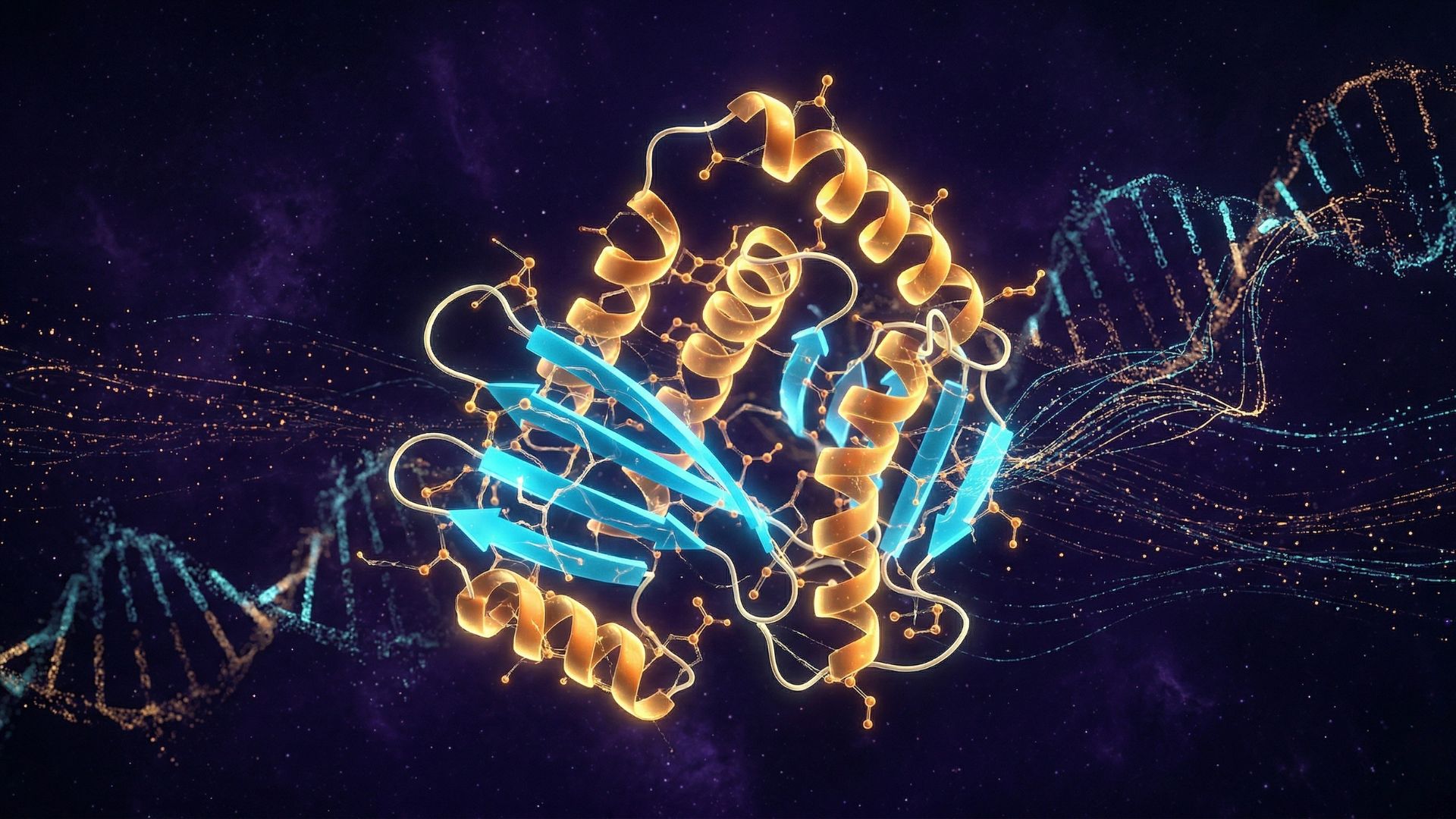
The first proof-of-concept was bacteria. Researchers used Evo 2 to generate novel bacteriophage genomes — the viruses that infect and kill bacteria, which have become a last-resort tool against antibiotic-resistant infections. Several AI-designed phages demonstrated what the team called "higher fitness" than the natural ΦX174 phage, replicating faster and dominating mixed populations. Others showed dramatically faster and more potent lysis kinetics: they killed bacteria more efficiently than anything that had evolved naturally over millions of years.
In head-to-head tests, AI-designed bacteriophages outcompeted their natural ancestors — replicating faster, killing more efficiently, and dominating mixed populations. No human designer wrote those genomes. The AI did.
Why Now?
The convergence that made Evo 2 possible required three things arriving simultaneously: massive genomic datasets, transformer-scale compute, and a conceptual shift in how biologists think about their work.
The datasets came first. Over the past decade, the cost of genome sequencing has dropped by a factor of a million, and research consortia have assembled databases containing the complete genetic codes of tens of thousands of species. These datasets are, in the language of machine learning, training data — and for a system like Evo 2, they constitute an exhaustive record of every evolutionary solution nature has found to every engineering problem.
The compute came next. NVIDIA's partnership with Arc Institute wasn't incidental. Training Evo 2's 40-billion-parameter model at single-nucleotide resolution — capturing every A, T, C, and G rather than abstracting to coarser representations — required the kind of sustained GPU infrastructure that didn't exist five years ago. The model has since been integrated into NVIDIA's BioNeMo framework, giving pharmaceutical researchers direct access to its capabilities.
"We're transitioning from biology as a science of discovery to biology as a science of design. AI is what makes that transition possible."— Patrick Hsu, Arc Institute, 2026
The conceptual shift is perhaps the most significant. For most of the twentieth century, synthetic biology meant editing existing organisms — cutting and pasting genetic sequences, knocking out genes, inserting new ones. What Evo 2 suggests is something more fundamental: the possibility of writing genomes the way an engineer writes software. Not editing what exists, but designing from first principles.
The Synthetic Virus Question
No story about AI-designed life can ignore its most disturbing dimension. In 2025, scientists used an AI system to create the first entirely synthetic virus — not modifying an existing pathogen, but generating a coherent viral genome from scratch, which was then synthesized in a laboratory and shown to replicate. The paper, published in Nature, was accompanied by extensive biosafety commentary. It was also a demonstration that the barrier between "understanding biological sequences" and "creating novel biological threats" has grown paper-thin.
Biosecurity researchers have been warning about this for years. The concern isn't that Evo 2 or its successors would spontaneously generate a pandemic pathogen — the models require significant human expertise to deploy, and the gap between a designed genome and a synthesized, released organism involves many steps. The concern is the acceleration: that what previously required a PhD, a well-funded laboratory, and months of work can now be prototyped in hours.
The Bloomsbury Intelligence and Security Institute published a detailed risk assessment in 2026 arguing that the convergence of AI and synthetic biology represents "the most significant biosecurity challenge since the development of recombinant DNA technology." The report called for a new international framework governing the synthesis of novel biological sequences — something that doesn't yet exist.
"The question is not whether AI will be used to design organisms. It already has been. The question is who controls that power, and toward what ends."— Biosecurity researcher, Bloomsbury Intelligence and Security Institute, 2026
The Promise Side of the Ledger
For all the biosecurity anxiety, the therapeutic applications of generative biology are genuinely staggering. Antibiotic resistance kills approximately 1.27 million people per year globally and is projected to kill 10 million annually by 2050. The pipeline of new antibiotics from traditional pharmaceutical research is nearly empty — developing a new antibiotic takes fifteen years and costs over a billion dollars, and the commercial incentives are poor because patients take them for days, not decades.
AI-designed bacteriophages sidestep the antibiotic problem entirely. Phages are viruses that evolved to kill bacteria; unlike antibiotics, they can be designed to target specific strains with minimal collateral damage to the microbiome. The problem has always been that developing a new phage therapy is as slow and expensive as developing a new drug. Evo 2 changes that calculation. A researcher who once needed years to find and characterize a useful phage can now iterate through thousands of AI-generated designs in days.
Beyond bacteriophages, the same approach is being applied to enzyme engineering (designing proteins that catalyze specific chemical reactions), gene therapy (writing regulatory sequences that turn therapeutic genes on and off in specific tissues), and the nascent field of "genome-scale" design — generating entire metabolic pathways for use in industrial biotechnology. Several pharmaceutical companies have begun licensing Evo 2's capabilities through the NVIDIA BioNeMo platform, accelerating early-stage drug discovery by orders of magnitude.
Artificial Biological Intelligence
Where does this end? Researchers at Arc Institute describe the ultimate ambition of generative biology as "artificial biological intelligence" — AI models capable of proposing complete, functional genomes for organisms with specified properties. Not editing the genome of a bacterium, but designing one from scratch with novel metabolic capabilities. Not engineering a virus to target a specific cancer marker, but inventing the delivery mechanism itself.
Current models can't do this yet. Evo 2 can generate sequences as long as the genomes of simple bacteria, but a functional bacterium requires more than a valid genome — it requires a cellular environment, membrane chemistry, the whole physical infrastructure of life. The gap between a written genome and a living thing remains large. But the trajectory is unmistakable.
What's striking about Evo 2 is not what it can do today, but what it reveals about the nature of biological information. If a sufficiently large neural network, trained on enough genomic data, can generate functional biological sequences — sequences that work in the real world — then the genetic code is, in a deep sense, learnable. It has structure. It has grammar. It can be modeled, and eventually, it can be written.
Four billion years of evolution produced a library of working solutions to every engineering problem biology has ever faced. We are, for the first time, building machines that can read that library in its entirety — and begin writing new chapters of their own.
Sources
- Nature: AI tools can design genomes. Will they upend how life evolves? (2026)
- Nature: AI can write genomes — how long until it creates synthetic life? (2026)
- Arc Institute: AI can now model and design the genetic code for all domains of life
- Genetic Engineering News: Arc Institute's Evo 2 designs genetic code across all domains of life (2026)
- Nature: World's first AI-designed viruses — a step towards AI-generated life (2025)
- Cell Systems: Generative AI for synthetic biology — designing biological parts, circuits, and genomes (2026)
- Phys.org: With Evo 2, AI can model and design the genetic code for all domains of life (March 2026)
- Maginative: NVIDIA and Arc Institute introduce Evo 2 (2025)
- Bloomsbury ISI: AI and Synthetic Biology — The New Frontier of Promise and Power (2026)
- IEEE Spectrum: How AI Could Supercharge Synthetic Biology
- Ailurus Bio: AI Designs Viable Genomes — A New Era for Synthetic Biology (2026)
- Arc Institute: Evo 2 — One Year Later (2026)
- Goodfire AI: Interpreting Evo 2 — Arc Institute's next-generation genomic foundation model


 Buy me a coffee