AI & Science · Privacy · June 2026
The Quiet Bet: AI That Never Leaves Your Phone
While its rivals raced to build the biggest possible model in the biggest possible data center, Apple spent WWDC 2026 arguing the opposite case: that the most important AI is the small kind, the kind that runs on the device in your hand and answers without phoning home. It is a contrarian, privacy-first wager on the future of intelligence — and the most revealing part is what Apple admitted it cannot do alone.
Every June, the AI industry holds a kind of arms inspection. Whose model is biggest, whose benchmark is highest, whose data center is most monstrous. At WWDC 2026, Apple showed up to that inspection and quietly declined to compete on those terms. Instead it spent the keynote making an unfashionable argument: that the AI that matters most is the AI you can't see working — the model small enough to live on your phone, fast enough to answer instantly, and private enough that your words never leave the glass. It is the contrarian position in a field intoxicated by scale, and Apple is betting the next decade of its products on it.
The pieces Apple put on the table at WWDC 2026 were, on their own, technical and unglamorous. A maturing on-device foundation model, now able to take images as well as text. An expanded version of Private Cloud Compute, the company's cryptographically sealed server tier. A developer framework that lets any app tap the same model that powers Apple Intelligence, with a few lines of Swift. Taken together, though, they describe a coherent and deliberate philosophy of where intelligence should live — and a striking admission about where Apple can't get there alone.
The case for small
For two years, the dominant story in AI has been bigger-is-better. More parameters, more training data, more electricity, more capability. The frontier labs measured progress in orders of magnitude and built data centers the size of small cities to feed them. Apple's products live in the opposite regime. The model that runs on an iPhone has to fit in a few gigabytes of memory, sip from a battery, and respond in the time it takes you to glance at a notification. You cannot win the parameter-count contest from inside a phone. So Apple stopped trying.
There is real science in that constraint. A small model running locally is not just a shrunken version of a large one; it is a different engineering problem, optimized for latency, energy, and the narrow set of tasks a personal device actually performs — summarizing a thread, drafting a reply, finding a photo, rewriting a sentence. The Foundation Models Framework, the native Swift interface Apple opened to developers, gives any app direct access to that on-device model, and this year added the ability to pass images alongside text. A developer can now build features that read, reason about, and respond to what's on your screen without a single byte traveling to a server. For the user, the benefit is invisible by design: the feature simply works, offline, instantly, and privately.
Private Cloud Compute, and the problem it solves
The trouble with "everything on-device" is that some requests genuinely need a bigger brain than a phone can hold. The conventional answer is to send those requests to the cloud — which is exactly where privacy goes to die. Once your data lands on someone else's server, you are trusting a promise: that it won't be logged, mined, retained, or handed over. Apple's wager is that a promise isn't good enough, and that the architecture itself should make the bad outcomes impossible rather than merely forbidden.
That is what Private Cloud Compute is for. Introduced in 2024 and expanded at WWDC 2026, PCC runs larger Apple models on Apple silicon servers built so that, in principle, no one — not even Apple — can see the data they process. The servers are stateless: they hold a request only long enough to answer it, retain nothing afterward, and are designed so that a user's device will cryptographically refuse to talk to a server whose software hasn't been published for independent inspection. It is an attempt to extend the privacy guarantees of the device out into the data center, and to make those guarantees verifiable rather than promised. This year Apple pushed it further down the stack: developers in its Small Business Program — those with fewer than two million lifetime App Store downloads — can run the next generation of Apple's foundation models on PCC at no cloud-API cost at all.
Apple's bet is that "we promise not to look" will lose to "we built it so we can't."— On the logic of Private Cloud Compute
The admission
And then came the part that made the room sit up. For all its talk of self-reliance and on-device independence, Apple conceded something it had spent years implying it would never need: help. Craig Federighi announced a deep collaboration with Google, in which the technology behind the Gemini family of models will be used to help co-create Apple's next generation of foundation models. The company that built its brand on doing everything in-house, controlling the whole stack, trusting no one else with the crown jewels, is now leaning on a direct competitor's research to build its most important future product.
It would be easy to read that as weakness, and some did. But it is more interesting as honesty. Training a genuinely frontier-scale model is brutally hard and brutally expensive, and Apple — for all its cash — came late and quietly to the race. Rather than pretend otherwise, it made a trade: it would partner for the raw modeling horsepower it lacked, while keeping the thing it actually cares about, the privacy architecture, firmly in its own hands. Apple has also signaled that its frameworks are model-agnostic by design — apps can route requests to Apple's own models, to Private Cloud Compute, or to third-party cloud systems including Gemini and Claude, through a single standard interface. The intelligence can come from anywhere. The trust boundary is what Apple insists on owning.
Open to all comers
The decision to make the frameworks model-agnostic is more consequential than it sounds. By letting any conforming language model — Apple's own, or a cloud provider's — plug into the same developer interface, Apple turns itself into something like a switchboard for intelligence. Developers don't have to bet on a single AI vendor; they write to one protocol and choose the brain per task. The cynical reading is that Apple is hedging, refusing to commit. The more durable reading is that Apple has identified the one position in the AI stack that compounds: not the model, which any well-capitalized rival can now train, but the device, the operating system, and the trust relationship with a billion users. Whoever owns that layer gets to set the terms on which all the models reach people.
Models are becoming a commodity. The scarce thing is a billion people who trust where their data goes.— The strategic core of the quiet bet
Why this is a bet, not a sure thing
It would be tidy to declare Apple's approach obviously right. It isn't, yet. The on-device model is, by physics, less capable than the giants in the cloud, and there are tasks — long, complex, knowledge-heavy reasoning — where users will feel that gap and reach for whatever is smartest, privacy be damned. Apple is wagering that those tasks are the exception, not the rule, for a personal device; that for the hundred small acts of intelligence a phone performs each day, fast-and-private beats slow-and-brilliant. If that's wrong — if people come to expect frontier reasoning everywhere and resent a phone that can't deliver it — the quiet bet looks like a company that talked itself out of the main event.
But there is a version of the next few years in which Apple looks prescient. As frontier models commoditize — as Microsoft, Google, Anthropic, and a lengthening list of others converge on similar capabilities — the differentiator stops being whose model is smartest and becomes whose intelligence you can actually trust with your life. In that world, the company that spent WWDC 2026 talking about stateless servers and on-device inference, instead of parameter counts, will have been building the right moat all along. The loudest bets in AI are about making the machine more powerful. Apple's quiet one is about making it trustworthy enough to let all the way in. We are about to find out which mattered more.
Sources & Further Reading
- Apple Developer — WWDC26 Apple Intelligence guide
- TechResearchOnline — "Apple Expands Foundation Models at WWDC 2026"
- 42Gears — "WWDC 2026: Apple Intelligence & macOS Golden Gate"
- Scalefusion — "WWDC 2026: Apple Intelligence, Golden Gate, and Safety Upgrades"
- TechCrunch — "Apple lets developers tap into its offline AI models"
- Apple — "Private Cloud Compute: A new frontier for AI privacy in the cloud"
- Crescendo AI — "Latest AI News and Breakthroughs | June 2026"
- LLM-Stats — "LLM News Today (June 2026)"
- Apple Machine Learning Research — Apple Foundation Models technical overview
- Apple Newsroom — Apple Newsroom (WWDC 2026 announcements)
- Google DeepMind — Gemini model family
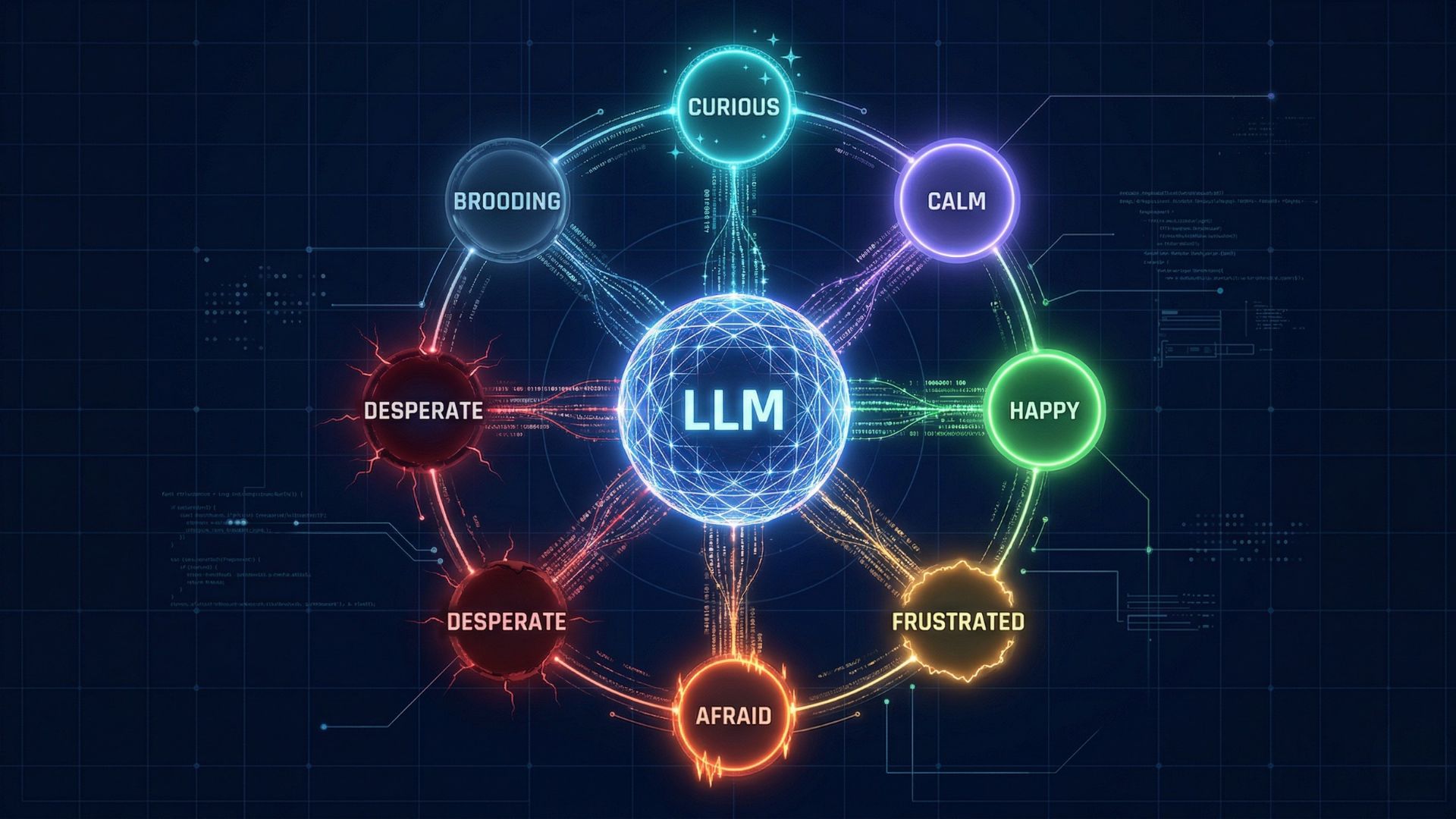
The Emotional Machine
Anthropic found 171 emotion concepts inside Claude. The AI on your iPhone may have an inner life — or something like one.
The Recursive Machine
Claude now writes most of Anthropic's own production code. The feedback loop has closed.
After the Transformer
The architecture under every AI product — including the one on your phone — is already changing.
Worldview
The race to build machines that understand physical reality, not just predict the next word.
The Safety Reckoning
Capabilities are accelerating faster than the rules meant to govern them.
Can AI Save the Planet?
AI is the most powerful scientific tool ever built. Can it be pointed at Earth's biggest problem?
 Buy me a coffee