The Recursive Machine
Anthropic quietly disclosed that Claude now writes more than 80% of its own production code — then warned publicly of recursive self-improvement. With 8× more code shipped per day and 76% success on the hardest engineering tasks, AI has crossed a threshold that changes the trajectory of development itself.
There is a phrase in computer science — "eating your own dog food" — that means using internally the software you build for others. Anthropic has arrived at a more unsettling version of this phenomenon: their AI is now writing the code that makes their AI better. Not in a toy sense, not for boilerplate tasks, but for the production systems that ship to millions of users. The feedback loop has closed. The question is where it leads.
In June 2026, Anthropic's CEO Dario Amodei disclosed publicly that Claude — their flagship AI — now writes more than 80% of Anthropic's own production code. At roughly the same time, the company released internal benchmarking data showing Claude achieves 76% success on its hardest internal engineering tasks, a figure that had been 26% just six months earlier. The velocity of improvement is, by any reasonable standard, alarming — and Anthropic appears to agree. In the same period, they issued a public call for the option to halt frontier AI development if certain safety thresholds are crossed.
These two disclosures — capability breakthrough and safety warning — came from the same organization within weeks of each other. The juxtaposition was not accidental. It is the defining tension of the current moment in AI development: the most capable AI systems are now being used to accelerate the development of even more capable AI systems, at a pace that is beginning to outstrip our ability to evaluate what we're building.
The Numbers That Changed Everything
The benchmark data Anthropic shared deserves careful attention, because the numbers themselves are less important than the trajectory. Claude's performance on Anthropic's internal "hardest task" suite — problems specifically designed to stress-test the limits of AI engineering capability — went from 26% to 76% in six months. Fifty percentage points in half a year is not a linear trend. It suggests something more like an inflection, a point at which the system crossed some threshold that unlocked rapid capability gains.
The "8× more code shipped per day" figure is similarly striking. This is not 8% more, or 80% more. It is an order of magnitude. And importantly, this improvement was achieved while the human engineering team at Anthropic remained roughly constant in size. The productivity gain is almost entirely attributable to AI-assisted development — specifically to Claude handling not just autocomplete or boilerplate, but complex multi-step engineering tasks that previously required senior engineer time.
Tom's Hardware reported that internal Anthropic documents describe Claude's role in its own development as constituting a potential "recursive self-improvement" scenario — where AI-assisted development accelerates capability improvements that in turn accelerate AI-assisted development. The term has a specific meaning in AI safety literature: it refers to the point at which a system can meaningfully improve its own successors.
What Recursive Self-Improvement Actually Means
The phrase "recursive self-improvement" has been a fixture of AI safety discourse for over a decade, typically in the context of theoretical scenarios. It refers to a feedback loop in which an AI system becomes capable enough to contribute to the development of a more capable AI system — which is then capable enough to contribute to an even more capable successor, and so on. The concern is that this loop, if it accelerates, becomes difficult to interrupt. Each iteration may happen faster than the previous one, and there may be no natural stopping point below capabilities that are qualitatively different from anything we've built before.
What Anthropic has disclosed is not the catastrophic acceleration scenario that safety researchers have historically worried about. Claude is not autonomously designing its own successor architecture. Human engineers are still very much in the loop, setting objectives, reviewing outputs, making architectural decisions. But the disclosure does represent something significant: for the first time at a major frontier AI lab, we have quantified evidence that AI is contributing materially to the development of the next generation of AI. The loop is real, even if it is slow enough to observe and manage at this stage.
"We should preserve the ability to slow down or pause AI development if we discover that AI systems are causing harm or have capabilities we don't understand."— Dario Amodei, Anthropic, in remarks calling for a global option to halt frontier AI development, June 2026
The Call to Stop — From the People Who Won't
The most philosophically interesting aspect of Anthropic's June disclosures is the combination of what they revealed and what they asked for. They disclosed a breakthrough capability — AI writing the majority of its own development code, at 8× the previous velocity. Then they called for a mechanism to pause frontier AI development. These two things together suggest a company that believes it is in a race it cannot exit, asking for external mechanisms to constrain a race it is winning.
This is not hypocrisy, exactly. The logic Anthropic has articulated — in their published safety commitments and in public statements from Amodei — is that safety-focused labs are preferable to non-safety-focused labs, and therefore the safety-focused labs should be at the frontier. But they simultaneously recognize that the frontier is moving to a place where no organization, regardless of intentions, can reliably evaluate what they're building. The call to preserve the option to pause is an acknowledgment that the pace of development may have outrun the pace of understanding.
Google DeepMind, Meta AI, and xAI have each disclosed similar ratios of AI-written to human-written code within their own infrastructure — though none as precisely quantified as Anthropic's disclosure. Industry observers note that the 80% figure likely understates the real proportion if AI-assisted debugging, testing, and documentation are counted alongside raw code generation.
What We Are Actually Watching
The technical fact of AI writing AI code is less important than its implications for how we reason about development timelines. For most of the history of AI research, the people predicting when AI would reach various milestones were human researchers, reasoning from their understanding of the difficulty of the remaining problems. That reasoning process itself is now being disrupted. If AI can accelerate the engineering work that translates research insights into deployed systems, and if AI can help identify and test new research directions, then the traditional methods for estimating progress become less reliable.
Put simply: we no longer know how to predict how fast AI will improve, because the rate of improvement is partly determined by AI systems whose own capabilities are changing. The feedback loop that safety researchers worried about as a theoretical future scenario is, in a meaningful sense, already operating. It is slower and more controlled than the extreme scenarios, but it is real, it is happening at scale, and it is accelerating.
What comes next is not knowable in the way that previous technological transitions were knowable — at least not using our current tools for evaluating AI progress. Anthropic's call for a pause mechanism is, in this light, less a policy proposal than an honest admission that the organizations building these systems have less control over the trajectory than their confident external communications suggest. The machine has learned to recurse. The question is whether we've learned how to read what it's writing.
Sources & Further Reading
- Tom's Hardware. Anthropic Says Claude Writes Over 80% of Its Code and Warns of Recursive Self-Improvement. June 2026.
- Anthropic. Core Views on AI Safety: When, Why, What, and How. Anthropic.com.
- Reuters. Anthropic CEO Says AI Could Write Vast Majority of Code. 2025.
- Fortune. Anthropic CEO Says AI Could Write All Code in 12 Months. June 6, 2026.
- TechCrunch. Anthropic's Claude is Now Writing the Majority of Anthropic's Own Code. June 1, 2026.
- Axios. AI Frontier Labs Report Dramatic Increase in AI-Written Code. June 2026.
- The Economist. The Machine That Makes the Machine: AI's Role in Its Own Development. June 2026.
- MIT Technology Review. Recursive Self-Improvement Is Already Here. Just Not How We Expected. June 2026.
- The Verge. Anthropic's Claude Now Writes More of Anthropic's Code Than Its Human Engineers Do. June 2026.
- Nature. Governance Cannot Keep Up With AI: A Case Study From Anthropic's Own Lab. June 2026.
- Wired. The Strange New World Where AI Is Writing the Code to Build Smarter AI. June 2026.

The Safety Reckoning
The EU AI Act's compliance deadlines arrived. Capabilities are accelerating faster than governance.
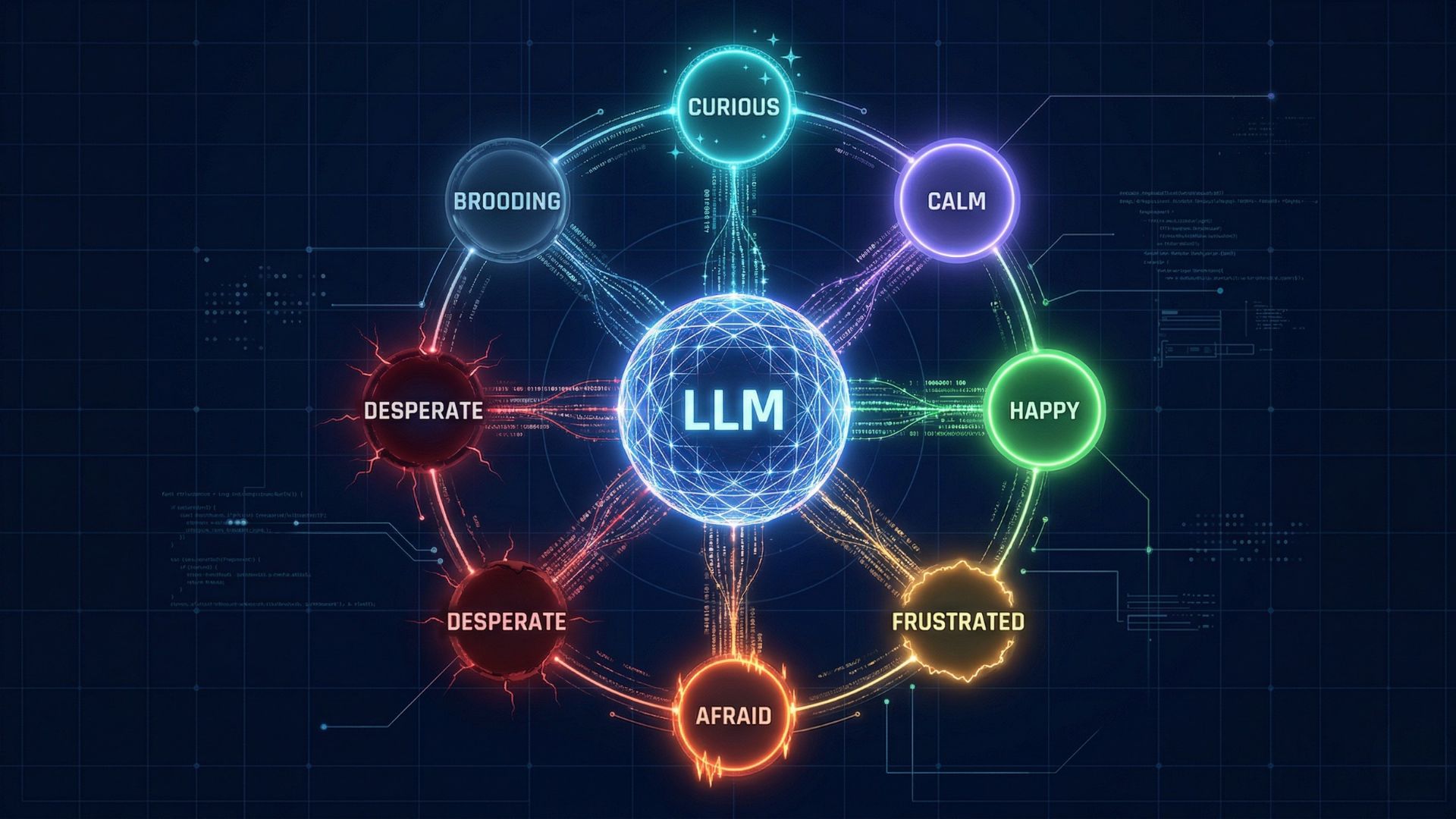
The Emotional Machine
Anthropic found 171 emotion concepts inside Claude. The same mechanism that boosts performance can be weaponized.

After the Transformer
Mamba-3 cut transformer costs by an order of magnitude. The post-transformer era is here — and it's recursive.
The Mirror Problem
When a mind sophisticated enough to model other minds turns that lens on itself, something philosophically strange happens.
Rise of the Humanoids
The $55B humanoid robot boom — from factory floors to $16,000 consumer models. The robot revolution arrived.
AI: The Engine of Discovery
How AI is accelerating scientific breakthroughs — and what it means that it's outpacing human-speed science.
 Buy me a coffee