AI Goes Native
Tim Cook just announced that Siri runs on Gemini — and that Claude is now an iPhone option. Microsoft unveiled its own AI family, breaking from OpenAI. Waymo is launching in London. In 2026, AI stopped being a product and became the medium: invisible infrastructure powering everything, everywhere, for everyone.
For most of the history of technology, you could tell which era you were in by what the dominant platforms looked like. The mainframe era had terminals. The PC era had desktops. The internet era had browsers. The smartphone era had app icons. In mid-2026, we appear to be entering something new: an era where the dominant platform is invisible. Not hidden by design, but absent by nature — because the interface has become language itself, and the AI behind it has become as ambient as electricity.
Three announcements in the first half of June 2026 made this visible. Apple's Tim Cook announced at WWDC that Siri would be powered by Google's Gemini model going forward, and that for the first time, iPhone users would have the option to route queries to Anthropic's Claude. Microsoft unveiled its "MAI" family of AI models — built entirely in-house, without the OpenAI architecture that had defined the company's AI strategy for three years — signaling a clean break toward AI independence. And Waymo announced its expansion to London, making it the first fully autonomous vehicle service to operate in a European capital city.
Taken individually, each announcement is significant. Together, they describe something larger: AI is going native. It is being embedded so deeply into the infrastructure of daily life — our phones, our software, our roads — that it is becoming indistinguishable from the infrastructure itself.
The iPhone Becomes a Model Marketplace
The Siri announcement is architecturally significant in a way that transcends the choice of Gemini. For the first time in the history of personal computing, Apple is shipping a device with multiple competing AI backends that users can select between. This is not a minor UX choice — it represents a fundamental shift in how Apple thinks about the role of AI in its products, and about the relationship between its platform and the AI industry.
Apple's previous approach, embodied in its "Apple Intelligence" framework, was to treat AI as a feature that Apple controlled and differentiated — a competitive advantage to be guarded, like the A-series chips or the App Store. The Gemini deal changes that. By integrating Google's model as Siri's primary engine, and by offering Claude as an alternative, Apple has effectively decided that AI is infrastructure — something that should be best-in-class rather than Apple-proprietary. The parallel to the decision to ship Google as Safari's default search engine is obvious and almost certainly intentional.
The strategic logic is that Apple's value proposition is not which AI model runs on your phone, but the overall ecosystem experience — the privacy protections, the hardware integration, the seamless handoff between devices. If Gemini or Claude is the best AI at any given moment, Apple benefits by giving users access to it rather than insisting they use a worse Apple-proprietary alternative.
For Anthropic, the iPhone integration is a distribution milestone that dwarfs anything the company has achieved through its direct channels. Claude is now available to approximately two billion iPhone users, accessible without any additional download or subscription for basic queries. The implications for Anthropic's commercial trajectory are significant; the implications for the AI industry's evolution — toward models as commoditized utilities rather than differentiated products — are more significant still.
Microsoft's Quiet Declaration of Independence
The Microsoft MAI announcement received less coverage than the Apple news, but it may be the more historically meaningful development. Since 2019, Microsoft's AI strategy has been almost entirely derivative of its partnership with OpenAI. The company invested billions, integrated GPT-4 and its successors into every major Microsoft product, and made OpenAI's models the engine of its Copilot platform. MAI represents the first clean break: a family of AI models built entirely by Microsoft Research, on Microsoft's own architecture, without OpenAI's intellectual property at its core.
The reasons for this are partly commercial — dependency on a single model provider creates both cost and strategic risk — and partly technical. Microsoft's research team has developed approaches to model efficiency and specialization that differ from the OpenAI playbook. MAI models are optimized for specific enterprise use cases: document processing, code generation, data analysis, and enterprise search. They are not trying to out-GPT GPT-4. They are trying to be better at the specific things Microsoft's enterprise customers actually need.
"We are not building a general AI to compete with OpenAI. We are building the AI that knows your company, your data, your processes — and gets better the more you use it."— Satya Nadella, Microsoft Build, June 2026
Waymo and the Infrastructure Argument
The Waymo London announcement is the most concrete example of what "AI as infrastructure" actually means in practice. For years, autonomous vehicle companies made promises about when their technology would arrive in real cities, for real users, without safety drivers. Those promises were repeatedly deferred. London represents a meaningful milestone: Waymo is deploying its service in a major European city, navigating the left-hand traffic, centuries-old street layouts, and dense pedestrian environments that make London one of the technically hardest urban driving environments in the world.
The significance extends beyond transportation. An autonomous vehicle fleet operating at commercial scale in a major city is a proof point for the entire premise of ambient AI infrastructure — that AI systems can be trusted to operate in safety-critical, high-variability environments without constant human supervision. If Waymo can navigate London traffic, it strengthens the case that AI can handle hospital logistics, air traffic management, power grid optimization, and all the other invisible systems that modern infrastructure depends on.
The invisible nature of infrastructure is not a bug — it is the goal. When electricity became infrastructure, people stopped thinking about electricity and started thinking about what electricity enabled. The same transition appears to be underway with AI. The question is whether the enabling that AI makes possible comes with the same kinds of dependencies, vulnerabilities, and concentrations of power that our electrical grid does.
What Gets Lost When AI Disappears
There is a political economy to infrastructure that tends to be obscured by the marvel of the technology itself. When something becomes invisible infrastructure, the decisions about how it works, who controls it, how much it costs, and who benefits from it become political and regulatory questions rather than consumer choices. We have not yet seriously grappled with this for AI.
The Apple/Gemini deal, for example, concentrates power in interesting ways. Google pays Apple billions of dollars annually to be the default search engine on Safari. The Gemini integration is likely similarly structured — a commercial arrangement in which Google pays for the distribution advantage of being the default AI on two billion iPhones. The beneficiaries are Apple's shareholders and Google's AI business. The question of what this means for competing AI companies, for data privacy, for market competition — these are policy questions that regulators have not yet caught up to.
The Waymo expansion raises similar questions in a more visceral form. Who bears the insurance liability when an autonomous vehicle is involved in an accident? How are the economics of displaced taxi and rideshare drivers accounted for? What happens to a city's transportation system when a significant fraction of its vehicles are controlled by a single private company? These are not hypothetical future questions — they are live policy debates in San Francisco, Phoenix, and now London.
"Infrastructure used to be boring. The age of AI infrastructure will not be boring. Every design choice embedded in these systems is a political choice, and we should treat it as one."— Kate Crawford, AI: Power and Accountability, Oxford University Press, 2026
The age of AI going native has arrived ahead of the governance frameworks designed to manage it — which is, perhaps, the defining characteristic of every previous infrastructure transition. Electricity, telephone networks, and the internet all became embedded in society before anyone had fully thought through their implications. The difference this time may be the speed. Previous transitions unfolded over decades. This one is unfolding in quarters. Whether that pace leaves enough time for the governance to catch up is the question that will define the next several years of AI development — and perhaps much longer than that.
Sources & Further Reading
- The Verge. Apple Announces Siri Powered by Gemini, Claude Available as iPhone AI Option. June 2026.
- Bloomberg. Microsoft Unveils MAI Model Family, Breaking From OpenAI Architecture. June 2026.
- TechCrunch. Waymo Launches Fully Autonomous Service in London — First in Europe. June 2026.
- Financial Times. Apple Signs Multi-Year Deal with Google to Power Siri via Gemini. June 2026.
- Reuters. Satya Nadella Unveils Microsoft's Own AI Family at Build 2026. June 2026.
- The Guardian. Waymo Comes to London: What Does a Driverless Fleet Mean for the City?. June 2026.
- Wired. The Age of Invisible AI: How Artificial Intelligence Became Infrastructure. June 2026.
- MIT Technology Review. From Product to Utility: The Platformization of AI. June 2026.
- LLM Stats. AI News — Platform & Infrastructure Week, June 2026. 2026.
- Kate Crawford. AI: Power and Accountability. Oxford University Press, 2026.
- Anthropic. Anthropic — AI Safety and Research. 2026.
The Recursive Machine
Claude now writes 80%+ of Anthropic's own production code. The feedback loop has closed.
The Safety Reckoning
The EU AI Act's compliance deadlines arrived. Capabilities are accelerating faster than governance.

After the Transformer
Mamba-3 landed at ICLR 2026. The architecture underlying all these AI products is already changing.
Rise of the Humanoids
The $55B humanoid robot boom — from factory floors to $16K consumer models.
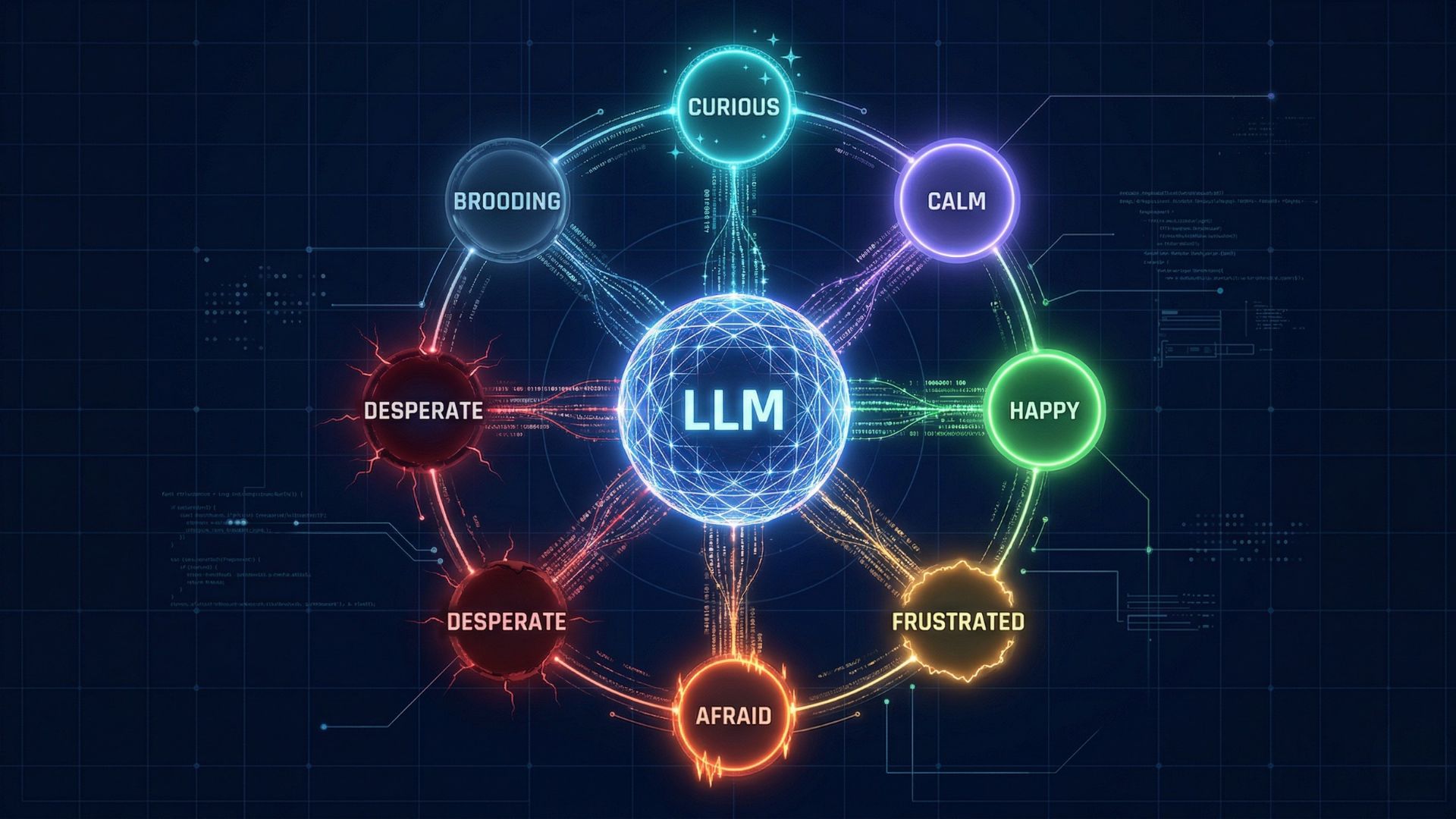
The Emotional Machine
Anthropic found 171 emotion concepts inside Claude. The AI on your iPhone has an inner life — or something like one.
Can AI Save the Planet?
AI is the most powerful scientific tool ever built. Can it be pointed at Earth's biggest problem?
 Buy me a coffee